

An office move is more than a change of address. It is a rare opportunity to redefine your work environment, boost employee well-being, and build a foundation for higher productivity. However, the success of a relocation project often hinges on one of the most complex components: furniture planning and procurement. Getting it right means creating a space that empowers your team; getting it wrong leads to budget overruns, logistical nightmares, and a workspace that hinders rather than helps.
This comprehensive checklist is designed for project managers, office managers, and corporate relocation teams. It provides a structured framework for navigating every stage of the furniture lifecycle, from initial needs assessment to post-move optimization. We will move beyond generic advice to provide data-backed specifications and expert warnings drawn from real-world project experience.
Phase 1: Pre-Move Planning & Needs Assessment
Before you look at a single catalog, a thorough discovery phase is essential. Rushing this step is a common cause of costly downstream errors. Your goal is to build a clear picture of what you have, what you need, and what your budget can realistically accommodate.
Audit Your Existing Furniture Assets
First, conduct a detailed inventory of your current furniture. For each item, document its condition, age, and original specifications. This is not just about counting desks and chairs; it is about evaluating their potential for reuse.
Common Misconception: Many assume that all used furniture should be liquidated and replaced. In reality, the total cost of ownership is a more critical metric. High-quality, modular furniture has a long design life. According to industry guidance, a BIFMA-certified benching system that is only four or five years old can be a better candidate for reconfiguration and reuse than purchasing a lower-quality new system. Before deciding to dispose of an asset, evaluate its modularity. Can desktops be replaced or resized while keeping the legs and frames? If so, you may be able to retain valuable assets while simply adapting them to your new space.
Survey Employee & Departmental Needs
Your new office must serve your team. A successful furniture plan is built on a deep understanding of their workflows. Conduct surveys or focus groups to gather input:
- Work Patterns: How many days a week are employees in the office? Do they have dedicated desks or share them?
- Task Requirements: What kind of work do they do? Does it require deep focus, frequent collaboration, or a mix of both?
- Ergonomic Needs: Do any employees have specific ergonomic requirements or pre-existing musculoskeletal conditions? Providing adjustable solutions is key to supporting a diverse workforce.
- Storage: How much physical storage do teams need now that workflows are more digital?
Establish a Comprehensive Budget
Your furniture budget must account for more than just the sticker price of the items. A realistic budget includes:
- Furniture & Accessories: Desks, chairs, storage, monitor arms, etc.
- Taxes, Shipping & Delivery Fees: These can add a significant percentage to the total cost.
- Installation & Assembly: Labor costs for professional installers.
- Decommissioning & Disposal: The cost of removing and recycling or donating old furniture.
- Contingency Fund: Set aside 10-15% of your budget for unexpected costs, such as re-delivery fees or minor damages.
Phase 2: Space Planning & Ergonomic Design
With your needs defined, you can begin planning the layout. This phase translates your company’s operational goals into a physical floor plan, with ergonomic principles as the guiding force.
Define Workstation Density & Layout
First, determine the appropriate density for your new space. For hybrid teams, a common planning heuristic is to allocate between 1.1 and 1.4 square meters per individual workstation. This provides adequate room for movement and equipment without feeling cramped.
From there, map out zones for different types of work:
- Focus Zones: Quiet areas with individual workstations for tasks requiring concentration.
- Collaborative Zones: Open areas with shared tables or lounge seating to encourage teamwork.
- Private Spaces: Small, enclosed rooms for phone calls or one-on-one meetings.

Apply Authoritative Ergonomic Standards
To ensure your new workspace is safe and comfortable, your design should adhere to established ergonomic standards. These guidelines are developed to accommodate a wide range of body types, typically from the 5th percentile female to the 95th percentile male. Key standards to reference include:
- BIFMA G1-2013 Ergonomics Guideline for Furniture: This industry guideline provides dimensional recommendations for creating adjustable furniture that fits most users.
- ISO 9241-5:2024: This international standard specifies the postural and layout requirements for office workstations, ensuring a healthy and safe setup.
- OSHA Computer Workstation eTool: The U.S. Occupational Safety and Health Administration provides clear, visual guides for setting up monitors, chairs, and desks to achieve a neutral posture.
The core principle is to create a workstation that adjusts to the user, not the other way around. This means every key component—chair, desk, and monitor—should be independently adjustable.
Phase 3: Furniture Selection & Specification Checklist
Selecting the right furniture is a long-term investment in your team’s health and productivity. For B2B applications, durability, and mechanical performance are paramount to minimize service calls and ensure a long service life. Use this checklist to specify high-performance furniture.
Standing Desks
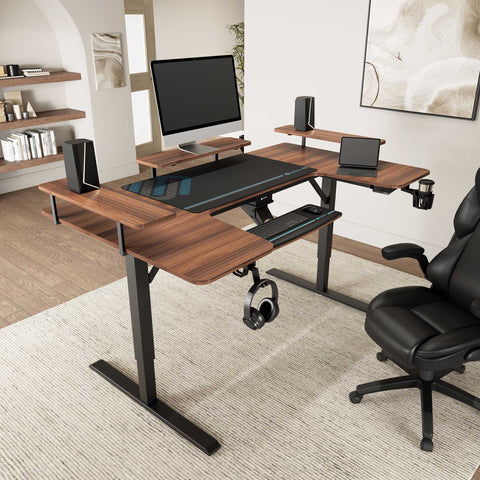
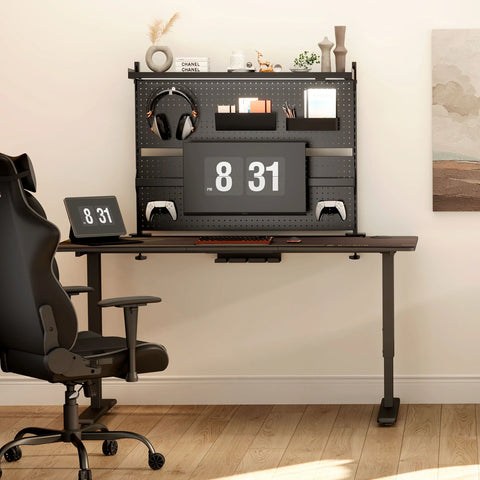
A height-adjustable desk is the cornerstone of a modern, ergonomic workstation. However, not all standing desks are created equal. For a corporate environment, look for commercial-grade performance.

| Feature | Recommended B2B Specification |
|---|---|
| Lift Mechanism | Dual-Motor System: Ensures smoother, faster, and quieter adjustment with better stability. |
| Load Capacity | > 120 kg (265 lbs) Dynamic Load: Safely supports multi-monitor setups, CPUs, and accessories. |
| Height Range | Approx. 650mm – 1250mm: Accommodates the 5th-95th percentile of users for sitting and standing. |
| Control System | Memory Presets (Minimum 2): Allows users to save their preferred sit and stand heights for quick changes. |
| Safety Features | Anti-Collision System: Detects obstructions and stops/reverses to prevent damage or injury. |
| Cable Management | Integrated Trays or Raceways: Keeps cables organized and prevents them from getting snagged during height adjustments. |
| Certifications | UL 962 / ANSI/BIFMA X5.5: Verify that the desk has been tested for electrical safety and structural performance. |
Ergonomic Chairs
An ergonomic chair is a critical tool for preventing musculoskeletal issues. Look for chairs that are highly adjustable and certified for durability.
- Adjustability: The chair should have adjustments for seat height, seat depth, backrest angle, and lumbar support. Armrests should be height-adjustable at a minimum.
- Base & Casters: A five-point base is standard for stability. Ensure casters are appropriate for your flooring (hard casters for carpet, soft casters for hard surfaces).
-
Durability Standards: The chair should meet or exceed
[ANSI/BIFMA X5.1](https://www.micomlab.com/micom-testing/bifma-x5-1/)standards, which test for safety and durability under continuous use.
Storage & Accessories
- Storage: In open-plan offices, plan for at least one shared storage cabinet for every ten employees to reduce clutter.
- Monitor Arms: Essential for multi-monitor setups and for achieving the correct monitor height and depth, especially on desktops that are 700mm deep or more.
- Footrests: An adjustable footrest can help smaller individuals achieve a neutral posture when their feet cannot rest flat on the floor at the proper chair height.
Phase 4: Logistics, Procurement, & Vendor Management
This phase is where even the best-laid plans can fail. Successful execution requires proactive management of timelines, vendors, and unforeseen obstacles. Several common assumptions can put your project at risk.
Expert Warning: Avoid the ‘Master Timeline’ Trap
A frequent mistake is building a single project timeline around a generic 4-6 week furniture lead time. The reality in 2024-2025 is that lead times are highly variable and product-specific. In-stock task chairs might arrive in 2-4 weeks, while custom-finish, made-to-order standing desks could take 8-12 weeks or longer. You must build a micro-timeline for each major product category and confirm lead times before signing any contracts. Always add a buffer for potential shipping delays.
Expert Warning: Measure Twice, Move Once
Another critical failure point occurs on delivery day. A test-fit is not just about checking if the furniture footprint fits on a floor plan. You must account for the entire path of travel. Professional movers measure furniture at its widest, tallest, and deepest points, and you must verify that the diagonal depth of each large item is less than the clearance of every doorway, elevator, and stairwell it must pass through. Delivery crews are typically not contracted to remove doors, so a failed clearance check can result in costly re-delivery fees and project delays.
Expert Warning: Your Contract Is More Important Than Your Calendar
Most relocation disputes hinge on contract clauses, not scheduling conflicts. Before work begins, you must perform due diligence on all vendors (movers, installers, IT).
- Verify Insurance: Collect a Certificate of Insurance (COI) from every vendor. Ensure their general liability and workers' compensation coverage meets or exceeds your building's requirements.
-
Understand Subrogation: Check if your vendor contracts include a waiver of subrogation. As explained in risk management resources like
[Hiscox](https://www.hiscox.com/blog/what-waiver-subrogation), this clause can prevent your insurance company from suing a negligent vendor to recover damages after a claim is paid. Consult with your legal or risk management team to understand the implications.
Plan for Decommissioning Early
Finally, do not assume you can easily sell or donate all your surplus furniture. Many "special order" or customized items are contractually non-returnable. Furthermore, local recycling options may be limited. To avoid landfill fees and ensure responsible disposal, you must lock in your disposal channels with specialized haulers before the move begins.
Phase 5: Installation & Post-Move Optimization
Your new furniture is in, but the job isn’t done. Proper installation and employee education are key to realizing the full value of your investment.
Streamline Installation Day
Coordinate closely with your installation partner to ensure a smooth process. Field experience shows that pre-assembling desk frames and testing all electronic controllers off-site before delivery can reduce on-site installation time by 30-40%. Ensure a clear staging area is available for installers.
Empower Your Team with Ergonomic Training
Do not assume employees will know how to use their new ergonomic furniture correctly. Provide simple training guides or short workshops on how to adjust their chair and desk. Encourage dynamic work habits, such as the "20-8-2" rule recommended by researchers at [Cornell University Ergonomics Web](https://ergo.human.cornell.edu/ergoguide.html): for every 30 minutes, sit for 20, stand for 8, and move around for 2. For more detailed guidance, direct them to resources on [Setting Up Your Standing Desk for Peak Productivity](https://eurekaergonomic.com/blogs/eureka-ergonomic-blog/standing-desk-setup-productivity-guide).
Key Takeaways
A successful office furniture project is a marathon, not a sprint. By following a structured, five-phase approach—Audit, Plan, Specify, Procure, and Implement—you can mitigate risks and create a workspace that truly serves your organization. Prioritize data-backed specifications, challenge common assumptions with expert insights, and always plan for the unexpected. An office move is your chance to invest in your most valuable asset: your people. Make it count.
Disclaimer: This article is for informational purposes only and does not constitute professional health or safety advice. The ergonomic recommendations provided are based on general industry guidelines. Individuals with pre-existing health conditions or specific ergonomic needs should consult with a qualified medical professional or a certified ergonomist to determine the best setup for their situation.




Leave a comment