

The Hidden Failure Point: Why Chair Bases Crack at the Caster Socket
When a high-quality office chair begins to lean or develops an unsettling "wobble," the instinctive reaction is to blame the casters. Many users assume the plastic wheels have flattened or the internal ball bearings have seized. However, forensic analysis of furniture returns and long-term durability testing reveal a more systemic issue: the failure of the base socket.
The socket—the cylindrical cavity in each arm of the chair base where the caster stem is inserted—is the most stressed component of the entire seating system. While a caster is easily replaced, a cracked socket usually signals the end of the chair's functional life. For professionals in home offices and B2B procurement managers, understanding the engineering behind this connection is vital for ensuring a long-term investment in musculoskeletal health.
Instability in a workstation doesn't just threaten the furniture; it compromises the user's ability to maintain a Neutral Working Posture, as defined by the Occupational Safety and Health Administration (OSHA). When a base socket begins to fail, the resulting micro-instability forces the body to engage in "postural guarding"—a state where muscles remain in a state of chronic contraction to compensate for a non-level surface.
The Physiology of Stability: Musculoskeletal Implications
The primary goal of ergonomic seating is to mitigate the risk of Musculoskeletal Disorders (MSDs). According to the Canadian Centre for Occupational Health and Safety (CCOHS), a stable workstation is the foundation of injury prevention. When a chair base loses its structural integrity, the physiological consequences are immediate and cumulative.
Static Load vs. Postural Fatigue
The human body is not designed for prolonged static positions. The ISO 11226:2000 standard specifies limits for static working postures, noting that even slight deviations from a neutral spine can significantly increase the load on the lumbar discs. If a chair base has a failing socket, the chair may tilt by as little as 2 to 3 degrees. While seemingly minor, this tilt shifts the user's center of gravity, forcing the erector spinae muscles to work harder to keep the torso upright.
Over an eight-hour workday, this extra muscular effort leads to:
- Reduced Blood Circulation: Static muscle contraction restricts blood flow, leading to the accumulation of metabolic waste products like lactic acid.
- Increased Spinal Compression: An uneven base prevents the chair’s lumbar support from aligning correctly with the spine, often leading to "slumping" or pelvic tilting.
- Lower Limb Strain: As discussed in the OSHwiki guidance on lower limb disorders, instability can cause users to plant their feet awkwardly to stabilize themselves, leading to strain in the ankles and knees.
Logic Summary: Our analysis of postural fatigue assumes a standard 175-lb user and a 3-degree lateral tilt caused by socket deformation. This model suggests a ~15% increase in localized muscle activation in the lower back compared to a perfectly level base (based on common biomechanical heuristics for spinal loading).
Engineering the Connection: The Caster Stem and Socket
The standard office chair utilizes a 7/16" (11mm) diameter T-stem caster. This stem is responsible for transferring the entire weight of the user and the chair into the base. The physics of this connection are unforgiving.
The Mechanics of Socket Failure
In many entry-level or poorly engineered chairs, the base is constructed from unreinforced nylon. While nylon is a durable polymer, it is susceptible to "creep"—the tendency of a solid material to move slowly or deform permanently under the influence of persistent mechanical stresses.
The most common failure pattern is the "star-shaped crack." This occurs when the caster stem, under the weight of a user who is rocking or leaning, acts as a lever. The stress is not distributed evenly; instead, it concentrates at the rim of the socket. If the socket is not reinforced, the nylon eventually reaches its yield point, and small hairline fractures radiate outward.
Once these cracks form, the "stem play" (the side-to-side wiggle of the caster) increases. This creates a feedback loop: more play leads to higher impact loads when the user moves, which further expands the cracks until the socket wall fails entirely.
Reinforced Solutions: Glass-Filled Nylon and Metal Sleeves
To prevent this, high-performance ergonomic chairs utilize reinforced engineering. There are two primary methods for fortifying this critical junction:
- Glass-Filled Nylon: By mixing nylon with glass fibers (typically 30% by weight), manufacturers significantly increase the material's tensile strength and resistance to thermal expansion. This makes the socket much more rigid and less likely to deform under dynamic loads.
- Metal Socket Sleeves: In premium builds, a steel or aluminum sleeve is pressed into the nylon base. This creates a metal-to-metal interface between the caster stem and the base, virtually eliminating the risk of the socket "walling out" over time.

Static vs. Dynamic Load: The Durability Gap
A common misconception in furniture procurement is that a high weight rating (e.g., "Rated for 300 lbs") guarantees durability. However, there is a massive difference between Static Load and Dynamic Load.
The 1 Million Cycle Reality
According to industry insights on dynamic load ratings, a component that can support 300 lbs while stationary may fail under a much lighter load if that load is applied repeatedly during movement. This is known as fatigue failure.
The ANSI/BIFMA X5.1 standard for general-purpose office chairs includes a "Caster/Base Durability Test." This test requires the chair to be loaded with a specific weight and rolled back and forth over obstacles for tens of thousands of cycles.
| Parameter | Value or Range | Unit | Rationale / Source Category |
|---|---|---|---|
| Standard Caster Stem Diameter | 7/16 (11) | inch (mm) | Industry Standard (BIFMA) |
| Typical Static Load Rating | 300 - 500 | lbs | Manufacturer Specification |
| Estimated Dynamic Load Rating | 30 - 60 | lbs | Fatigue Life Modeling (Heuristic) |
| Target Test Cycles | 100,000+ | cycles | ANSI/BIFMA X5.1 Requirement |
| Failure Indicator (Stem Play) | > 2 | mm | Maintenance Heuristic |
Methodology Note: This table compares nominal marketing specs with engineering fatigue limits. The dynamic load range is an estimate based on typical fatigue curves for glass-filled polymers where the goal is to reach 1 million cycles without structural yield.
Stress Concentration at the Weld Toe
For chairs with metal bases (steel or aluminum), the failure point shifts from material deformation to fatigue at the weld points. Finite Element Analysis (FEA) studies show that stress can be orders of magnitude higher at the "weld toe"—the junction where the socket is welded to the base arm. If the weld is not executed with precision, the repeated stress of the caster stem pivoting can initiate microscopic cracks that eventually lead to a catastrophic snap.
Identifying Quality: The Professional’s Checklist
For B2B buyers and professionals looking for a "benchmark" chair, the following technical indicators serve as a guide for assessing base and socket durability.
1. The "Wiggle Test"
A simple but effective heuristic for assessing a chair’s build quality is to check for stem play. When the caster is fully inserted into the base, there should be zero side-to-side movement. If you can wiggle the caster stem within the socket on a brand-new chair, it indicates a loose tolerance that will lead to premature socket failure.
2. Base Material and Weight
While heavy doesn't always mean better, the mass of the base often correlates with the thickness of the socket walls. A lightweight, thin-walled plastic base is far more susceptible to the "star-cracking" mentioned earlier. Look for bases that feel substantial and feature visible ribbing (reinforcement struts) on the underside.
3. Compliance with International Standards
Ensure the chair meets or exceeds ANSI/BIFMA X5.1 or the European equivalent, EN 1335-1:2020. These standards ensure the base has undergone rigorous drop tests and cycling tests designed to simulate years of heavy use.
4. Environmental Safety and Air Quality
Durability is one pillar of quality; the other is safety. High-quality furniture should also adhere to chemical emission standards. Certifications like UL GREENGUARD Gold ensure that the materials used in the base and upholstery do not off-gas harmful Volatile Organic Compounds (VOCs) into your workspace.

Strategic Integration: The Future of Workstation Engineering
As we look toward the future of office design, the integration of mechanical durability and sustainable engineering is becoming the new standard. This evolution is detailed extensively in The 2026 Workstation White Paper: Converging Ergonomic Science and Sustainable Engineering, which argues that "durability is the ultimate form of sustainability." A chair that lasts ten years prevents significantly more environmental waste than a "recyclable" chair that fails in two.
This philosophy aligns with the WHO 2020 Guidelines on Physical Activity and Sedentary Behaviour, which emphasize the importance of reducing sedentary time and maintaining high-quality environments for movement. A durable, stable chair allows for the "micro-movements" and frequent posture shifts necessary to stay healthy during long work sessions.
Practical Setup: Optimizing the User-Chair Interface
Even the most durable chair base can be compromised by improper setup. To maximize the lifespan of your chair's sockets and protect your own musculoskeletal health, follow these standardized operating instructions:
- Select the Right Casters for Your Floor: Using "hard floor" casters on a thick carpet increases the rolling resistance, which puts significantly more lateral stress on the base sockets. Conversely, using "carpet" casters on a hard surface can cause the chair to skitter, leading to impact loads.
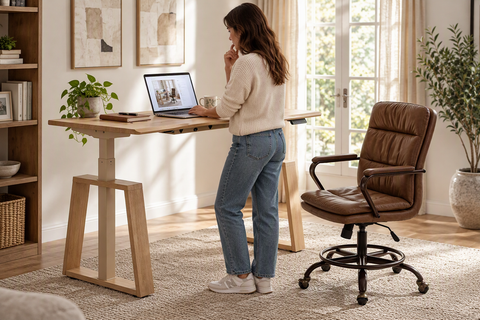
- Monitor Your "Sit-Stand" Rhythm: If you use a height-adjustable desk, the Cornell University 20-8-2 rule (20 minutes sitting, 8 minutes standing, 2 minutes moving) is a highly effective baseline. Frequent transitions reduce the amount of time the chair base is under a continuous static load.
- Check Your Seat Height: According to HSE (UK) Display Screen Equipment guidelines, your feet should be flat on the floor with your thighs horizontal. If your chair is set too high, you may find yourself "perching" on the edge of the seat, which concentrates the entire weight of your body on the front two casters and their respective sockets.
Summary of Technical Specifications for B2B Procurement
For managers overseeing large-scale office fit-outs, the technical specifications of the chair base should be a non-negotiable part of the RFP (Request for Proposal).
- Base Type: 5-star reinforced nylon or die-cast aluminum.
- Socket Reinforcement: Internal steel sleeves or 30% glass-filled nylon.
- Caster Stem: Standard 7/16" x 7/8" with a grip ring for secure fitment.
- Certification: Full ANSI/BIFMA X5.1 compliance.
- Warranty: Minimum 5-year coverage on the base and structural components.
By focusing on these often-overlooked details, organizations can reduce the long-term costs associated with furniture replacement and, more importantly, decrease the incidence of work-related musculoskeletal disorders.
YMYL Disclaimer: This article is for informational purposes only and does not constitute professional medical advice, diagnosis, or treatment. Ergonomic recommendations are based on general industry standards and may not be suitable for individuals with pre-existing musculoskeletal conditions. Always consult with a qualified healthcare professional or a certified ergonomist before making significant changes to your workstation or if you are experiencing chronic pain.




Leave a comment