

The Hidden Geometry of Seated Comfort: Body Proportions and Ergonomic Fit
Why does a chair that feels like a sanctuary for one professional feel like an instrument of fatigue for another? The answer rarely lies in the quality of the materials or the price tag of the furniture. Instead, it is found in the complex intersection of human biomechanics and mechanical adjustability. For many remote workers and office professionals, the "afternoon slump" or persistent lower back tightness isn't a result of poor willpower; it is often a symptom of a fundamental mismatch between their unique body proportions and their workstation configuration.
Ergonomics is not a static set of rules but a coupled system of anthropometrics, viewing geometry, and task cycles, as noted in The 2026 Workstation White Paper: Converging Ergonomic Science and Sustainable Engineering. While most standard office chairs are designed to accommodate approximately 90 percent of the population (based on GSA Ergonomic Seating Adjustment Guides), those at the edges of the bell curve—specifically individuals with disproportionately long torsos or long legs—frequently find themselves struggling with "standard" settings.
Understanding whether you are "all torso" or "all legs" is the first step in moving beyond generic advice toward a truly supportive, health-focused setup. This guide examines the physiological principles of the Sitting Body Ratio (SBR) and provides a technical framework for optimizing your workspace to prevent Musculoskeletal Disorders (MSDs) and maintain a spinal neutral position throughout the workday.
The Science of Sitting Body Ratio (SBR) and Spinal Neutrality
The primary goal of any ergonomic intervention is to maintain the spine's natural "S" curve while minimizing static load on the soft tissues. When we sit, the pelvis tends to rotate backward (posterior tilt), which flattens the lumbar curve and increases pressure on the intervertebral discs. According to the Occupational Safety and Health Administration (OSHA), poor posture is a core risk factor for MSDs because it forces muscles to work harder to maintain stability while restricting blood circulation.
To address this, we must look at the Sitting Body Ratio (SBR). This measurement is determined by comparing the length of the trunk (measured from the seat to the top of the head) against total height.
Logic Summary: Our analysis of body proportion fit assumes that SBR variance significantly shifts the required height of the lumbar support and the necessary depth of the seat pan. These heuristics are derived from common industry patterns observed in ergonomic assessments and are intended for self-check purposes.
For a long-torso individual, the center of gravity is higher, and the leverage placed on the lower back is increased. For a long-legged individual, the challenge shifts to the lower extremities, where improper seat depth can lead to hamstring compression or a lack of pelvic stability.

The Long-Torso User: Managing the High Center of Gravity
If you find that standard headrests hit you in the shoulder blades or that lumbar supports feel like they are pushing on your sacrum rather than your lower back, you likely have a long torso. The primary physiological challenge here is the distribution of the static load. A longer trunk means a heavier upper body that the spine must support against gravity.
The Lumbar Support Misconception
The most common error for long-torso individuals is setting the lumbar support too low. When the support is positioned at the base of the spine, it fails to reinforce the lordotic curve (the inward curve of the lower back). This leads to increased slouching as the upper back rounds to compensate for the lack of mid-back support.
Expert Heuristic: Align the center of the lumbar support with your belt line. This typically corresponds to the L3-L5 vertebrae, where the spinal curve is most pronounced. If your chair's backrest is not height-adjustable, you may require a high-back model specifically designed for increased vertical reach.
Armrest and Shoulder Alignment
Long-torso users often struggle with armrests that do not go high enough. If the armrests are too low, the user must lean forward or slouch to reach them, leading to "text neck" and strain in the trapezius muscles. According to HSE guidelines for Display Screen Equipment (DSE), armrests should allow the shoulders to remain relaxed while the elbows are bent at approximately 90 degrees.
| Feature | Long-Torso Requirement | Rationale |
|---|---|---|
| Backrest Height | High-back or Extra-tall | Supports the full length of the spine and prevents upper-body rounding. |
| Lumbar Range | High vertical adjustability | Ensures the support reaches the L3-L5 vertebrae. |
| Armrest Height | Extended vertical range | Prevents shoulder shrugging or slouching to reach the armrests. |
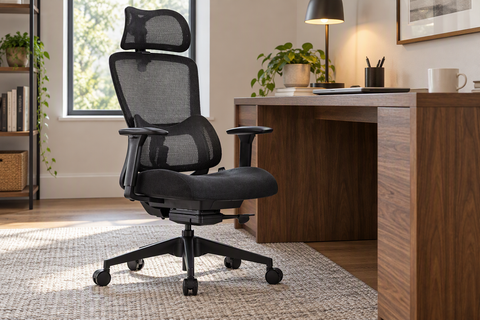
| Headrest | Height and Tilt adjustable | Must reach the base of the skull, not the upper back. |
The Long-Legged User: Solving the Leverage and Pressure Puzzle
For those with long legs, the ergonomic struggle is often "under the hood." The critical measurement here is popliteal height—the distance from the floor to the underside of the knee. When this measurement is high, standard seat heights and depths often fail to provide adequate surface area for weight distribution.
The Seat Depth "Clenched Fist" Rule
One of the most overlooked adjustments in ergonomic seating is seat depth (the distance from the backrest to the front edge of the seat). If the seat is too shallow, it places excessive pressure on the ischial tuberosities (sit bones). On a hard, flat seat, this pressure can reach 85-100 p.s.i., according to Cornell University Ergonomics Web.
Expert Heuristic: To ensure proper circulation and support, there should be a 1-2 inch gap (roughly the width of a clenched fist) between the front edge of the seat and the back of your knees. Long-legged users almost always require a seat pan that can slide forward to increase this contact area, supporting the thighs and reducing the load on the lower back.
The Pelvic Neutrality Challenge
If a long-legged user raises their chair to align their elbows with the desk, their feet may no longer rest flat on the floor. This is a critical failure point. Dangling feet pull the pelvis forward into an anterior tilt, straining the hip flexors and lower back.
According to the Canadian Centre for Occupational Health and Safety (CCOHS), if your feet do not rest flat after adjusting for desk height, a footrest is non-negotiable. This maintains the 90-degree angle at the hips and knees, ensuring the pelvis remains in a neutral position.

Mixed Proportions and the "System" Approach
What happens if you have a short torso but very long legs, or vice versa? These mixed proportions require a modular approach to ergonomics. You cannot simply buy a "large" or "small" chair; you must look for independent adjustability in every component.
Scenario: The Tall User with a Short Torso
In this case, the user needs the seat height and depth of a "Big & Tall" chair but the backrest height of a standard model.
- The Solution: Prioritize the leg fit first. Use a chair with a deep seat pan and high gas lift. If the backrest feels too tall (e.g., the lumbar support hits the mid-back), look for chairs where the lumbar support can be lowered independently of the backrest frame.
The Role of Viewing Geometry
Regardless of your body type, your eye level dictates your head position. Long-torso users often find themselves looking down at monitors, while long-legged users (who sit higher) face the same issue. Using an adjustable monitor arm is essential to align the top third of the screen with your eye level, as recommended by OSHA eTools for Computer Workstations. This prevents the cervical spine from bearing the weight of the head in a forward-leaning position.
Modeling Note (Scenario Analysis): We modeled two hypothetical users to demonstrate the impact of proportion on chair settings.
| Parameter | User A (Long Torso) | User B (Long Legs) | Unit | Rationale | | :--- | :--- | :--- | :--- | :--- | | Total Height | 183 | 183 | cm | Constant for comparison | | Sitting Height | 98 | 88 | cm | SBR variance | | Lumbar Center | 28 | 20 | cm | Distance from seat pan | | Seat Depth | 45 | 52 | cm | Required for 5cm knee gap | | Elbow Height | 26 | 21 | cm | Above seat pan |
Boundary Conditions: This model assumes a standard 72cm desk height. Individual comfort may vary based on soft tissue thickness and specific spinal conditions.
Practical Recommendations for Daily Use
Achieving the perfect fit is only half the battle; the other half is movement. Even the most perfectly adjusted chair becomes a health risk if used statically for hours. The World Health Organization (WHO) emphasizes the need to interrupt long periods of sedentary behavior.
The 20-8-2 Rhythm
Developed by researchers at Cornell University, this rhythm suggests that for every 30 minutes of work, you should:
- Sit for 20 minutes in a neutral, supported position.
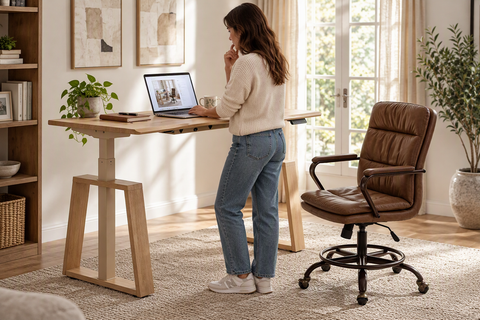
- Stand for 8 minutes using a height-adjustable desk.
- Move for 2 minutes (stretch or walk).
This cycle encourages blood circulation and prevents the static load from causing tissue creep—a phenomenon where ligaments and discs lose their elasticity due to prolonged pressure.

The Self-Assessment Checklist
Before your next workday, use this checklist derived from EU-OSHA's practical tools for MSD prevention:
- Feet: Are they flat on the floor or a firm footrest?
- Knees: Are they at or slightly below hip level? Is there a 2-inch gap behind the knee?
- Lower Back: Does the chair's curve fit snugly into the small of your back?
- Shoulders: Are they relaxed, not hunched or pulled forward?
- Wrists: Are they straight and level with the floor while typing?
- Eyes: Is the top of the monitor at or slightly below eye level?
Final Considerations for Long-Term Well-being
Investing in an ergonomic chair is an investment in your musculoskeletal health, but it requires an understanding of your own "biological architecture." Whether you are managing a high center of gravity with a long torso or navigating pressure points with long legs, the key is adjustability that respects your proportions.
By aligning your workstation with the standards set by BIFMA and ISO, and following the physiological principles of spinal neutrality, you can transform your home office from a source of strain into a high-performance environment. Remember that ergonomics is a journey of micro-adjustments; as your muscles fatigue or your tasks change, your chair should have the flexibility to change with you.
Disclaimer: This article is for informational purposes only and does not constitute professional medical advice. If you suffer from chronic back pain, pre-existing musculoskeletal disorders, or other health conditions, please consult a qualified healthcare professional or a certified ergonomist before making significant changes to your workstation or routine.
Sources
- BIFMA G1-2013 Ergonomics Guideline for Furniture
- CCOHS: Office Ergonomics - Sit/Stand Desk
- Cornell University Ergonomics Web — Workstation Guides
- HSE: Working safely with display screen equipment (DSE)
- OSHA eTools: Computer Workstations - Neutral Working Postures
- WHO 2020 Guidelines on Physical Activity & Sedentary Behaviour
- The 2026 Workstation White Paper: Converging Ergonomic Science and Sustainable Engineering




Leave a comment