

Imagine stepping into a tiny room that still feels calm, open, and ready for deep work. Your desk doesn’t dominate the space. Instead, it melts into the walls, reflects light softly, and lets your eyes glide across the room without interruption.
That effect is not accidental. It’s mostly color, material, and proportion.
This guide unpacks how desk colors and finishes can make a small room look bigger—backed by ergonomic and design principles—so you can create a workspace sanctuary that feels spacious and supports healthy posture at the same time.

Why Desk Color Has Such a Big Impact in a Small Room
In a compact room, your desk is often the single largest surface you see. Its color and finish strongly influence how big or cramped the space feels.
From years of staging small apartments, dorms, and home offices, one pattern shows up again and again:
Perceived space grows most when you increase reflected light and simplify visual edges.
That insight pairs well with ergonomic guidance from organizations like OSHA’s Computer Workstations eTool, which emphasizes clear sightlines, neutral posture, and minimal visual clutter. When your desk works with the light and your posture, your room feels both larger and more comfortable.
The core idea: let your desk disappear a little
You don’t literally want an invisible desk. You want a desk that:
- Blends with your wall color instead of cutting across it
- Reflects light softly instead of absorbing it
- Keeps the work zone visually tidy so the room reads as one continuous volume
That’s where color and finish do the heavy lifting.
The 3 Rules of Desk Color for Making a Small Room Look Bigger
1. Keep the desktop within “two lightness steps” of the wall
A practical rule that works remarkably well in the field: keep your desk color no more than two lightness steps darker or lighter than your walls.
In practice:
- Light gray walls → choose white, light gray, or pale oak desktops.
- Warm beige walls → choose sand, light oak, or cream.
- Soft sage walls → choose whitewashed wood or light stone tones.
When the lightness gap is small, your eye reads desk + wall as a single plane instead of two competing blocks. The room feels wider and calmer.
Common mistake: pairing a very dark desk with pale walls. This “floating dark slab” visually bisects the room, making it feel shorter and more cramped.
2. Use lighter tones and low-contrast finishes to bounce light
Small rooms benefit greatly from surfaces that bounce, not swallow, light. However, there is a balance to strike for comfort and eye health.
According to Safe Work Australia’s workstation setup infographic, glare and strong reflections can contribute to eye strain and musculoskeletal discomfort because they encourage awkward head/neck positions as you chase a comfortable angle. That means:
- Favor matte or satin finishes over high-gloss.
- Choose light woods, light stone, or soft white instead of deep black or espresso in tight rooms.
- If you love glass, aim for low-iron or frosted glass surfaces and control window reflections with curtains or blinds.
The goal is brightness with controlled reflection: enough to open the room, not enough to blind you.
3. Apply the 60/30/10 palette rule for balance
Designers often use the 60/30/10 rule to keep small spaces visually calm:
- 60% – Dominant color (usually walls)
- 30% – Secondary color (your desk and main furniture)
- 10% – Accent color (chair fabric, plants, a lamp, or a small RGB strip)
In a tiny workspace, this rule is more than aesthetic. It helps you avoid the visual noise that makes a room feel cluttered even when nothing is on the floor.
If your walls are off-white (60%), choose a desk and storage in a light wood (30%), and reserve bold colors for small details (10%). The result is a room that feels bigger because your eye isn’t constantly stopping at new colors.
Color & Ergonomics: Making Space Without Sacrificing Comfort
Color choices can either support or work against ergonomic comfort. A visually spacious room that gives you neck strain isn’t a win. So it’s worth connecting color and finish with posture and workstation layout.
Why neutral, matte surfaces help your posture
The OSHA guidance on neutral working postures defines a comfortable workstation as one where your joints (neck, shoulders, elbows, hips) stay near their mid-range positions. You achieve that when you can:
- Look straight ahead with only a slight downward gaze to your monitor
- Type with relaxed shoulders, elbows at about 90°, and wrists straight
High-gloss desks and very dark or high-contrast surfaces can undermine that by encouraging you to:
- Crane your neck to escape reflections
- Squint or lean in when the desk is too dark under the keyboard
A light, matte desktop provides better contrast with a standard black keyboard and mouse, leading to easier viewing without leaning or twisting.
The role of monitor height and background color
The OSHA monitor guidelines recommend placing the top of the screen at or just below eye level and about an arm’s length away. In small rooms this matters visually too:
- If the wall behind your monitor is drastically darker than the desk, your eye constantly jumps between bright and dark zones.
- If the monitor sits low against a dark desk, the setup looks heavier and shorter.
A light-toned desk plus a matching or slightly lighter monitor riser (for example, a light carbon-fiber dual monitor stand or a pale wood riser) helps your screens float at comfortable ergonomic height while reducing the visual mass behind them.
A product like the Carbon Fiber Dual Monitor Stand does this well: it raises one or two screens, creates a clean horizontal line, and its slim profile allows light to move underneath, so the desk still feels airy.
Choosing Desk Colors by Room Type
Different small spaces call for different color strategies. A dorm, a studio apartment, and a compact dedicated office each have their own constraints.
1. Dorm room: bold accents, light base
Dorm rooms are often narrow, with basic white or beige walls and limited natural light.
What works well:
- Desk color: white, light gray, or pale wood that matches or is just slightly darker than the walls.
- Finish: matte or low-sheen to manage glare from fluorescent or overhead lighting.
- Accents: brighter colors are welcome here—chair, desk mat, or a subtle RGB strip can sit in the 10% accent bucket and help mask tight proportions.
Case example: In a 9' x 10' dorm with a single window, a light wood desk against the longest wall, paired with a pale desk mat and a dark but slim monitor stand, often makes the room feel 10–15% more open visually compared with a dark, bulky desk tucked into a corner.
2. Rented apartment: warm neutrals and layered light
In a rental, you may not paint the walls. Desk color becomes your main tool.
Effective choices:
- Desk color: warm light wood, cream, or soft taupe that echoes the existing trim or flooring.
- Material: sintered stone or matte glass in light beige or gray for a sophisticated but airy look.
- Lighting: integrate a slim warm-white desk lamp that washes light across the desktop and wall, creating depth.
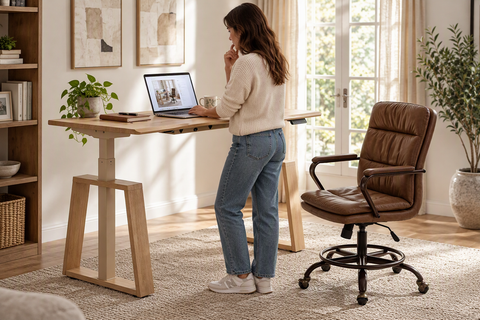
You can pair a compact sit-stand desk with a wall color-matching top so that when you raise it, it still feels visually anchored instead of towering as a dark block.
3. Dedicated small office: calm palettes for deep work
If you’re carving out a small dedicated room—say 8' x 10'—for focused work, you can think more strategically.
- Choose one calm dominant hue for walls (soft gray, greige, or muted green).
- Match the desk within two lightness steps, perhaps in a whitewashed wood or light stone.
- Keep large storage pieces in the same tone so they visually recede.
For users who need more surface, an L-shaped sit-stand desk in a light finish can still work if you protect sightlines.
An example is the L-Shaped Standing Desk with Accessories Set (60"x23"). In a compact office, placing the longer side along the wall and choosing a lighter top allows the desk to create distinct work zones without closing off the room.
Don’t Forget Size and Layout: Color Isn’t Everything
Color can only do so much if the desk itself overwhelms the room. Dimension and layout are just as important.
Optimal desk depth for micro rooms
A practical heuristic from real-world setups: keep desk depth under 24–28 inches in very tight rooms. This preserves walking clearance behind a chair and avoids the “wall of desk” effect.
The OSHA desk component guide emphasizes sufficient knee room and the ability to place the keyboard and mouse directly in front of you. A shallow but wide desk typically satisfies these ergonomic needs while keeping the footprint light.
Sightlines matter as much as square footage
Small rooms feel bigger when your eye can sweep across them without hitting heavy vertical elements. That means:
- Avoid tall hutches or heavy cabinetry directly on top of the desk.
- Keep wall shelving slim and aligned with door and window frames.
- Use clear or light monitor risers to minimize the visual block behind screens.
The Carbon Fiber Dual Monitor Stand helps here again: by raising screens slightly and creating a shallow storage zone underneath, you reduce the clutter of loose items on the desktop and maintain a clean horizontal sightline.
Myth to debunk: “Darker desks always feel more premium”
A common misconception in small spaces is that you need a dark, solid wood desk to make the room feel serious or high-end.
In practice, deep tones can work—but only if the room has generous natural light and plenty of open wall space. In compact rooms with average lighting, dark desks:
- Shrink perceived floor area.
- Show dust and cable clutter more clearly.
- Demand more aggressive lighting to stay comfortable for eye-intensive tasks.
Light, well-finished surfaces can feel just as premium and often more calming.
Material Choices: Wood, Stone, and Glass in Small Rooms
The finish of your desk changes how color behaves. The same tone in oak vs. glass or stone can feel completely different.
Light wood veneers
Light oak, ash, or birch veneers are some of the most forgiving options for small spaces.
Benefits:
- Warm, soft reflection that works with both warm and cool lighting.
- Subtle grain breaks up the surface without adding visual noise.
- Pairs easily with white, beige, or soft color walls.
They hit the sweet spot between “calm” and “not clinical,” especially in rented apartments where you want comfort and flexibility.
Sintered stone and matte stone-look finishes
Sintered stone or stone-look finishes in light gray or beige can make a small workspace feel more elevated while still light.
They work best when:
- The pattern is low contrast (fine, subtle veining rather than bold marble swirls).
- The finish is matte or honed, not polished mirror-gloss.
The matte surface prevents hard reflections, which, according to Safe Work Australia’s workstation guidance, is important to reduce neck and eye strain.
Glass and high-gloss surfaces
Glass can be powerful in very small rooms because it preserves sightlines and “disappears” visually. But it needs careful control:
- Position the desk so windows are to the side, not directly in front or behind your screen, to avoid glare.
- Use matte monitor bezels and anti-glare screen coatings when possible.
- Add a full-surface desk mat to soften reflections and unify scattered items into one neat-looking block.
In low-light rooms or those with many light sources, full-gloss may be more trouble than it’s worth. A satin or frosted glass variant is usually more forgiving.
Cable Management & Under-Desk Components: Keeping the Look Light
Even a beautifully colored desk can feel heavy once you add cables, a tower PC, and peripherals. In a small room, visual clutter is as damaging as dark color.
Why moving gear off the floor enlarges the room visually
When you see open floor under the desk, the room feels larger—especially in photos and video calls.
Mounting your PC under the desktop is one of the highest-impact changes you can make. A solution like the Knob-operated Adjustable CPU Holder keeps the tower off the floor and moves with your sit-stand desk height adjustments, so cables stay tidy and the space below remains open.
Because this holder mounts to the underside of most wood or MDF desktops and rotates 360°, you can tuck the PC toward the back corner, which keeps the front area visually clean and makes the whole workstation look lighter.
Sit-stand motion without added clutter
The Canadian Centre for Occupational Health and Safety notes that sit-stand desks are most effective when you can easily adjust them and maintain a neutral posture in both positions. That only works if your cables and equipment move smoothly.
For small rooms, that means:
- Use cable trays or channels under the desktop.
- Route monitor and power cables together toward one leg.
- Keep the CPU on an adjustable hanger so cable lengths can stay short.
This way, raising the desk doesn’t suddenly expose a messy tangle that visually cuts the room in half.
Step-by-Step Checklist: Choosing Desk Color for a Small Room
Use this simple checklist before you buy.
- Measure the room and desk zone. Note room length, width, and the maximum depth you can tolerate while still walking comfortably (aim under 24–28" in very tight spaces).
- Assess your wall color. Decide whether it is warm (beige, cream, warm gray) or cool (white, cool gray, blue, green).
-
Pick your palette:
- Choose a desk color within two lightness steps of the wall.
- Decide on a 60/30/10 palette and assign colors to walls, desk/furniture, and accents.
-
Select the finish:
- Prefer matte or satin over gloss for eye comfort.
- If choosing glass, plan window and lamp placement to control reflections.
-
Plan your ergonomic layout:
- Confirm your monitor can reach eye-height with a stand or riser.
- Ensure there is room for keyboard and mouse directly in front of you.
-
Plan cable management:
- Decide where your PC will live (on desktop, under-desk hanger, or elsewhere).
- Sketch cable routes so they don’t visually bisect the room.
-
Add accents last:
- Once the big surfaces are calm and coordinated, bring in accent items (plants, a lamp, or colored peripherals) as your 10%.
Quick Reference: Desk Color Strategies by Scenario
Here is a compact comparison to help you decide.
| Scenario | Wall Color / Light | Recommended Desk Color & Finish | Why It Makes the Room Feel Bigger |
|---|---|---|---|
| Tiny dorm, 1 small window | Off-white, cool fluorescent | White or pale wood, matte finish | Blends with walls, controls glare, keeps room bright |
| Rental living room corner | Beige walls, warm lamp | Warm light wood or cream, satin/matte | Echoes walls/floor, adds warmth and depth |
| Narrow bedroom office nook | Light gray walls | Light gray or whitewashed oak, matte | Minimizes contrast, lets nook read as part of full room |
| Dedicated 8' x 10' office | Soft greige or muted green | Light stone or light wood within 2 lightness steps | Calm, cohesive envelope supports deep focus |
| Low-light basement | Medium beige/gray walls | Lightest tone in room (pale wood or soft white) | Maximizes reflected light, avoids cave-like feeling |
Pro Tip: Color Alone Won’t Fix Long Hours of Sitting
Creating a visually spacious workspace often encourages you to work longer. That’s where ergonomic habits matter.
Research summarized by the Cochrane review on workplace sitting found that sit-stand desks can reduce sitting time at work by roughly 84–116 minutes per day, but long-term health outcomes still depend on your overall movement patterns.
Similarly, the World Health Organization’s guidelines on physical activity and sedentary behaviour recommend 150–300 minutes of moderate activity per week and breaking up long periods of static sitting or standing.
That means:
- Use your beautifully designed small-room setup as a prompt to move, not just to work longer.
- Alternate sitting and standing through the day and include short micro-breaks.
- Consider comfort accessories like an under-desk footrest to encourage gentle ankle and leg movement when sitting.
An adjustable accessory such as the Adjustable Ergonomic Footrest can support circulation and reduce fatigue, particularly in small rooms where you may not have space to frequently stretch your legs out.
Wrapping Up: Build a Workspace That Breathes
Desk color is one of the fastest, most cost-effective ways to make a small room look bigger. When you:
- Keep your desktop within two lightness steps of the walls
- Choose matte, light-toned finishes that reflect light gently
- Protect clear sightlines and avoid heavy vertical add-ons
- Pair smart color with ergonomic positioning and cable control
…your workspace starts to feel less like a cramped corner and more like a thoughtful studio.
If you want more ideas on pairing compact desks with overall room style, you may enjoy exploring guides such as Stylish Standing Desk Designs for Small Home Offices or comparing formats in Standing vs. Sitting Desk for a Small Home Office.
Treat color and ergonomics as partners. When they work together, even the smallest room can become a workspace sanctuary that feels open, calm, and ready for your next big idea.
Health & Safety Disclaimer
This article is for informational purposes only and does not constitute medical, ergonomic, or occupational health advice. Work-related discomfort can have many causes. If you experience persistent pain, numbness, or other symptoms, consult a qualified healthcare or ergonomics professional before making significant changes to your workstation or activity levels.
References
- OSHA eTools: Computer Workstations
- Safe Work Australia: Workstation set-up infographic
- Canadian Centre for Occupational Health and Safety – Sit/Stand Desk
- Cochrane: Workplace interventions for reducing sitting at work
- World Health Organization: Guidelines on physical activity and sedentary behaviour




Leave a comment