

Imagine a home office that sparks your limitless creativity—a true workspace sanctuary where the lighting is soft, the clutter is non-existent, and every piece of gear is positioned with surgical precision. Here’s how a day of deep work begins once you say goodbye to the chaos: you step into a room that feels like an extension of your mind. You press a button, and your professional-grade workstation glides silently to your preferred standing height. Your camera, mounted perfectly at eye level, is ready to capture your best self without you having to move a single cable.
For many content creators, this vision often hits a snag. You buy the high-end DSLR, the premium lens, and the expensive teleprompter, only to realize your desk is too shallow. Suddenly, you’re cramped. Your face looks distorted on camera because the lens is too close, and there’s no room for your teleprompter glass without your nose practically touching it. We often focus on the width of a desk to fit our monitors, but the secret to a professional broadcast aesthetic—and long-term physical health—lies in the depth.
The Physics of Framing: Why Depth is Non-Negotiable
When you’re building a creator studio, the distance between your lens and your face dictates the "vibe" of your video. In the world of cinematography, focal length is king. If your desk is only 24 inches deep, you are forced to use wide-angle lenses (like 16mm or 24mm) to get your head and shoulders in the frame. The problem? Wide-angle lenses used at close range create "barrel distortion," making your nose look larger and your ears seem to disappear.
Practitioners in the field have found that a minimum depth of 26 to 30 inches is critical for standard DSLR setups using a 35mm to 50mm lens. This range allows for a natural perspective that mimics how the human eye sees. If you intend to use a teleprompter, the requirements become even more stringent. A teleprompter adds a beam-splitter glass rig in front of your lens, which typically requires an additional 8 to 12 inches of clearance. Without that depth, you’ll find yourself leaning back awkwardly, straining your neck and ruining your posture.
Breaking the AI Illusion: Resolution and Native Clarity
A common misconception in the creator community is that "AI Auto-Framing" or digital cropping can fix poor camera placement. While these software solutions are convenient, they come with a hidden quality penalty. According to technical analysis on native resolution recording, AI cropping typically reduces your effective resolution by 25% to 50%.
When you crop a 4K image to fix a framing issue caused by a shallow desk, you are often degrading your output to 1080p or even 720p, introducing digital artifacts and noise. By choosing a desk with sufficient depth (30+ inches), you allow for native 4K sensor usage. This physical solution provides a level of clarity that no software algorithm can currently match.
The Ergonomic Blueprint: Health Meets Aesthetics
Your workspace sanctuary isn't just about how you look to others; it’s about how you feel during those eight-hour editing marathons. Professional ergonomics and high-end video production actually share a common requirement: space.
According to the Canadian Centre for Occupational Health and Safety (CCOHS), a primary goal of workstation design is to allow the user to sit or stand in a "neutral" posture. This means your monitor should be roughly an arm's length away. Interestingly, the distance required for ergonomic monitor placement (typically 50–75cm for a 27-inch screen) is almost identical to the ideal distance for a professional camera focal length.
Desk Depth Requirements by Setup Type
| Gear Configuration | Recommended Depth | Why it Matters |
|---|---|---|
| Laptop Only | 24" - 26" | Basic ergonomics; fits the 5th percentile population. |
| Single Monitor + Webcam | 27" - 30" | Allows for "arm's length" viewing distance and neutral neck angle. |
| DSLR + Prime Lens (35mm) | 30" - 32" | Eliminates facial distortion; provides room for a desk-mounted camera arm. |
| DSLR + Teleprompter Rig | 34" - 38" | Accommodates the 8-12" depth of the prompter glass and housing. |
Note: Estimates based on standard industry hardware dimensions and BIFMA G1-2013 Ergonomics Guidelines.
Stability: The Silent Killer of Professional Video
Imagine you’re mid-stream, standing up to bring more energy to your audience. As your desk rises, your camera begins to vibrate. On a 4K screen, even a 1mm wobble looks like an earthquake to your viewers. This is a frequent "gotcha" for creators who prioritize aesthetics over structural integrity.
Stability at standing heights is a mechanical challenge. Standard sit-stand desks can experience significant sway when extended. To maintain a professional workflow, look for workstations featuring dual-motor lifts and reinforced leg columns. As noted in the OSHA eTools for Computer Workstations, a stable work surface is foundational to preventing repetitive strain and ensuring equipment safety. If your desk wobbles when you type, that energy travels directly into your camera mount.

Transforming Your Space: From Chaos to Flow
Once you have the right foundation—a deep, stable desk—the transformation into a "Workspace Sanctuary" begins. This is where you link functionality with emotion.
- Declutter Your Mind via Cable Management: A tidy desk isn’t just beautiful; it reduces visual noise, helping you maintain a state of "Deep Work." Use integrated power strip holders and under-desk trays to ensure that when your desk moves from sitting to standing, your cables aren't tugging on your expensive camera ports.
- The Magic of Monitor Arms: Integrating a monitor arm is an ergonomic necessity, but for creators, it’s a secret weapon for engagement. By using a high-quality arm, you can position your screen directly behind your camera lens. This allows you to read your notes or monitor your feed while maintaining perfect eye contact with your audience. According to OSHA guidelines on monitor placement, the top of the screen should be at or slightly below eye level to reduce neck fatigue.
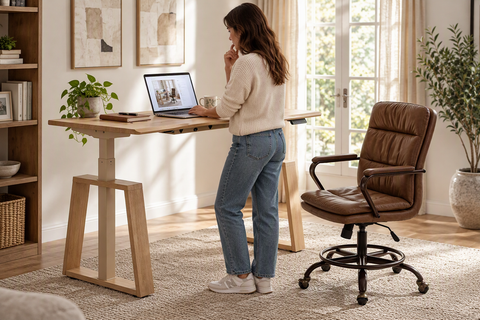
- Ambiance and Mindfulness: Your studio should be a place where you want to spend time. Incorporate elements like dimmable LED lighting or a touch of greenery. The World Health Organization (WHO) emphasizes reducing sedentary time, but we suggest going further: use your desk's height adjustment as a psychological "mode switch." Use the sitting position for administrative tasks and "thinking" mode, then transition to standing for "execution" or "broadcast" mode to boost your physical and mental energy.
Personal Tips for the Modern Creator
I have spent years troubleshooting studio setups, and the most common mistake I see isn't buying the wrong camera—it's buying the wrong "stage" for that camera. If you are currently stuck with a shallow desk, one trick is to use a "wall-mount" for your monitors or a "floor-standing" tripod for your camera behind the desk. However, this limits your ability to use a sit-stand workflow effectively.
If you are just starting your journey, prioritize a desk with at least 30 inches of depth. It gives you the "spatial runway" to grow. You might start with a webcam, but eventually, you’ll want that DSLR. You might start with a single screen, but soon you’ll want a pegboard for your headphones and controllers.

The "20-8-2" Rhythm for Creators
To keep your creativity flowing without burning out, adopt the rhythm recommended by the Cornell University Ergonomics Web. For every 30 minutes of work:
- 20 minutes of sitting in a neutral posture.
- 8 minutes of standing (ensure your desk is stable enough for filming during this time!).
- 2 minutes of moving or stretching.
This cycle prevents the "prolonged static posture" that the EU-OSHA warns can lead to chronic musculoskeletal disorders.
Building for the Future
Your home studio is more than just a collection of furniture; it is the launchpad for your venture. By choosing a workstation that respects the physics of light and the biology of the human body, you are investing in your own longevity.
Imagine your day ending not with a sore back and grainy footage, but with the satisfaction of a professional broadcast and a body that feels energized. That is the power of a well-planned workspace. It’s not just about the desk—it’s about the limitless creativity that happens when the environment finally gets out of your way.
Ergonomics & Health Disclaimer: The information provided in this article is for informational and educational purposes only and is not a substitute for professional medical advice, diagnosis, or treatment. Always seek the advice of your physician, physiotherapist, or other qualified health provider with any questions you may have regarding a medical condition or ergonomic setup, especially if you have pre-existing back, neck, or joint issues.
Sources and Authoritative References
- BIFMA G1-2013: Ergonomics Guideline for Furniture
- CCOHS: Office Ergonomics - Sit/Stand Desk Guide
- Cornell University: Ergonomics Web - Workstation Setup
- OSHA: Computer Workstations eTool - Desks and Components
- World Health Organization: Guidelines on Physical Activity and Sedentary Behaviour
- EU-OSHA: Musculoskeletal Disorders and Prolonged Static Sitting
- The 2026 Workstation White Paper: Converging Ergonomic Science and Sustainable Engineering




Leave a comment