

Defining the Desks: More Than Just Surface Area
Choosing a desk often starts with a simple question of size, but the real distinction between a traditional desk and an executive desk lies in their intended function and presence within a space. Understanding this difference is the first step to creating a workspace that is both productive and ergonomically sound.
The Traditional Desk: A Compact Hub for Focused Work
A traditional desk is the quintessential workspace for focused, single-task activities. Typically measuring between 48 to 60 inches in width and 24 to 30 inches in depth, it’s designed to fit comfortably in smaller home offices or corporate cubicles. Its compact footprint makes it a practical choice where space is at a premium.
However, this simplicity comes with limitations. Most traditional desks are built at a fixed height and often lack integrated storage, forcing users to add external file cabinets or shelving. More importantly, their limited depth can create ergonomic challenges, especially for users with multiple monitors or those who need space for documents alongside their keyboard. This can lead to craning the neck or adopting awkward postures to view screens, a significant risk factor for musculoskeletal issues.
The Executive Desk: A Command Center for Leadership
An executive desk is not just a piece of furniture; it’s a statement. It functions as a command center for multitasking professionals who require space, storage, and a sense of authority. These desks typically start at 60 inches wide and can extend to 84 inches or more, with depths of 30 to 36 inches being common. This generous surface area is designed to accommodate multiple monitors, docking stations, documents, and personal items without feeling cluttered.
Key features often include integrated storage like pedestals (file drawers) or an attached credenza, creating an L-shaped or U-shaped workstation. Historically, these desks were large, static, and often made from heavy woods. However, the modern executive desk has evolved. For instance, the Ark SWS Pro Executive Standing Desk (63"x29") combines a spacious work surface and sophisticated design with the critical ergonomic benefit of height adjustability, allowing a seamless transition between sitting and standing.

To clarify the core differences, here’s a direct comparison:
| Feature | Traditional Desk | Executive Desk |
|---|---|---|
| Typical Width | 48" – 60" | 60" – 84"+ |
| Typical Depth | 24" – 30" | 30" – 36"+ |
| Primary Use Case | Single-tasking, focused work | Multitasking, management, client-facing roles |
| Footprint | Compact, suitable for small rooms | Large, requires significant space |
| Integrated Storage | Uncommon; usually requires add-ons | Common; often includes pedestals or credenzas |
| Ergonomics | Often fixed-height, limited depth | Increasingly features height adjustability |
The Critical Factor: Sizing and Office Layout
Selecting the right desk size is less about filling a room and more about optimizing the flow and function of your workspace. An improperly sized desk can create bottlenecks, hinder movement, and undermine the ergonomic benefits you seek.
Debunking the "Bigger is Better" Myth
A common misconception is that a large executive desk automatically confers a sense of professionalism and authority. While a commanding desk can be impressive, forcing an oversized one into a small or medium-sized room is a classic design mistake. I’ve seen it many times in office installations: a beautiful, large desk is chosen without considering the room’s total volume, leading to a cramped and dysfunctional space.
Movement is restricted, drawers can’t open fully, and the user feels trapped rather than empowered. The real measure of a professional workspace is not the size of the desk, but how effectively the entire space supports the user’s well-being and productivity.
The Measurement Checklist You Must Follow
To avoid costly mistakes, a systematic approach to measuring your space is essential. Before you fall in love with a desk, follow these steps. It’s a process I walk every client through to guarantee a perfect fit.
-
Measure the Room’s Dimensions: Start with the basics. Measure the length and width of your office. This gives you the maximum available footprint.
-
Check Access Clearances: This is a step people often forget. Measure the width of all doorways, hallways, and elevators the desk must pass through during delivery. I’ve heard horror stories of desks being left in lobbies because they couldn’t make it up the stairs. An executive desk, especially one with a one-piece top, requires careful planning.
-
Account for "Working" Clearances: A desk doesn’t exist in a vacuum. You need space to move and work around it.
- Chair Space: The U.S. Occupational Safety and Health Administration (OSHA) emphasizes the need for adequate legroom and movement. As a rule of thumb, leave at least 36 inches of clear space behind the desk for your chair. This allows you to recline, push back, and stand up without feeling constrained.
- Drawer and Door Clearance: If the desk or any nearby cabinets have drawers, measure their full extension depth and add a few inches. A common mistake is placing a desk too close to a wall or another piece of furniture, only to find a drawer is blocked.
- Circulation Paths: Ensure there are clear pathways (at least 30-36 inches wide) for walking around the office.
Desk Depth: The Overlooked Ergonomic Dimension
Desk width gets all the attention, but depth is arguably more critical for your musculoskeletal health. Proper viewing distance to your monitor is essential for preventing eye strain and "forward head posture," where you crane your neck forward, putting immense strain on your spine.
As a practical guideline based on countless ergonomic assessments:
- Single-Monitor Setups: A depth of 24 to 28 inches is often sufficient. It allows you to place the monitor at arm's length, the recommended distance.
- Multi-Monitor or Creative Setups: For users with two or more monitors, or those who need to spread out blueprints or documents, a depth of 30 to 36 inches is far better. This additional space allows you to arrange screens in a gentle curve and maintain a healthy viewing distance without constantly turning your head and neck.
Ergonomics and Functionality: From Static to Dynamic
The greatest evolution in desk design has been the shift from static, fixed-height surfaces to dynamic, adjustable workstations. This change is a direct response to overwhelming evidence about the dangers of prolonged sedentary behavior.
The Health Risks of a Fixed-Height Desk
Traditional desks, both standard and executive, lock you into a single posture. According to the World Health Organization (WHO), adults should limit the amount of time spent sedentary. Prolonged sitting is linked to a host of health issues, including musculoskeletal disorders, poor circulation, and metabolic problems. A fixed-height desk, by its very nature, encourages this harmful static loading on your spine and muscles.
The Rise of the Ergonomic Executive Desk
The solution isn’t to abandon the space and presence of an executive desk but to infuse it with modern ergonomic principles. Height-adjustable executive desks represent the pinnacle of this evolution. They offer the large surface area, premium materials, and integrated storage expected of an executive-level product while allowing you to combat a sedentary work style.
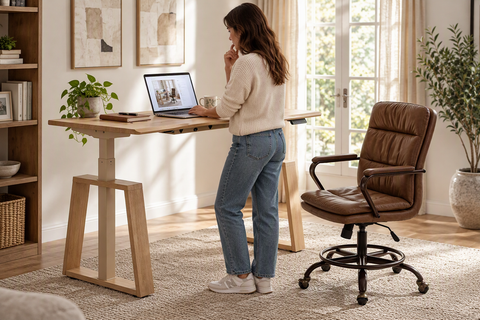
By incorporating a sit-stand model, you gain the ability to change your posture throughout the day. This simple act of alternating between sitting and standing reduces static load, improves blood circulation, and can significantly decrease discomfort in the lower back and neck.
Setting Up Your Sit-Stand Executive Workstation
Owning an adjustable desk is only half the battle; using it correctly is what unlocks the benefits. The goal is to create two neutral postures—one sitting, one standing.
- Finding Your Heights: Adjust the desk so that when you are sitting or standing, your elbows are bent at a roughly 90-degree angle with your wrists straight while typing. Most high-quality standing desks come with programmable presets. Use them to save your ideal sitting and standing heights for one-touch adjustments.
- Adopt a Rhythm: Don’t try to stand all day. That can lead to its own set of problems, like lower limb fatigue. A balanced approach is best. A great starting point is the "20-8-2" rule, popularized by Cornell University's Ergonomics Web. For every 30 minutes, aim to sit for 20 minutes, stand for 8 minutes, and move or stretch for 2 minutes. The key is frequent change.
- Manage Your Cables: A "gotcha" moment for many new standing desk owners is cable tension. When the desk rises, it can pull on monitor, power, and peripheral cords, potentially unplugging or damaging them. Always plan for an adjustable CPU holder and ensure all cables have enough slack to accommodate the desk's full range of motion.
Case Study & Material Considerations
Applying these principles helps translate theory into a practical decision. Let’s consider a common scenario.
Case Study: Choosing a Desk for a Home Office CEO
- The Persona: A CEO running her company from a dedicated 12' x 14' home office. She uses dual 27-inch monitors, needs space for reviewing physical documents, and wants an office that feels both professional and comfortable for long hours.
- The Challenge: A standard 60" x 30" desk feels cramped with her monitors and leaves no room for paperwork. A massive, traditional L-shaped desk would dominate the room, leaving little space for movement or a guest chair. More importantly, it would keep her seated all day, worsening the back pain she experiences by late afternoon.
-
The Analysis & Solution:
- A massive piece like the Zen Pro Executive Standing Desk (86"x39") would be too large, violating the clearance rules and overwhelming the room.
- The ideal solution is a desk that balances a generous surface with a smart footprint and ergonomic functionality. The Ark SWS Pro Executive Standing Desk (63"x29") is a perfect fit. Its 63-inch width easily accommodates her dual monitors and documents, while its 29-inch depth is sufficient for proper viewing distance. The integrated drawers provide storage without adding external bulk. Most importantly, its sit-stand capability allows her to change postures throughout the day, directly addressing her back pain by reducing static spinal loading.
Materials, Certifications, and Trust
The final consideration is the material and build quality, which contribute to the desk's longevity, aesthetic, and health impact. Executive desks often feature premium materials like solid wood, high-quality veneers, or modern options like sintered stone. When choosing a wood desk, look for certifications that signal responsible sourcing, such as the one from the Forest Stewardship Council (FSC). This ensures the wood comes from sustainably managed forests, which is a mark of a trustworthy and environmentally conscious brand.
Wrapping Up: Key Takeaways for Your Decision
Choosing between a traditional and an executive desk is a decision that extends far beyond aesthetics. It’s an investment in your productivity, health, and the overall functionality of your workspace. To make the right choice, prioritize function over sheer size.
- Start with Space: Measure your room and all necessary clearances before you start shopping. An elegant desk in a cramped room is poor design.
- Analyze Your Workflow: Choose a desk depth that supports your specific monitor setup and task requirements to maintain ergonomic posture.
- Embrace Dynamic Work: Prioritize a height-adjustable model. The ability to alternate between sitting and standing is one of the most effective ways to improve comfort and well-being during the workday.
The best desk is not the largest one, but the one that fits your body, your work, and your room in perfect harmony.
Frequently Asked Questions (FAQ)
How much space should I leave around my desk? Aim for at least 36 inches of clear space behind the desk for your chair to move freely. Also, account for the full extension of any drawers and ensure there are clear walking paths (at least 30-36 inches wide) around the furniture.
Are executive standing desks stable at full height? High-quality executive standing desks are engineered for stability. Look for models with heavy-duty steel frames, dual motors for a smooth and powerful lift, and a wide base. Many are tested against industry standards, like those from BIFMA, to ensure they remain stable even when fully extended.
How many hours a day should I stand? There is no magic number, but the goal is to avoid static postures. Most ergonomic experts recommend a cumulative standing time of 2 to 4 hours spread throughout an 8-hour workday. The key is to alternate between sitting and standing every 30 to 60 minutes.
Disclaimer: This article is for informational purposes only and does not constitute professional medical advice. You should consult a qualified professional or physician, especially if you have pre-existing health conditions, before making significant changes to your workstation or physical routine.




Leave a comment