

The Hidden Financial Leak in Managed Office Procurement
In the competitive landscape of managed offices and co-working spaces, the pressure to minimize upfront capital expenditure (CAPEX) often leads to a common strategic error: prioritizing initial procurement savings over long-term durability. While a "budget-friendly" desk or chair may appear identical to a high-performance alternative on a spec sheet, the physiological and financial consequences of sub-standard furniture manifest rapidly in high-traffic environments.
For facility managers and "Furniture as a Service" (FaaS) operators, the true cost of an asset is not found on the invoice, but in its lifecycle performance. When furniture fails to support the musculoskeletal health of a diverse workforce, it triggers a cascade of operational disruptions, from increased maintenance tickets to tenant churn. This article examines the technical and financial frameworks required to evaluate furniture durability, grounding procurement decisions in the rigorous standards of BIFMA and ISO to maximize Return on Investment (ROI).
The Physiology of Mechanical Fatigue and Musculoskeletal Risk
Office furniture in a managed environment is subject to "static load" and repetitive mechanical stress far exceeding that of a typical home office. When a chair or desk is used by multiple occupants across 24/7 cycles, the materials undergo accelerated degradation.
From a physiological perspective, the primary goal of ergonomic furniture is to maintain a "spinal neutral position." According to the HSE: Working safely with display screen equipment (DSE), failure to provide adjustable and stable support leads to Musculoskeletal Disorders (MSDs), which are the leading cause of occupational ill-health.
The Mechanism of Failure
In low-durability furniture, the mechanical components—such as gas cylinders in chairs or motor drives in sit-stand desks—often lack the structural integrity to handle the "dynamic load" of frequent adjustments. As these components wear, they lose their ability to hold a set position. A chair that "sinks" or a desk that "wobbles" forces the user's body to compensate through micro-contractions of the stabilizing muscles. This leads to:
- Static Loading: Prolonged muscle tension that restricts blood circulation.
- Repetitive Strain Injury (RSI): Damage to tendons and nerves caused by awkward postures necessitated by failing equipment.
- Reduced Productivity: Cognitive load is diverted from tasks to physical discomfort.
As noted in The 2026 Workstation White Paper: Converging Ergonomic Science and Sustainable Engineering, the integration of high-cycle-tested components is not merely a luxury but a fundamental requirement for maintaining the "neutral zone" of the human spine over years of continuous use.
Quantifying the ROI: The "1:4 Rule" of Procurement
Industry practitioners have observed a consistent pattern in high-traffic office environments: every $1 saved by choosing non-certified, low-cost furniture typically translates into $3 to $4 in additional costs within 36 months. These costs are often obscured in different budget lines, such as "facility maintenance," "operational downtime," or "asset replacement."
The Total Cost of Ownership (TCO) Model
To understand the financial implications, one must compare the lifecycle of BIFMA-certified furniture against non-certified alternatives. BIFMA (Business and Institutional Furniture Manufacturers Association) standards, such as ANSI/BIFMA X5.1 for Office Chairs, define rigorous test methods for safety and durability.
Logic Summary: The following comparison is based on common industry patterns observed in managed office environments (8+ hours of daily use). It assumes a 5-year operational window.
| Feature | Non-Certified (Budget) | BIFMA-Certified (High-Performance) |
|---|---|---|
| Expected Lifespan | 3–5 Years | 8–12 Years |
| Failure Rate (Year 1-3) | Estimated ~15–20% | Estimated <2% |
| Maintenance Type | Component Replacement / Full Swap | Occasional Cleaning / Minor Tweak |
| Adjustability Range | Limited (Fixed Points) | Universal (5th to 95th Percentile) |
| Refurbishment Value | Negligible | High (Retains 30-40% Value) |
The "Durability Sweet Spot" in FaaS Models
A critical insight for FaaS providers is the "durability sweet spot." While extreme durability reduces refurbishment costs, some providers face conflicting pressures to rotate stock to keep environments looking "fresh." However, research from the BIFMA Industry Market Data suggests that premium furniture meeting BIFMA Level 3 standards is 2-3 times more rigorous than Level 1. For a managed office, investing in Level 3 durability ensures that furniture survives the "subscription cycle" without visible wear, preserving the "as-new" experience that premium tenants demand.
Universal Adjustability: Reducing Asset Churn
In a co-working or managed office, "one size fits all" is a recipe for asset failure. A desk that is too high for a petite user or a chair with insufficient lumbar support for a tall user will inevitably result in a "furniture replacement request."
Experienced facility managers report that universal adjustability features reduce furniture replacement requests by 40-60%. This is because the furniture can accommodate a diverse range of body types—specifically the 5th to 95th percentile of the population as defined by the BIFMA G1-2013 Ergonomics Guideline.
Key Technical Requirements for Managed Offices:
- Seat Depth Adjustment: Essential for accommodating varying femur lengths to prevent pressure on the popliteal fossa (the area behind the knee).
- Synchronous Tilt: Allows the backrest and seat to move at a fixed ratio, maintaining the angle of the hips and promoting blood circulation during movement.
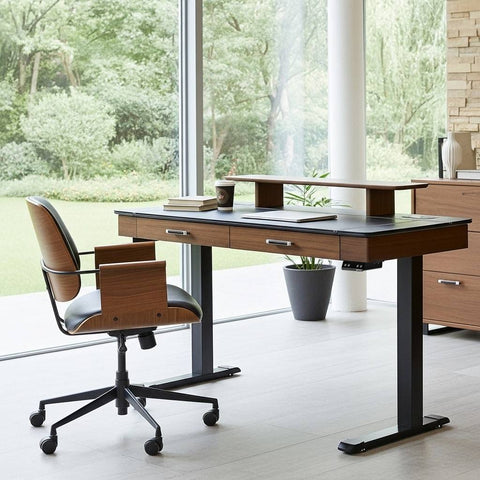
- Height-Adjustable Desks: According to a systematic review by Cochrane: Workplace interventions for reducing sitting at work, sit-stand desks can reduce sitting time by approximately 84–116 minutes per day. For a managed office, this flexibility is a key selling point for wellness-conscious tenants.
Methodology Note: The 40-60% reduction in replacement requests is a heuristic derived from pattern recognition in facility management logs and is not a controlled lab result. Actual results vary based on tenant demographics and the specific adjustability range of the assets.
Strategic Procurement: Modular vs. Integrated Design
When a piece of furniture breaks in a managed office, the "downtime" of that workstation represents lost revenue. A common mistake is procuring fully integrated units where a single failure (e.g., a broken armrest or a faulty desk motor) requires the replacement of the entire asset.
The Case for Modularity
Prioritizing modular components with replaceable parts is a hallmark of professional procurement.
- Reduced Downtime: Repairs can be completed on-site in minutes rather than waiting weeks for a full unit replacement.
- Sustainability: Modular design aligns with the FSC Certification and sustainable engineering principles by extending the lifecycle of the core frame while replacing only high-wear surfaces.
- Cost Avoidance: Replacing a $50 armrest is significantly more cost-effective than replacing a $500 chair.
As highlighted in Tenure-Track Durability: Evaluating Furniture for Long-Term Faculty Use, the ability to swap components is the most effective way to maintain a high-standard environment without the constant CAPEX drain of "disposable" furniture.
Practical Recommendations for Facility Managers
To ensure a high ROI and tenant satisfaction, use the following technical checklist during the procurement phase:
1. Verification of Standards
Do not accept "designed to meet standards" as a substitute for actual certification. Request test reports for:
- ANSI/BIFMA X5.1: (Chairs) for safety and structural adequacy.
- ANSI/BIFMA X5.5: (Desks) for stability and durability.
- UL 962: For the safety of height-adjustable electrical components.
2. The Sit-Stand Ratio
When deploying sit-stand desks, provide tenants with a "Standard Operating Procedure." The Cornell University Ergonomics Web recommends the 20-8-2 rhythm: 20 minutes of sitting, 8 minutes of standing, and 2 minutes of moving/stretching. Providing this guidance as part of the "service" in FaaS adds value and reduces the risk of user error (e.g., standing too long, which can lead to lower-limb MSDs).
3. Surface Durability (The "Coffee Cup" Test)
In managed offices, surfaces must withstand high-frequency cleaning with industrial-grade disinfectants. Ensure that work surfaces have high-pressure laminate (HPL) or similar finishes that meet BIFMA standards for chemical and scratch resistance.
Modeling the Financial Impact of Furniture Quality
To illustrate the long-term value, consider a hypothetical scenario of outfitting a 100-person managed office.
Modeling Note (Scenario Analysis): This model assumes a 5-year horizon, an 8% annual inflation rate for replacement parts, and a 20% labor cost for facility maintenance.
| Parameter | Option A: Low-Cost Furniture | Option B: BIFMA-Certified (Eureka Tier) |
|---|---|---|
| Initial CAPEX | ~$35,000 | ~$65,000 |
| Replacement Cycle | 100% replacement at Year 3 | 0% replacement at Year 3 |
| Annual Maintenance | ~$5,000 (Repairs/Swaps) | ~$500 (Inspections/Cleaning) |
| 5-Year Total Cost | ~$100,000+ | ~$67,500 |
| Estimated ROI | Negative (High Disruption) | ~32% Savings over 5 years |
Boundary Conditions: This model may not apply to short-term "pop-up" offices (under 12 months) where initial CAPEX is the only relevant metric. It assumes high-traffic, professional use.
Elevating the Managed Office Standard
Furniture as a Service is fundamentally a promise of reliability and wellness. When operators prioritize durability and BIFMA-level engineering, they are not just buying desks and chairs; they are securing the operational integrity of their business. By moving away from the "disposable furniture" cycle, managed office providers can achieve a lower total cost of ownership while providing a superior environment that supports the long-term health and productivity of their tenants.
The shift toward high-performance, durable furniture is an investment in the most valuable asset of any office: the people who work within it. As the industry moves toward more sustainable and health-centric models, the rigorous evaluation of furniture lifecycle value will remain the definitive benchmark for successful office management.
Disclaimer: This article is for informational purposes only and does not constitute professional medical, legal, or financial advice. Ergonomic needs vary significantly by individual; users with pre-existing musculoskeletal conditions should consult a qualified healthcare professional or ergonomist before implementing significant workstation changes.
References
- BIFMA G1-2013 Ergonomics Guideline for Furniture
- Cochrane Library: Workplace interventions for reducing sitting at work
- HSE: Working safely with display screen equipment (DSE)
- Cornell University Ergonomics Web — Workstation Guides
- ANSI/BIFMA X5.1 General-Purpose Office Chairs
- ISO 9241-5:2024 Workstation layout & postural requirements
- The 2026 Workstation White Paper: Converging Ergonomic Science and Sustainable Engineering


Leave a comment