

A Gamer's Guide to Wrist Health and Performance
For competitive gamers, reaction time is everything. A single frame can be the difference between victory and defeat. But speed and accuracy are only sustainable when they’re built on a foundation of physical well-being. Your wrists, the crucial link between your brain and your controls, are highly susceptible to strain from repetitive motions. This guide breaks down the ergonomics of a high-performance gaming setup, focusing on the principles that can help prevent injury, reduce fatigue, and sharpen your competitive edge.
Author & Review Notes
This guide was written by our peripherals and ergonomics editor, who has several years of experience helping PC gamers troubleshoot comfort and posture issues. It has been reviewed for general ergonomic accuracy by a licensed physical therapist / occupational health professional. It is not a personalized medical assessment.
Why Your Wrists Are a Critical Performance Bottleneck
Long gaming sessions involve thousands of repetitive, high-speed movements. Clicks, key presses, and mouse flicks place a cumulative load on the muscles, tendons, and nerves in your hands and wrists. When your setup forces your joints into awkward angles, you create friction and compression, which can contribute to inflammation and pain. This is one of the roots of Repetitive Strain Injuries (RSIs), a category of musculoskeletal disorders that can manifest as issues like carpal tunnel syndrome, tendonitis, or general discomfort.
The initial signs are often subtle: a slight ache after a long match, a bit of morning stiffness, or a feeling of weakness. Ignored, these symptoms can escalate into more persistent pain that limits your gameplay and affects daily life. According to the U.S. Occupational Safety and Health Administration (OSHA), poor posture and repetitive tasks are key risk factors for these disorders. For a gamer, this translates directly to performance degradation: wrist pain can slow your reaction time, disrupt your muscle memory, and in some cases force you to take extended breaks from gaming.
Building Your Ergonomic Foundation
Before you fine-tune your hand position, you need a stable and neutral posture. Your entire setup—chair, desk, and monitors—works as a system. Always start with your chair.
Step 1: Anchor Your Posture with Your Chair
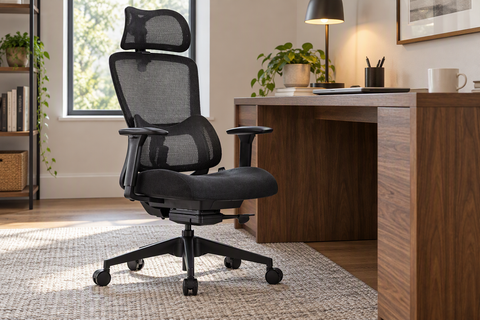
Your chair is the base of your posture. Adjust its height so your feet are flat on the floor or on a stable footrest, and your knees are at a roughly 90-degree angle. Your lower back should be firmly supported by the chair's lumbar cushion, maintaining the natural curve of your spine. Next, adjust the armrests so your shoulders can relax, with your elbows resting lightly at about a 90 to 110-degree angle.
A practical self-check: if your shoulders feel shrugged or tense, your armrests are probably too high. If your elbows are dangling with no support, they may be too low.
Step 2: Bring the Desk to You
Once your seated posture is set, adjust your desk height. Whether sitting or standing, the goal is to bring the surface to a level where your forearms are roughly parallel to the floor when your elbows are at that 90–110 degree angle. A common mistake is setting the desk too high, which forces you to bend your wrists upward to reach the keyboard and mouse. This position, known as wrist extension, increases strain.
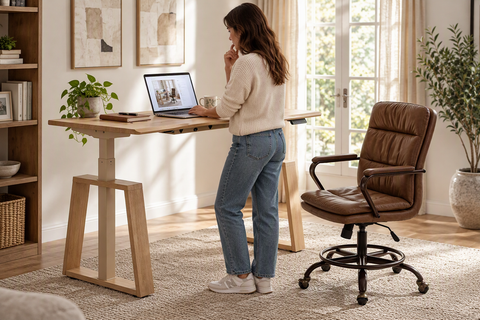
For those using a sit-stand desk, remember that standing is not a replacement for movement. The key is to vary your posture. A strategy often cited by Cornell University's Ergonomics Web is the "20-8-2" pattern: over a 30-minute window, aim to sit for about 20 minutes, stand for about 8, and move or stretch for about 2. This rhythm promotes blood circulation and reduces the static load that can contribute to musculoskeletal discomfort.
How to self-test your foundation
- Sit in your usual gaming position.
- Check your knees: are they close to a right angle, with feet flat? If not, adjust chair or add a footrest.
- Relax your shoulders and let your arms hang, then bring your forearms up to desk level. If you have to shrug your shoulders or reach up, the desk is too high; if you have to hunch forward, it may be too low.

Mastering Keyboard and Mouse Positioning for Peak Performance
With your foundational posture set, the next step is dialing in your peripherals. This is where many gamers make critical errors that affect both comfort and performance.
The Neutral Wrist: Your Aiming Anchor
A central ergonomic principle is maintaining a neutral wrist position. This means your wrist is straight, not bent up (extension), down (flexion), or to the side (deviation). Imagine a straight line running from your forearm through your wrist and into your hand. This is generally the position of least strain and maximum stability.
Achieving this requires practical control over your keyboard and mouse height. According to guidance from OSHA's Computer Workstation eTool, your keyboard should be positioned at or slightly below elbow height. For many gamers, a fixed, standard desk height makes this difficult without compromising chair height and posture.
This is where an adjustable keyboard tray can be very helpful. It allows you to position your keyboard independently of your main desk surface, making it possible to achieve a neutral or even a slightly negative tilt (where the top of the keyboard is lower than the bottom). In many office and gaming setups, a small negative tilt—on the order of a few degrees—can help keep the wrists straighter more naturally.
Quick self-test for neutral wrists
- Place your hands on the keyboard in your normal gaming position.
- Look from the side (or take a quick photo): is the back of your hand in a straight line with your forearm?
- If your knuckles sit noticeably higher than your wrist, try lowering the keyboard or adding a slight negative tilt.
- If your wrists drop below your fingers, raise the keyboard slightly or adjust your chair.

Mouse Placement and Surface Area
Your mouse should be positioned at the same height as your keyboard. Placing it far forward or out to the side forces you to reach with your shoulder and upper arm, creating tension that can radiate down to your wrist.
Instead of focusing on an exact number of centimeters, use these practical cues:
- When your elbow is relaxed by your side, you should be able to rest your hand on the mouse without reaching or leaning forward.
- Your upper arm should stay close to your torso rather than flaring out widely.
A large, full-surface mousepad is not just for aesthetics; it's an ergonomic tool. It provides a consistent, low-friction surface that allows for large, sweeping arm movements for aiming, rather than relying mainly on small, rapid wrist movements. This "arm aiming" technique distributes the workload across the larger muscles of the shoulder and arm, which are generally more tolerant of load than the smaller structures of the wrist.
Simple mouse-distance check
- Sit up straight with your back supported.
- Let your arm hang loosely, then bend your elbow to about 90 degrees.
- Without leaning forward, reach your hand straight out onto the mouse.
- If you have to scoot your chair forward or shrug your shoulder to reach, bring the mouse and keyboard closer.
Ergonomic Setup Checklist
Use this checklist to audit your gaming station. Small adjustments can yield noticeable improvements in comfort and performance.
| Component | Checkpoint | Optimal Setup (General Guideline) |
|---|---|---|
| Chair | Feet Position | Flat on the floor or a footrest. |
| Knee Angle | Approximately 90 degrees. | |
| Lumbar Support | Engaged with the natural curve of your lower back. | |
| Armrest Height | Elbows at about a 90–110 degree angle, shoulders relaxed. | |
| Desk | Seated Height | Surface is at or just below resting elbow height. |
| Standing Height | Surface allows forearms to be roughly parallel to the floor. | |
| Keyboard | Height & Angle | At or slightly below elbow height, with a neutral or slightly negative tilt (small downward slope away from you). |
| Mouse | Position | Same height as keyboard, close enough to reach without leaning or shrugging. |
| Wrists | Alignment | Kept in a straight, neutral position—no sustained bending up, down, or sideways. |
These checkpoints are general guidelines based on common ergonomic principles and may need to be adjusted slightly to fit your body size and specific setup.
Myth Debunked: Are Puffy Wrist Rests Helping or Hurting?
A common misconception is that a thick, gel wrist rest is the ultimate solution for wrist pain. While they can provide comfort during breaks, using one incorrectly can actually worsen the problem. Many gamers rest the carpal tunnel area (the base of the palm where the wrist meets the hand) directly on the pad while typing or gaming. This creates a fulcrum point, compressing the delicate nerves and tendons inside the carpal tunnel—exactly what you want to avoid.
The Canadian Centre for Occupational Health and Safety (CCOHS) advises that supports should not press directly on the wrist. If you use a rest, it should support the palm of your hand, not the wrist joint itself. Use it mainly for brief pauses, and avoid applying constant pressure during active gameplay. The goal is to float your hands over the keys and mouse, maintaining that neutral alignment from forearm to fingertips.
Key Takeaways for Sustainable Gaming
Building an ergonomic gaming setup is an investment in your health and performance. It’s not about finding a single "perfect" product, but about understanding the principles of neutral posture and applying them to your unique body and playstyle.
- Start with Your Foundation: Set your chair first, then adjust your desk to meet your ideal posture.
- Prioritize Neutral Wrists: The straight line from your forearm to your hand is your north star. Use tools like adjustable keyboard trays or desk mounts to help achieve it.
- Aim with Your Arm: Use a large mouse surface to encourage broader movements, taking some of the repetitive load off your wrist.
- Move Frequently: Alternate between sitting and standing where possible, and take short breaks every 20–30 minutes to stretch and move.
Remember that different bodies and pre-existing conditions can change what “comfortable” and “neutral” feel like. If you experience persistent numbness, tingling that wakes you up at night, or progressive weakness, reduce your gaming load and consult a healthcare professional. A smart setup today can help you stay in the game for years to come.
Disclaimer: This article is for informational purposes only and does not constitute professional medical advice. The information provided is not a substitute for a consultation with a qualified healthcare professional. If you are experiencing pain, numbness, or other symptoms of a musculoskeletal disorder, please seek a medical diagnosis and treatment plan from a doctor or physical therapist, especially if you have pre-existing conditions or are in a higher-risk group (for example, diabetes or prior wrist injuries).




Leave a comment