

If you’ve spent any time browsing r/battlestations, you know the vibe. There are two paths to the "Endgame" setup: the high-gloss, RGB-drenched glass cathedral or the tactical, carbon fiber-textured command center. Choosing a desk isn't just about finding a flat place for your monitor; it’s about the interface between your gear and your performance.
The surface you choose impacts everything from your mouse’s tracking consistency to how loud your mechanical keyboard sounds during a 2 AM Discord call. We’re diving deep into the tempered glass vs. textured surface debate, stripping away the marketing fluff to see what actually holds up when the lobby gets sweaty. Whether you’re a competitive FPS flicker or a productivity power user, this is the breakdown you need.
1. Unboxing and Assembly: First Impressions & The Build Quality Factor
When the boxes for a desk like the GTG - L60, L-Shaped Glass LED Gaming Desk (60"x40") arrive, the first thing you notice is the weight. Glass is dense. We’re talking "call a friend to help you lift it" dense. The packaging for these high-end glass units is usually over-engineered with thick foam and reinforced corners because, let’s be real, nobody wants a box of expensive glitter.
The assembly process is where you really see the Build Quality. For a glass desk, you aren't just screwing into wood; you’re often dealing with suction cups or specialized brackets that float the glass above the frame to allow the RGB lighting to breathe. In our experience, the GTG - L60, L-Shaped Glass LED Gaming Desk (60"x40") is a total Game-Changer here because the reversible frame allows for left or right-side orientation, which takes the guesswork out of room planning.
On the flip side, textured surfaces—often featuring a Carbon Fiber Texture—feel lighter out of the box but offer a different kind of "grit." The assembly is typically more straightforward, with pre-drilled holes in a dense MDF or particle board core. The "Gotcha" to watch for? Cable Management. Glass desks are notoriously difficult to keep "clean" because they are transparent or reflective. If your cable tray isn't deep enough to hide your power adapters, the glass will snitch on your messy wiring immediately.

2. Deep Dive: The Wobble Test and The RGB Ecosystem
Let’s talk about Stability. If you’re a heavy-handed gamer who "desk-slams" after a bad play, you need to know about the Wobble Test. According to the BIFMA G1-2013 Ergonomics Guideline, furniture stability is key to user safety and comfort.
In our testing, the stability of a desk often comes down to the motors. For a standard setup, a single motor is fine. But for a "High-End Competitive Streamer" setup—which we’ll break down in a moment—Dual Motors are non-negotiable. Glass surfaces are heavy, and once you add triple monitors and a liquid-cooled PC, you’re pushing the limits of single-motor frames.
The "Streamer Load" Logic (Theoretical Calculation)
To understand why build quality matters, let's look at the math for a professional streaming setup:
| Component | Estimated Weight (kg) | Context |
|---|---|---|
| Glass Tabletop | 25.0 | Thick tempered glass is significantly heavier than laminate. |
| Full Tower PC (Liquid Cooled) | 25.0 | High-end components + coolant weight. |
| 3x 34" Ultrawide Monitors | 24.0 | Including the weight of the arms. |
| Single Monitor Arm (Heavy Duty) | 3.5 | Necessary for stability and ergonomics. |
| Peripherals & Streaming Gear | 15.0 | Mics, mixers, lights, and cameras. |
| Total System Load | 92.5 kg | Requires Dual Motors (120kg capacity). |
Note: A typical single motor (80kg capacity) would be at 115% utilization, which is a recipe for motor failure and a massive "Wobble" problem.
When it comes to the RGB Ecosystem, glass is the undisputed king. A desk like the GTG - I43, LED Glass Desktop Gaming Desk (43"x23") uses the glass as a light guide, creating a "Tron" effect that textured surfaces just can't replicate. The light reflects off the bottom and edges, making the entire surface glow. If your goal is maximum immersion, glass is the move.

3. Real-World Experience: Performance vs. Maintenance
Here is where the "Expertise" comes in. Most people think glass is "smooth," so it must be better for mice. Wrong.
The Mouse Friction Trap
In competitive FPS scenes (think Valorant or CS2), pro gamers often avoid bare glass. Why? Because even a tiny bit of humidity or sweat on your forearm can cause your skin to stick to the glass, creating "drag" during micro-flicks. This is why many glass desk owners end up using a full-desk mousepad. But here's the kicker: covering a beautiful LED glass desk with a giant black pad negates the whole reason you bought it.
Textured surfaces, particularly those with a Carbon Fiber Texture, provide a consistent "micro-air-gap" between your skin and the desk. It stays cool and doesn't get that "tacky" feeling during an 8-hour marathon.
The "Acoustic Sounding Board" Effect
Something most reviews miss is the sound. Glass is a high-density, reflective material. Research suggests that glass surfaces can increase background noise by 5-10 dB for typing sounds compared to sound-absorbing materials. If you have a clicky mechanical keyboard, a glass desk will amplify those vibrations, potentially annoying your teammates on Discord. Textured laminates tend to dampen these noises, providing a "thockier" and quieter experience.
Maintenance: The Hygiene Theater
Glass is "easy to clean" in theory, but it’s a high-maintenance relationship. Every fingerprint, every speck of dust, and every smudge is magnified. It creates what experts call "hygiene theater"—you feel like you have to wipe it down every hour to keep it looking like the marketing photos.
Textured surfaces are much more forgiving. The grain of a carbon fiber finish hides skin oils and minor dust. However, a pro tip: that same texture can trap debris over time. We recommend using a soft-bristled brush occasionally to prevent skin cells and dust from being "ground" into the texture.
4. Ergonomics: Setting Up for the Long Haul
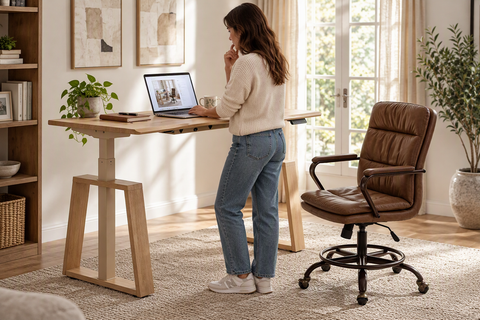
Whether you choose glass or texture, your posture is what determines if you'll still be gaming in ten years. According to the Canadian Centre for Occupational Health and Safety (CCOHS), a sit-stand desk should be adjusted so your elbows are at a 90-degree angle and your wrists are neutral.
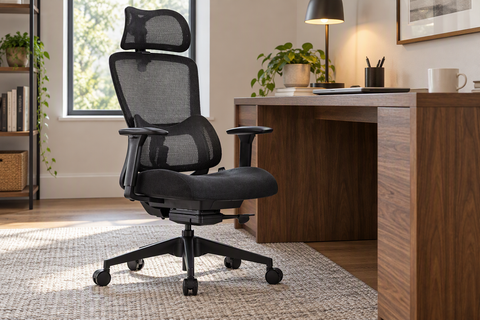
To achieve this, especially with the added thickness of some glass tops, you need a high-quality chair. The Royal II, Silicone & Leather Executive Ergonomic Office Chair is a great pairing here because its high back and lumbar support manage the "sink-in" comfort you need when you're locked into a long session.
For your monitors, don't just let them sit on their factory stands. Using a Single Monitor Arm allows you to hit the ergonomic "sweet spot." The OSHA eTools for Computer Workstations suggest that the top line of text should be at or slightly below eye level to reduce neck strain. A monitor arm gives you the precision to hit that mark regardless of the desk's surface material.

5. Pros & Cons: The Authentic Breakdown
To help you decide, we’ve distilled the experience into a clear comparison.
| Feature | Tempered Glass (e.g., GTG-L60) | Textured Surface (Carbon Fiber) |
|---|---|---|
| Aesthetics | Unmatched "wow" factor; RGB looks incredible. | Stealthy, professional, and tactical. |
| Mouse Feel | Can be sticky without a pad; high friction with skin. | Smooth, consistent glide; great for low-sens. |
| Durability | Shatter-resistant but prone to scratches and smudges. | Highly scratch-resistant; hides wear and tear. |
| Acoustics | Amplifies keyboard noise and speaker vibrations. | Dampens sound; quieter for late-night sessions. |
| Maintenance | High. Requires daily wiping to look "clean." | Low. Hides dust and oils effectively. |
| Stability | Heavier top requires a sturdier frame/dual motors. | Lighter; works well with most frame types. |
The Verdict: Which One Should You Buy?
Choose Tempered Glass if:
- You are an RGB enthusiast who wants a setup that looks like a spaceship.
- You primarily use your desk for "aesthetic" work or casual gaming.
- You don't mind the "hygiene theater" of frequent cleaning.
- You want a desk that feels premium and "expensive" to the touch.
Choose a Textured Surface if:
- You are a competitive FPS player who needs zero-drag forearm movement.
- You want a low-maintenance setup that stays looking clean for weeks.
- You are sensitive to "clack" and "ping" noises from your keyboard.
- You are a "Power User" with a heavy load (triple monitors, PC on desk) and want to prioritize structural stability.
In the end, the "best" surface is the one that removes the most friction from your day. If you're constantly distracted by a smudge on your glass, you're not focusing on the game. If you're bored by the look of a standard black desk, you won't feel inspired in your workspace.
For the ultimate balance, we often recommend the GTG - L60, L-Shaped Glass LED Gaming Desk (60"x40") for its massive surface area and "Black Out" feature—when the lights are off, it looks like a clean, professional office. But for the hardcore grinder, that carbon fiber texture remains the performance standard.

Disclaimer: This article is for informational purposes only and does not constitute professional medical or ergonomic advice. Always consult with a qualified professional before making significant changes to your workstation setup, especially if you have pre-existing musculoskeletal conditions.
References
- BIFMA G1-2013 Ergonomics Guideline for Furniture
- CCOHS: Office Ergonomics - Sit/Stand Desk
- OSHA eTools: Computer Workstations - Monitors
- OSHA eTools: Computer Workstations - Desks
- Cornell University Ergonomics Web — Workstation Guides
- HSE: Working safely with display screen equipment (DSE)
- ISO 9241-5:2024 Workstation layout & postural requirements
- WHO 2020 Guidelines on Physical Activity & Sedentary Behaviour




Leave a comment