

When One Plane Is Not Enough
For programmers, designers, financial traders, and other power users, a standard rectangular desk is often a landscape of compromise. Multiple monitors vie for position, peripherals spill over the edges, and physical documents get buried under keyboards. This constant battle for space isn’t just a minor annoyance; it’s a direct tax on productivity and focus. When your workflow involves juggling complex applications, vast datasets, and constant cross-referencing, a single surface creates friction, forcing you to minimize windows, stack devices, and lose your train of thought.
The L-shaped executive desk emerges not as a luxury, but as a fundamental solution to this high-density work style. It provides the expansive real estate needed to manage multiple monitors, specialized equipment, and project files simultaneously. By offering distinct work zones, it allows power users to move from a state of organized chaos to one of streamlined efficiency, transforming their workspace from a source of friction into a catalyst for peak performance.
The Core Advantage: Maximizing Usable Workspace
The most apparent benefit of an L-shaped desk is its sheer size, but its true value lies in how that space is structured. Unlike a long rectangular desk where everything competes in a single line, the L-shape creates distinct zones, a principle that dramatically enhances workflow organization.
Beyond Simple Surface Area: Creating Distinct Work Zones
An L-shaped desk is best understood as two distinct surfaces combined: a primary zone and a secondary zone. This separation is key to an efficient setup.
- The Primary Zone (The "Cockpit"): This is the main desk area directly in front of you. It should house your primary monitor, keyboard, and mouse. This is where your most immediate and focus-intensive tasks occur. By keeping this area dedicated to your main digital interface, you maintain an optimal ergonomic posture without twisting or reaching.
- The Secondary Zone (The "Return"): This is the perpendicular section of the desk. It’s the ideal home for secondary monitors, a laptop, reference materials, charging stations, and other peripherals. It keeps essential tools within easy reach but outside your immediate line of sight, preventing visual clutter and distraction.
I’ve seen many users try to replicate this with two separate desks, but the seamless transition of an L-shaped surface is far superior. There are no gaps for cables to fall through and no mismatched heights to contend with. It creates a single, cohesive command center.

A Dedicated Space for Every Task
This zoned approach directly combats context-switching, a major drain on cognitive resources. When your coding environment, design canvas, and communication tools all have their own physical space, you can mentally and physically shift between tasks more fluidly. A programmer can have their primary IDE open on the main screen, with documentation and a terminal on a secondary monitor to the side. A designer can use the main area for their primary design software and the return for mood boards, client feedback, and other assets.
This separation ensures that your primary workspace remains uncluttered and focused. The frustration of having to move a keyboard to make space for a notebook or sketchpad disappears. The L-shaped desk provides a permanent, designated home for every tool, allowing you to build muscle memory and operate with greater speed and less mental friction.
Ergonomics by Design: Optimizing for Health and Productivity
A larger workspace is only beneficial if it’s designed to support the human body. The L-shaped desk, when set up correctly, offers significant ergonomic advantages, particularly for users with complex, multi-monitor setups. It addresses the core risk factors for musculoskeletal disorders (MSDs) identified by workplace safety authorities like the U.S. Occupational Safety and Health Administration (OSHA), such as poor posture and repetitive strain.
Achieving Neutral Posture with Multi-Monitor Setups
The most common ergonomic mistake I see with large or multiple monitors is poor placement, leading to persistent neck and shoulder pain. Users either place a large monitor too close or angle their bodies to view screens placed off-center. An L-shaped desk provides the ideal layout to solve this.
According to OSHA’s eTools for computer workstations, your monitor should be placed directly in front of you, with the top line of the screen at or just below eye level, and at about an arm's length away. With an L-shaped desk, your primary monitor can be positioned perfectly in your main work zone, while secondary monitors can live on the return. This encourages you to turn your head slightly to view them, a less strenuous movement than twisting your entire torso.
For optimal depth, a minimum of 24 inches is crucial to maintain a neutral neck posture and avoid forward head position. Desks with generous dimensions, like the Ark Pro L-Shaped Standing Desk (Sintered Stone, 63"x23"), provide ample surface area to achieve this proper monitor distance, even with large displays.
The Sit-Stand Advantage for Power Users
Power users often work long, focused hours, making them highly susceptible to the health risks of prolonged static postures. A height-adjustable L-shaped desk is the most effective engineering control to mitigate this. Systematic reviews, such as a landmark 2018 Cochrane analysis, have shown that sit-stand desks can reduce sitting time by 84–116 minutes per day.
For an L-shaped desk, a robust dual-motor system is essential. It ensures the desk remains stable and level when raising or lowering a heavy, multi-monitor setup. Single-motor desks can struggle with the unbalanced load, leading to slower adjustments or premature wear. Furthermore, models with at least two memory presets are a game-changer, allowing you to transition between your ideal sitting and standing heights with a single button press, minimizing workflow disruption.
Common Myth Debunked: "The Corner is the Best Place to Work"
A prevalent misconception is that the corner of an L-shaped desk is the most efficient place to set up your primary workstation. From an ergonomic standpoint, this is often the worst position. Working from the deep corner forces your body into an asymmetrical posture. It pushes your keyboard and mouse further away, encouraging you to lean forward and increasing the load on your spine. It also promotes a constant, subtle twist in your neck and torso to align with a monitor pushed into the corner. Over time, this can lead to significant musculoskeletal strain. The correct approach is to use the straight section of the main desk as your primary zone, reserving the corner for items you access less frequently.
Practical Implementation for Power Users
Owning an L-shaped desk is the first step. Setting it up for maximum productivity and ergonomic benefit is the next. Power users must pay special attention to cable management and zone configuration to unlock the desk’s full potential.
Power User's L-Shaped Desk Setup Checklist
To translate ergonomic principles into a practical setup, use this checklist. It synthesizes guidelines from authoritative sources like OSHA and Cornell University to create a high-performance workstation.
| Component | Action | The "Why" (Ergonomic Principle) |
|---|---|---|
| Primary Monitor | Place directly in front of you, centered on the main desk section. | Promotes a neutral neck and spine posture, avoiding torso twist. |
| Monitor Height | Adjust so the top line of text is at or slightly below eye level. | Minimizes neck extension or flexion. Follows OSHA guidelines. |
| Monitor Distance | Position it roughly an arm's length away (20-30 inches). | Reduces eye strain and prevents forward head posture. |
| Secondary Monitor(s) | Place on the "return" (side desk), angled slightly toward you. | Keeps information accessible with a comfortable head turn, not a full body twist. |
| Keyboard & Mouse | Position on the primary desk surface so your elbows are at a 90-100° angle. | Prevents repetitive strain on wrists and shoulders. |
| Chair Position | Adjust height so your feet are flat on the floor and knees are at roughly a 90° angle. | Establishes a stable, grounded posture as your ergonomic foundation. |
| Sit-Stand Ratio | Alternate between sitting and standing. Start with 30-60 minutes and adjust for comfort. | Reduces static load. The "20-8-2" rule from Cornell University Ergonomics Web (20 min sit, 8 min stand, 2 min move) is a great target. |
| Cable Management | Use under-desk trays and a flexible cable sleeve for sit-stand desks. | Prevents cable strain, snagging, and damage during height adjustment. |

Advanced Cable and Equipment Management
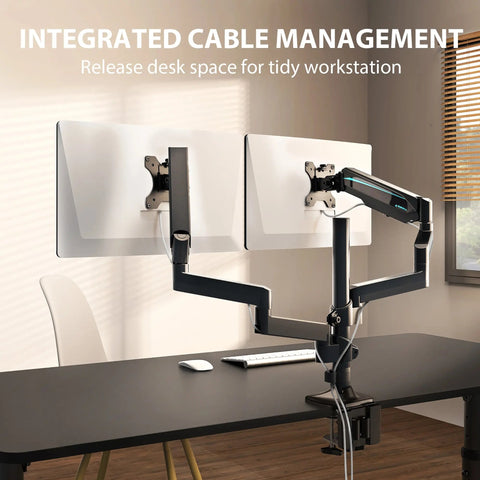
For a power user’s setup, cable management is not just about aesthetics; it’s about safety and functionality. A common mistake with sit-stand L-desks is running long power and data cables from the floor directly to the equipment. As the desk moves, these cables can become strained, unplugged, or even damaged.
The professional solution is to mount a surge protector or power strip to the underside of the desk. All your desktop equipment (monitors, PC, chargers) plugs into this strip. Then, only a single, flexible power cord needs to run from the power strip to the wall outlet. This bundle of cables can be routed down one of the desk legs inside a cable sleeve for a clean and safe setup.
For users with a desktop PC tower, a CPU hanger that attaches to the underside of the desk is a valuable accessory. It keeps the PC off the floor and moves with the desk, ensuring cables are never stretched or pulled during height adjustments. This is a far better solution than placing a heavy tower directly on the desk surface, where it takes up valuable space and adds to the weight load the motors must lift.
Material and Build Quality: An Investment in Durability
A power user’s desk must support a significant amount of weight—often two or three monitors, a PC tower, and various other heavy peripherals. This is where build quality and material choice become paramount. A flimsy desk will wobble during typing or height adjustments, creating a distracting and unstable work environment.
Look for desks built with a heavy-duty steel frame, which provides the structural integrity needed to remain stable under load. The lifting capacity of a sit-stand desk is a key specification; a dual-motor system with a capacity of 220 lbs or more, like that found in the L-Shaped Standing Desk with Accessories Set (60"x23"), is a good benchmark for a typical power-user setup. Compliance with industry standards, such as those from the Business and Institutional Furniture Manufacturers Association (BIFMA), provides an additional layer of assurance regarding safety, durability, and structural adequacy.
Beyond the frame, the desktop material itself is a critical consideration. While standard laminates are common, premium materials offer both aesthetic and functional benefits. For example, the Ark Pro L-Shaped Standing Desk (Sintered Stone, 63"x23") utilizes a sintered stone surface. This material is exceptionally resistant to scratches, heat, and stains, making it incredibly durable for a high-use environment. Its refined finish elevates the workspace, reflecting the professionalism of the user.
Wrapping Up: An Investment in Productivity and Well-being
For the power user, the desk is more than a piece of furniture—it is the foundation of their productivity. An L-shaped executive desk is a strategic choice that directly addresses the challenges of a complex, multi-device workflow. It provides the expansive, organized space needed to eliminate clutter and reduce context-switching.
When combined with height-adjustability and a proper ergonomic setup, it becomes a powerful tool for safeguarding long-term health and well-being. By enabling neutral postures, encouraging movement, and providing a dedicated zone for every task, it allows you to work longer, smarter, and more comfortably. It is an investment that pays dividends in focus, efficiency, and a healthier relationship with your work.
Disclaimer: This article is for informational purposes only and does not constitute professional medical advice. If you have pre-existing health conditions, such as chronic back pain or a musculoskeletal disorder, please consult with a qualified physician or physical therapist before making significant changes to your workstation or daily routine.




Leave a comment