

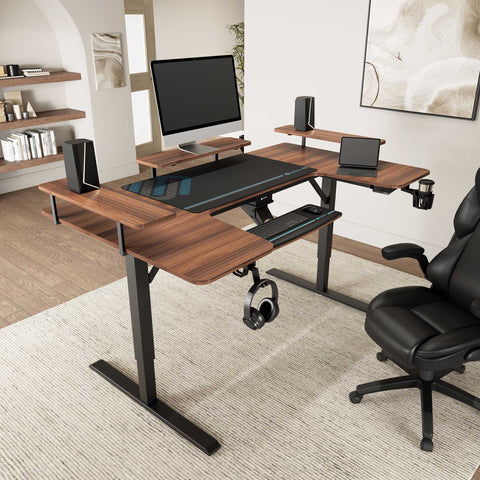
Your L-shaped gaming desk is more than a slab of wood and steel; it’s command central for everything you do: gaming, streaming, editing, chatting, even the occasional spreadsheet. The fun part? You can push an L-shaped layout in totally different directions—from ultra-clean minimal rigs to full-send RGB battlestations—without sacrificing ergonomics.
In this guide, I’ll walk through minimalist vs. maximalist L-shaped gaming desk ideas, with a special focus on streaming and multitasking. You’ll see how to use that corner intelligently, how to keep your spine happy while your K/D climbs, and how to pick layouts that match your playstyle instead of just copying a random setup pic.

Why L-Shaped Desks Shine for Gaming, Streaming & Multitasking
Before we dive into style, it’s worth asking: why even go L-shaped instead of a traditional straight desk?
More usable zones, not just more surface
A common myth is that an L-shaped desk automatically gives you “more usable space.” Reality check: anything deeper than about 30 inches on the side wing often turns into a dumping ground because your comfortable arm reach caps out at roughly 24–28 inches for most people (Research Insight IG1).
The real advantage of an L-shaped desk is zoning:
- Primary zone: where your keyboard, mouse, and main monitor live (high-input tasks: competitive gaming, editing, coding).
- Secondary zone: where streaming controls, chat, audio mixer, consoles, or a work laptop live (low-input but often always-on tasks).
When you keep the main leg of the L at about 60–75 cm deep and the secondary wing at 45–60 cm, you keep everything within a natural 30–45° gaze range and avoid elbow overreach.
Better multi-monitor ergonomics
People often assume maximalist multi-monitor setups are less ergonomic. In practice, a well-planned L-shaped arc can be healthier than a single ultrawide pushed too far away. With an L-shaped desk, you can:
- Keep your primary monitor directly in front of you at arm’s length.
- Angle side monitors 15–30° toward you along the L, so you rotate your eyes more than your neck (Research Insight IG2).
According to the OSHA eTools guide on neutral working postures, minimizing neck twisting is key for long computer sessions. An L-shaped layout lets you spread screens in an arc instead of a flat “wall” that forces big head turns.
Sit–stand advantage for long sessions
If you stream or game for hours, a standing-capable L-shaped desk is a serious upgrade. A systematic review from the Cochrane Library found that sit–stand desks can cut daily sitting time by about 84–116 minutes. That won’t magically fix every health issue, but it’s a solid tool for reducing static sitting.
The catch: you need the right height range. A coverage of roughly 23–49 inches works well for short and tall users and gives room to tune for thicker desktops or keyboard trays (Research Insight IG5). Pair that with a good standing rhythm—more on that later.
Minimalist L-Shaped Gaming Desk Ideas: Clean, Fast, Zero Distraction
Minimalist doesn’t mean boring. It means every item on the desk has a job—and anything that doesn’t earn its space gets cut.
Core layout: one wing to rule them all
For minimalist L-shaped setups, I usually recommend:
- Chair and body centered on one leg of the L (not the corner).
- Primary monitor directly in front, arm’s length away.
- Side wing used for “passive” gear: console dock, speakers, charging station, or a secondary work laptop.
A common mistake is planting your main monitor in the corner. That forces you to sit diagonally and twist your spine every time you type (Research Insight IG6). Use the corner for extra depth instead—perfect for a mic arm, camera tripod, or speaker stands.
Minimalist desk example: glass standing L with dual duty
If you want a setup that looks sleek on camera and handles both gaming and work, a height-adjustable glass L-shaped desk is a strong play. A good example is the GTG-L60 Pro, L shaped Glass Gaming Standing Desk (60"x23").
How I’d run a minimalist build on a standing glass L-shape:
- Primary leg (front): one 27–32" main monitor on a single arm, compact TKL keyboard, low-profile mouse pad.
- Side wing: laptop stand, audio interface, and a single vertical chat monitor.
- Under-desk: small cable tray with one power strip and a USB hub to keep the glass looking almost cable-free.
This sort of desk with integrated height adjustment and surround RGB lets you keep the surface visually minimal while lighting does the heavy lifting for ambience.
Cable management: the “hidden cost” of minimalism
One of the counterintuitive truths: minimalist L-shaped builds often cost more than maximalist ones because you’re buying infrastructure, not gadgets (Research Insight IG3). That means:
- Real cable raceways instead of cheap sticky clips.
- Proper under-desk power instead of a power strip on the floor.
- Dual monitor arms so you don’t see any stand feet.
With a sit–stand L-shaped desk, you also need 30–50 cm of extra slack in all cables and a central junction point moving with the desktop, so nothing tugs when the motors lift (Extra Installer Tip 3).
According to the OSHA eTools guide on desks, your legs need clear space with no sharp edges or obstructions; good cable routing helps you avoid improvising dangerous “cable tunnels” around your knees.
Minimalist zoning for work + play
A clean minimalist L-shaped layout for hybrid gaming and remote work might look like:
- Front leg: main monitor, keyboard, mouse—this is where you work and where you play.
- Side leg: closed laptop dock, wireless chargers, notebook, or a single console.
- Under desk: a pull-out tray for keyboard and mouse if you want the main surface to stay visually empty.
A pull-out tray like the Pull-out Keyboard Tray keeps your typing posture consistent while letting you reclaim desk depth for arm support or a desk mat.
Maximalist Battlestations: Full RGB, Multi-Monitor, Still Ergonomic
Now let’s flip the script. Maximalist doesn’t mean chaos; it means you intentionally fill the L-shape with gear—but keep it controlled.
The RGB ecosystem that actually helps your eyes
RGB lighting has a reputation for being purely cosmetic, but there’s a functional side. Research on surround lighting shows that placing light behind displays at about 10% of screen brightness and around 6500K reduces perceived visual fatigue in dark environments by softening contrast between the screen and the wall (Research Insight IG4, citing bias lighting research).
On an L-shaped glass gaming desk with perimeter RGB, this translates to:
- Lower eye strain during late-night sessions.
- Cleaner camera image for streamers because the back wall is softly lit.
The key is to avoid blasting bright saturated colors directly at your eyes. Use the desk’s RGB for indirect glow, then let your monitor or room lighting handle clarity.
Pro Tip: Maximalist ≠ neck-breaking
A lot of people assume maximalist equals unhealthy. But that’s usually a layout problem, not a gear problem.
Pro Tip – Don’t build a “monitor wall”
Instead of a giant horizontal line of monitors, create a gentle arc across the L:
- Center monitor straight ahead at arm’s length.
- Flanking monitors angled 15–30° inwards.
- Streaming preview or chat windows on the secondary wing, slightly off-axis, so you glance more with your eyes than by turning your neck.
This arc layout aligns with the neutral neck posture described by OSHA’s neutral working posture guide, which emphasizes keeping the head balanced over the spine.
Weight distribution & wobble control
Maximalist builds are heavier—multiple monitors, big towers, audio gear—so stability becomes a real engineering problem.
Installer rules that work in the real world:
- Keep 60–70% of the total weight near the lifting columns or inner legs (Research Insight IG12).
- Put the PC tower on a ventilated cart or low shelf on the short wing instead of on the main surface (Research Insight IG16). This shortens cable runs and frees prime surface depth for your arms.
- Avoid overloading any tempered glass wing; design a safety margin of ~20–30% under the rated load.
Standards like UL 962 for height-adjustable desks focus on mechanical and electrical safety, but they assume the user respects load ratings. If you’re running a multi-GPU monster, treat the rating as hard law, not a suggestion.
Maximalist example: streaming command center on an L-shaped glass standing desk
Here’s how I’d max out a desk like the GTG-L60 Pro, L shaped Glass Gaming Standing Desk (60"x23") for streaming:
-
Primary leg:
- Center 27–32" high-refresh monitor on an arm.
- Side 24–27" portrait monitor angled in for chat.
- Full-size keyboard and low-friction mouse pad.
-
Side wing:
- Audio interface, stream deck, and a compact mixer.
- Console or capture box toward the outer edge.
-
Corner depth:
- Boom arm with mic, mounted at the back corner so it swings in front of you without blocking the monitor.
The surround RGB syncs with your PC and audio, turning the entire surface into part of your stream scene. Meanwhile, the sit–stand function lets you switch posture without tearing your cable layout apart.
Minimalist vs. Maximalist: Which Style Actually Fits Your Life?
Let’s stack these two approaches side by side.
Quick comparison: minimalist vs. maximalist L-shaped setups
| Aspect | Minimalist L-Shape | Maximalist L-Shape |
|---|---|---|
| Visual style | Clean, open, few visible accessories | Dense, layered, lots of visible gear and lighting |
| Monitor setup | 1–2 monitors, simple arm or stand | 3–4 monitors in an ergonomic arc |
| Cable management | High upfront effort (raceways, trays) but easy to maintain | Complex, but easier to hide with under-desk trays and panels |
| Best for | Focused play, hybrid work, small rooms | Streaming, content creation, multitasking-heavy workflows |
| Ergonomic risk | Monitor corner placement, chair too close to wall | Overloaded wings, neck twist from monitor walls |
| Budget profile | Fewer gadgets but more spent on infrastructure | More gadgets, may reuse existing stands and accessories |
Expert Warning: The “corner throne” trap
Expert Warning – Don’t sit in the corner
A lot of L-desk owners push the chair directly into the 90° corner and wrap monitors around themselves. It looks cool, but the real-world impact is:
- You constantly twist your spine to type or mouse.
- Your knees crash into the corner supports.
- Legroom and roll-under width get tight.
Guides like ISO 9241-5 and BIFMA G1 ergonomic dimensions are designed around users sitting in front of a primary work surface, not diagonally wedged into a corner.
A healthier approach for both minimalist and maximalist styles:
- Center your chair on one leg of the L.
- Use the corner strictly as “depth” space (speakers, mic boom, decorative pieces).
- Place side monitors or control panels on the secondary wing where you pivot slightly rather than twist.
Zoning strategy: work and play without constantly swiveling
Another common misconception is that you should separate “work” and “play” to opposite wings, then spin your chair 90° whenever you switch. In practice, that gets old fast.
A better zoning strategy (Research Insight IG7):
- Keep high-input tasks (typing, editing, competitive gaming) on the same primary leg.
- Use the other wing for low-input tasks like chat monitoring, music controls, or secondary dashboards.
That way, you spend most of your time in a stable, neutral posture and only swivel slightly when needed.
Ergonomics That Matter: From Desk Height to Foot Support
All the RGB in the world won’t help if your back and wrists are wrecked after a long session. This is where standards-based ergonomics comes in.
Dialing in sit–stand heights and rhythm
According to the Canadian Centre for Occupational Health and Safety’s sit/stand desk guide, your desk—whether you’re sitting or standing—should let your elbows rest at about 90° with shoulders relaxed, and the top of the monitor at or slightly below eye level to reduce neck strain.
Cornell University’s workstation guidelines go a step further and propose a “20-8-2” rhythm: in every 30 minutes, aim for 20 minutes sitting, 8 minutes standing, and 2 minutes of moving. For most gamers and streamers, that’s tough to follow exactly during intense matches, so a practical compromise for an L-shaped sit–stand desk is:
- Aim for a 1:1 or 2:1 sit-to-stand ratio across your session (Extra Installer Tip 3).
- Program 3–4 height presets: a sit height, a mid-stand, a full stand, and a custom height for special tasks (e.g., controller play or drawing tablet).
Static standing isn’t a cure-all either. The OSHwiki article on prolonged static standing notes that long periods of standing can stress your lower limbs and back. The key is alternation, not picking a side in the “sit vs. stand” debate.
Footrests, trays, and why “under the desk” matters
Under-desk ergonomics is where a lot of L-shaped setups fall apart.
- A height-adjustable footrest like the Adjustable Ergonomic Footrest lets shorter users keep feet supported when the desk height is tuned for typing.
- A pull-out keyboard tray keeps your wrists neutral while your monitors stay high enough for eye comfort.
Standards such as ISO 11226 on static working postures emphasize limiting the duration of extreme joint angles. Keeping wrists straight and elbows close to 90° helps keep you within those acceptable ranges.
Accessibility and room size: don’t turn your rig into an obstacle course
If you’re building a big L-shaped battlestation in a small room, you need to think about clearances, not just desktop size.
Accessibility guidelines like the ADA clear floor space and turning radius guide suggest at least 32 inches (about 81 cm) of clear width for roll-under access and a 60-inch (152 cm) turning radius for wheelchairs.
You don’t have to hit every ADA metric perfectly at home, but using them as a design target means:
- Your chair can fully slide under the desk without hitting storage.
- You can move freely around the L without banging into towers, carts, or side tables.
Research Insight IG15 points out that you can make even a maximalist RGB-heavy setup wheelchair-friendly if you plan your L-shape around these clearances.
Setup Checklist: Building Your Ideal L-Shaped Minimalist or Maximalist Rig
To wrap this up into something you can actually use, here’s a practical build checklist.
1. Choose your style and workload
- Decide if you lean minimalist (focus, hybrid work, small room) or maximalist (streaming, content creation, multi-platform gaming).
- List your must-have devices: monitor count, PC, consoles, audio gear, etc.
- Decide whether you need sit–stand capability. If you stream long hours, seriously consider it.
For deeper thinking on whether a standing desk fits your routine, the article on standing vs. fixed-height desks for gaming setups breaks down posture and performance trade-offs.
2. Dial in desk shape, depth, and orientation
- Keep primary leg depth between 60–75 cm for comfortable arm reach.
- Keep secondary wing depth between 45–60 cm to avoid creating dead zones (Research Insight IG1).
- Decide which side you want the L to face based on room door, window glare, and where your camera will sit.
If you’re working in a compact home office, check out additional layout tips in the guide on stylish standing desk designs for small home offices.
3. Monitor and input placement
- Put your primary monitor centered on one leg, not in the corner (Research Insight IG6).
- Angle side monitors 15–30° toward you and keep them roughly at the same height.
- Keep keyboard and mouse directly in front of the primary monitor; avoid offset typing positions.
The OSHA eTools monitor guide recommends placing screens so the top line of text is at or slightly below eye level and about an arm’s length away.
4. Cable management and power
- Assemble and level the frame before mounting tops.
- Route mains power on one side of your under-desk tray and low-voltage signal cables on the other to reduce interference (Extra Installer Tip 4).
- Leave 30–50 cm of extra slack in cables around the sit–stand junction point so nothing is under tension.
Minimalist builders should plan for one central under-desk power strip and a USB hub; maximalist builders may want multiple power strips and a dedicated network drop tied into the frame.
5. Test for wobble, safety, and comfort
- Do a “wobble test”: gently shake the desk at full height. If it flexes badly, redistribute weight closer to the lifting columns (Research Insight IG10 & IG12).
- Run a full sit–stand cycle and check that anti-collision works properly, especially near walls and cabinets.
- Sit and stand in your typical gaming posture for 10–15 minutes each, then adjust monitor height or keyboard location based on any neck or wrist discomfort.
Guides like the OSHA workstation evaluation checklist are helpful here—you can walk through each item and verify your minimalist or maximalist layout still passes basic ergonomic checks.
Key Takeaways: Designing Your Own L-Shaped Gaming Battlestation
- L-shaped desks are about zones, not just size. Use the main leg for high-input tasks and the secondary wing for lower-input monitoring and controls.
- Minimalist setups cost more in infrastructure. Clean builds lean on cable raceways, under-desk power, and monitor arms instead of piles of visible accessories (Research Insight IG3).
- Maximalist battlestations can be ergonomic. A monitor arc, good weight distribution, and controlled RGB bias lighting can actually reduce strain.
- Don’t sit in the corner. Center yourself on one leg of the L and use the corner for depth.
- Sit–stand L-shapes need extra planning. Aim for a 23–49" range, generous cable slack, and a 1:1 or 2:1 sit–stand rhythm based on standards from organizations like CCOHS and Cornell.
Whether you’re building a minimalist glass workstation or a maximalist RGB monster, the best L-shaped gaming desk is the one that fits your room, protects your body, and makes you excited to sit—or stand—down and play.
FAQ
Do I really need a standing L-shaped desk for gaming and streaming?
You don’t need one, but if you spend several hours a day at your setup, a sit–stand L-shaped desk is a strong upgrade for comfort. Research summarized by the World Health Organization’s physical activity guidelines emphasizes reducing sedentary time and interrupting static positions. Standing is not a replacement for exercise, but alternating postures helps.
Is an L-shaped desk overkill for a single-monitor setup?
Not necessarily. Many people use the extra wing as a staging area for consoles, cameras, or work gear. If you truly have one monitor and a compact PC, a straight desk might be more space-efficient, but an L-shape gives you room to evolve into multi-monitor or streaming later.
How many monitors are “too many” for an L-shaped gaming desk?
It’s less about the number and more about the layout. Once you go past three monitors, focus on building a curved arc and keeping your primary display directly in front of you. If any screen forces extreme neck rotation or leans far beyond arm’s reach, it’s one too many for that specific desk size.
What’s the best way to keep a maximalist setup from looking messy?
Use closed storage where possible, mount as much as you can on arms (monitors, mic, camera), and run everything through under-desk trays or raceways. Visual clutter from open shelves contributes more to a messy feel than the raw number of devices.
Are glass L-shaped desks safe for heavy gaming PCs?
Tempered glass desktops are engineered to carry significant loads when they’re used as designed. Always respect the manufacturer’s weight rating, avoid placing extremely heavy towers on the far edge of a glass wing, and aim for a 20–30% safety margin. If in doubt, put the tower on a separate cart or shelf.
Disclaimer: This article is for informational purposes only and does not constitute medical, ergonomic, or occupational health advice. If you have existing musculoskeletal pain, circulation issues, or other health conditions, consult a qualified healthcare or ergonomics professional before making major changes to your workstation or activity patterns.
Sources
- OSHA eTools: Computer Workstations
- CCOHS: Office Ergonomics – Sit/Stand Desk
- Cochrane: Workplace interventions for reducing sitting at work
- Cornell University Ergonomics Web
- WHO 2020 Guidelines on Physical Activity and Sedentary Behaviour
- Effect of surround lighting on visual fatigue
- ADA clear floor space and turning space guide




Leave a comment