

The Hidden Lifecycle of Ergonomic Seating
Why does your lower back begin to ache by 3:00 PM, even if you are sitting in a chair that looked "ergonomic" on the showroom floor? For many professionals, the answer lies in the invisible degradation of materials—specifically the mesh tension and the internal structural integrity of the seat. While a mesh chair is often celebrated for its breathability and modern aesthetic, its lifespan is not a fixed number. It is a variable determined by the intersection of material science, mechanical engineering, and user behavior.
In the world of professional seating, we often observe a phenomenon known as "hammocking." This occurs when the mesh loses its elasticity, causing the user to sink into the frame rather than being supported by it. This is not merely a comfort issue; it is a physiological one. When a chair fails to maintain a Spinal Neutral Position, the static load on the intervertebral discs increases, leading to the development of Musculoskeletal Disorders (MSDs).
Understanding how long a mesh chair should last requires moving beyond the warranty card. It involves evaluating the chair as an investment in long-term health, where the "cost per year" often tells a more compelling story than the initial price tag.
The Physiology of Support: Why Mesh Fails Before It Breaks
To understand longevity, we must first understand the physiological principles of sitting. According to the ISO 11226:2000 standard for the evaluation of static working postures, maintaining a neutral posture is critical for reducing the risk of musculoskeletal strain. An ergonomic chair's primary job is to provide continuous, reactive support that adapts to micro-movements throughout the day.
The "Hammocking" Effect and Lumbar Collapse
Most users assume a chair is "dead" when the gas cylinder fails or a wheel pops off. However, in our experience analyzing chair lifecycles—based on common patterns from customer support and warranty handling—the most critical failure is often the "invisible sag."
Mesh tension loss is rarely uniform. It typically begins in the lumbar region, where the spine's natural curvature creates the most constant and concentrated pressure. In budget-tier chairs, the mesh is often secured using a simple "knot-and-loop" tensioning system around the perimeter. After 12 to 18 months of daily 8-hour use, these fibers fatigue. The result is a "hammock" shape that undermines the lumbar support. Once the mesh sags, the user’s pelvis tilts backward, flattening the lumbar curve and increasing the load on the lower back.
The Chemistry of Mesh Fibrils
The durability of a mesh chair is also tied to its chemical composition. Premium chairs use high-tenacity yarns—often a blend of polyester and elastomeric fibers—that are designed to return to their original shape after thousands of compression cycles. In contrast, cheaper polypropylene meshes are prone to "creep," a technical term for the slow, permanent deformation of a material under constant stress.
Furthermore, maintenance habits can accelerate this degradation. Using harsh chemical cleaners or stiff brushes can break the microscopic fibrils that provide elasticity. Once these fibrils are compromised, the mesh becomes brittle and loses its ability to distribute weight effectively, leading to localized pressure points and reduced Blood Circulation.
Logic Summary: Our analysis of chair longevity assumes a standard 40-hour work week. We define "functional lifespan" not by structural collapse, but by the chair's ability to maintain the tension required for a neutral spinal position as defined by ISO standards.
Decoding the Tiers: Longevity vs. Budget
When selecting a chair, it is essential to align your expectations with the engineering reality of the price point. While any chair can be marketed as "ergonomic," the internal components vary significantly.
1. The Entry-Level Tier ($100 – $250)
- Expected Lifespan: 1 – 3 years.
- Construction: These chairs typically feature a plastic sub-frame and a simple foam seat with a mesh back.
- The "Gotcha": The failure mode here is often the seat pan. Many budget chairs use a plastic pan that can crack at the bolt points after repeated adjustments.
- Who it’s for: Students or part-time home office users who do not exceed 3-4 hours of daily use.
A reliable example in this category is the Onyx, Ergonomic Office Chair. It provides the necessary Lumbar Support and airy mesh for cooling without the heavy price tag of commercial-grade furniture. For a value-conscious professional, it serves as a high-performance starter chair that prioritizes core ergonomic needs.
2. The Professional Mid-Tier ($300 – $600)
- Expected Lifespan: 5 – 8 years.
- Construction: Features such as 3D adjustable armrests, reinforced nylon or aluminum bases, and multi-stage gas cylinders.
- The Advantage: These chairs often pass ANSI/BIFMA X5.1 testing, which simulates years of heavy use through rigorous drop and cycle tests.
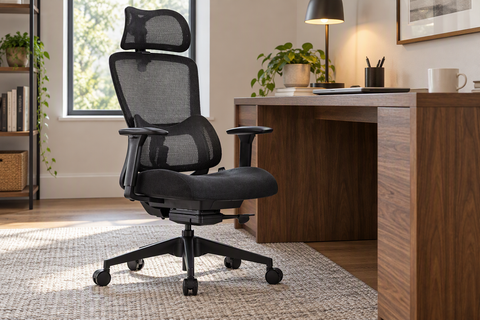
The Exis, Ergonomic Office Chair fits this profile perfectly. With its 4-level adjustable lumbar support and spring-foam seat cushion, it addresses the "hammocking" risk by providing a more resilient base than pure mesh seats. This hybrid approach—mesh for breathability on the back and a high-density cushion for the seat—is often the "sweet spot" for long-term durability in a home office.
3. The Premium/Commercial Tier ($800+)
- Expected Lifespan: 10 – 15+ years.
- Construction: Continuous cable-and-clamp tensioning systems, cast aluminum frames, and proprietary elastomeric meshes.
- The ROI: While the upfront cost is higher, these chairs are built to withstand 24/7 multi-shift environments.

Identifying Component Failure: The Warning Signs
To maximize your investment, you must be able to distinguish between a minor annoyance and a health-threatening failure. Based on patterns from facility managers and ergonomic auditors, here is how to spot the "silent" killers of office chairs.
The Gas Cylinder "Creep"
The gas cylinder is the heart of the chair's height adjustment. A common failure mode is not a catastrophic drop, but a gradual "creep" where the chair sinks 1 to 2 inches over the course of an hour.
- The Rule of Thumb: If a chair drops more than 2 inches under static weight within 60 minutes, the internal seals are failing. This forces the user into a "low-seated" position, which Safe Work Australia warns can lead to hip strain and poor wrist angles at the desk.
The Sub-Frame Stress Test
Check the underside of your chair. Budget models often use a simple plastic pan that bears the weight of the user and the torque of the backrest. Over time, the bolt holes can widen (ovaling), leading to a "wobbly" feel. This instability causes the user to subconsciously engage their core and back muscles to stay balanced, leading to premature fatigue.
Mesh "Fuzzing" and Brittleness
Inspect the mesh for microscopic "fibrils" (tiny hairs) sticking out. This is a sign that the weave is breaking down. According to research on yarn strength and tenacity, once these fibers begin to snap, the remaining weave must carry more load, accelerating the failure.
| Component | Budget Tier (1-2 yrs) | Mid-Tier (5-8 yrs) | Premium Tier (10+ yrs) |
|---|---|---|---|
| Mesh Type | Polypropylene / Simple Weave | High-Tenacity Polyester | Proprietary Elastomer |
| Base Material | Nylon / Plastic | Reinforced Nylon / Steel | Die-cast Aluminum |
| Cylinder Class | Class 2 or 3 | Class 4 | Heavy-Duty Custom |
| Mechanism | Simple Tilt | Multi-function Synchro-tilt | Weight-Sensitive / Advanced |
Modeling Note (Longevity Estimator): This table is based on a deterministic model assuming a 200lb user, 40 hours of use per week, and adherence to standard cleaning protocols. Lifespan may decrease by ~30% in high-humidity environments or if weight limits are consistently approached.
The Cost of "Cheap": A Financial Analysis
Conventional wisdom suggests that a $1,000 chair is an extravagance. However, when we apply the "Cost-per-Year" heuristic, the math shifts in favor of quality.
- The Budget Cycle: A $150 chair that lasts 2 years costs $75/year.
- The Mid-Tier Investment: A $450 chair (like the Exis, Ergonomic Office Chair) that lasts 7 years costs ~$64/year.
- The Premium Investment: A $1,200 chair that lasts 15 years costs $80/year.
While the budget chair appears cheaper, it often results in the highest long-term cost when you factor in the "health tax"—the potential medical expenses or lost productivity caused by poor support. As noted in The 2026 Workstation White Paper: Converging Ergonomic Science and Sustainable Engineering, sustainable engineering isn't just about the environment; it's about building products that don't need to be replaced every 24 months.
Practical Recommendations for Maximizing Lifespan
Regardless of the tier you choose, how you use and maintain your chair will dictate its ultimate survival.
1. Optimize Your Setup
A chair lasts longer when it is used within its intended mechanical ranges. Follow the BIFMA G1-2013 Ergonomics Guideline to ensure your chair is adjusted to your specific dimensions.
- Seat Height: Your feet should be flat on the floor with knees at a 90-degree angle.
- Lumbar Position: The curve of the chair should match the "small" of your back.
2. The 20-8-2 Rhythm
To prevent "static load" fatigue on both your body and the chair's mesh, adopt the Cornell University 20-8-2 rule: sit for 20 minutes, stand for 8 minutes, and move for 2 minutes. This reduces the time the mesh is under constant tension, allowing the fibers a "recovery" period.
3. Maintenance and Cleaning
- Vacuum Regularly: Dust and skin cells act as abrasives between the mesh fibers. Use a soft brush attachment once a month.
- Avoid Harsh Chemicals: Only use mild soap and water. Alcohol-based cleaners can strip the coatings that protect the fibers from UV degradation.
- Check Hardware: Every 6 months, tighten the bolts on the armrests and base. Vibrations from movement can slowly loosen these connections, leading to frame stress.

Balancing Aesthetics and Durability
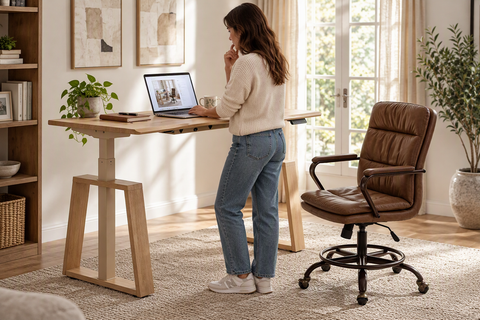
For some users, the "office" look of a mesh chair doesn't fit a home aesthetic. In these cases, choosing a chair with high-quality upholstery can offer similar longevity if the internal foam is of sufficient density. The Regal, PU Leather Home Office Chair and the Becky, Ultra Soft Cushion Home Office Chair offer a mid-century modern aesthetic without sacrificing the structural integrity required for a professional workspace.
However, be aware that Mesh vs. Leather involves a trade-off: leather and fabric require more active maintenance (conditioning) to prevent cracking, whereas high-quality mesh is largely "set and forget" until the fibers eventually reach their fatigue limit.
Investing in Your Future Self
Choosing an office chair is one of the few furniture decisions that directly impacts your physical health. A chair that sags or "creeps" isn't just a piece of broken furniture; it is a catalyst for chronic pain.
By understanding the benchmarks of quality—from the tensioning system of the mesh to the class of the gas cylinder—you can move away from the "disposable furniture" cycle. Whether you opt for the budget-friendly Onyx, Ergonomic Office Chair or the robustly adjustable Exis, Ergonomic Office Chair, the goal remains the same: a chair that supports your body as reliably on day 1,000 as it did on day one.
Disclaimer: This article is for informational purposes only and does not constitute professional medical advice. Individuals with pre-existing musculoskeletal conditions or chronic back pain should consult a qualified healthcare professional or ergonomist before making significant changes to their workstation setup.




Leave a comment