

Why “Minimum Desk Size” Matters More Than You Think
If your home office is squeezed into a bedroom corner or a studio apartment, it is tempting to buy the smallest desk that fits the wall. The problem is simple: once the monitor, keyboard, mouse, and a notebook are on the surface, there is often no room left to work in a neutral posture. That is when neck tension, wrist strain, and clutter start to build up.
This guide defines a clear, evidence-informed minimum desk size for remote work and shows how to stay productive even when your room is small.
According to the OSHA eTools on computer workstations, an office desk must provide enough space to keep the keyboard and mouse close to the body, allow neutral joint angles, and support forearms. Combining these principles with international ergonomic standards and field experience from hundreds of small-room installations gives practical, reliable size benchmarks.

The Ergonomic Logic Behind Minimum Desk Dimensions
Before choosing a number, it helps to understand why depth and width matter.
Depth: Preventing Forward Head Posture
In practice, desk depth is the limiting factor. If the desk is too shallow, the monitor sits too close to the edge, forcing the user to lean forward.
Field measurements across many home offices consistently show:
- Absolute minimum depth for laptop-only work: about 24" (60 cm). This allows the laptop to sit a little back from the edge so the wrists can rest on the surface.
- Comfortable depth for external monitor + keyboard: about 30" (76 cm). This makes it realistic to place the monitor at 20–30" (50–75 cm) from the eyes, a range also promoted by the OSHA guidance on monitors for reducing eye and neck strain.
A common mistake is choosing a desk with less than 55 cm depth. In those setups, the monitor ends up almost at the front edge. Users then slide their chair forward or crane the neck to see the screen, increasing the static load on the cervical spine and shoulders.
Width: Matching Your Equipment, Not Just the Wall
Width is more flexible, but it still follows simple, experience-based rules:
- Laptop-only setup: around 36" (90 cm) is workable.
- Single-monitor workstation: 48" (120 cm) is generally comfortable.
- Dual monitors side-by-side: at least 60" (150 cm) or an L-shaped corner layout.
These rules come from repeated field measurements of real desks and user behavior. They balance the need for device spacing with the reality of small apartments.
Standards Perspective: “Fits Most Users”
Ergonomic standards such as BIFMA G1-2013 and ISO 9241-5:2024 define recommended dimensions so furniture supports roughly the 5th to 95th percentile of the adult population. While they are not prescriptive laws for home offices, the logic is important: the desk must allow adjustable equipment placement so most adults can achieve neutral postures.
According to the BIFMA ergonomics guideline overview, the intent is to give dimension ranges that accommodate users of different body sizes rather than a single fixed value. For a small home office, that means avoiding furniture that is so narrow or shallow that it forces everyone into compromised positions.
Defining the Minimum Desk Size for a Home Office
Putting standards, health guidance, and field experience together, a clear picture emerges.
“Minimum Viable” Sizes by Setup Type
The table below summarizes practical minimum desk dimensions for different remote work setups, assuming you want to maintain a neutral posture and reasonable productivity.
| Setup Type | Recommended Minimum Width | Recommended Minimum Depth | Why This Size Works |
|---|---|---|---|
| Laptop only | 36" / 90 cm | 24" / 60 cm | Space for laptop centered, forearm support, small notebook on side. |
| Laptop + external monitor | 40–48" / 100–120 cm | 28–30" / 71–76 cm | Allows monitor at 20–30" viewing distance and separate keyboard. |
| Single external monitor + keyboard | 48" / 120 cm | 30" / 76 cm | Proper spacing for monitor, keyboard, mouse, and elbow support. |
| Dual monitors (side-by-side) | 60" / 150 cm | 30" / 76 cm | Monitors slightly angled, keyboard centered, mouse area preserved. |
| Ultra-wide monitor | 55–60" / 140–150 cm | 30" / 76 cm | Screen centered with room for speakers, notepad, and mouse. |

These values are practical targets, not regulatory limits. They are designed for typical adults without specific medical needs. Users with visual impairments, very large monitors, or special equipment (graphic tablets, audio mixers) often require extra depth or width.
Sit-Stand Desks: Add Extra Depth
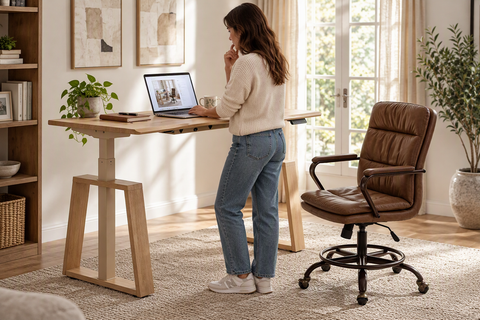
For sit-stand desks, installers consistently recommend adding 4–6" (10–15 cm) more depth than you would use for a fixed-height desk. When the desk rises, the monitor effectively “moves closer” because your eyes are now higher and often slightly closer to the screen.
Providing this extra depth allows the monitor to stay farther back so posture remains neutral in both sitting and standing positions. The Canadian Centre for Occupational Health and Safety notes that good sit-stand setups must allow easy adjustment of screen and keyboard height so that users can maintain straight wrists and relaxed shoulders in both modes.
Pro Tip: Do Not Forget Chair Clearance
Many people measure only the wall and the desk top. In practice, chair movement is the hidden constraint.
A simple, reliable rule from real installations is to allow at least 31" (80 cm) of free space behind the chair for comfortable movement and safe circulation. If this clearance does not exist, people tend to twist or half-stand to get out, which increases awkward postures.
How to Choose the Right Desk Size for a Small Room
Once you understand the minimums, the next step is to match them to your room.
Step 1: Map Your Room in Scale
A quick 1:20 scale sketch is often more accurate than mental guessing:
- Measure the room length and width.
- On paper, let 1 cm represent 20 cm of real space.
- Draw the room outline, including doors, radiators, and windows.
- Draw the desk footprint at your target size (for example, 120×76 cm) and add an 80 cm rectangle behind it to represent chair movement.
Most people are surprised at how a desk that “looked too big” on paper actually fits when chair space is planned from the start.
Step 2: Choose the Smallest Desk That Meets Your Setup
Match your actual equipment to the earlier table rather than chasing the narrowest top.
- If you use a 15" laptop and nothing else, a 36"×24" (90×60 cm) desk can be adequate.
- If you rely on a 24"–27" external monitor and keyboard, jumping up to at least 48"×30" (120×76 cm) usually transforms comfort.
For small rooms, a common sweet spot is around 55"×23" (140×60 cm), especially when paired with space-saving accessories like monitor stands and under-desk keyboard trays.
Step 3: Decide Between Rectangular and L-Shaped Layouts
In very compact rooms, L-shaped and corner layouts often unlock usable depth without blocking circulation.
- A reversible small L-shape with one flank about 60"×23" (150×60 cm) can host the main work zone.
- The shorter flank can hold a slim rolling file or a mobile CPU cart so storage does not eat into the primary desktop width.
This approach keeps the functional work area close to ergonomic minimums while using a wall corner that might otherwise be wasted.
Case Study: Converting a 2 m Wall into a Functional Office
Consider a 2 m wall in a 3×3 m bedroom:
- Equipment: 24" monitor, laptop dock, keyboard, mouse.
- Preferred desk: as small as possible.
Using the guidelines above:
- Depth: 30" (76 cm) for the monitor distance.
- Width: 48" (120 cm) to center the monitor and leave side space.
- Chair clearance: 80 cm behind.
The total footprint is about 120 cm (desk width) + 80 cm (chair zone) out from the wall. In a 300 cm deep room, the remaining 100 cm allows a bed or wardrobe opposite the desk with clear circulation.
Minimum Desk Size vs. Health: How Much Is “Enough”?
Sitting, Standing, and Sedentary Time
Choosing an ergonomic desk size does not replace regular movement. The World Health Organization recommends that adults accumulate 150–300 minutes of moderate-intensity physical activity per week and reduce sedentary time, especially long uninterrupted sitting or standing. The WHO guidelines emphasize breaking up static postures, rather than simply standing still for long hours.
This is where sit-stand desks and properly sized surfaces work together: a deep enough top keeps your posture neutral, and changing position regularly reduces static load on muscles and joints.
Evidence for Sit-Stand Desks
A systematic review from the Cochrane Library found that sit-stand workstations can reduce sitting time by roughly 84–116 minutes per day in office workers. The authors also note that evidence for long-term health outcomes is limited and that behavior (for example, break reminders) still matters.
From a home-office perspective, this means a sit-stand desk is a strong tool to cut daily sitting, but desk size and layout still need to support neutral posture and regular transitions.
Avoiding Prolonged Static Postures
The ISO 11226 standard on static working postures provides methods to evaluate postures by joint angles and duration, reinforcing a key principle: even “good” postures become stressful when held too long.
A practical application at home is to:
- Use a 20–30 minutes standing per hour rhythm as a starting point.
- Change position when you feel early signs of fatigue, not when pain starts.
- Adjust desk height so elbows are bent roughly 90–110° and wrists remain straight in both sitting and standing, consistent with the OSHA neutral posture guidance.
A desk that barely fits the equipment often forces cramped positions, making it much harder to follow these guidelines.
Small-Room Tactics: Making a Compact Desk Work Harder
When the room truly limits desk size, layout and accessories become critical.
1. Elevate Screens to Free Depth
Placing monitors directly on the desk surface eats into valuable depth. A compact monitor stand or riser allows you to move the screen farther back while using the space underneath.
A carbon-fiber-style dual monitor stand, for example, lets two displays sit higher and deeper while freeing the space beneath for keyboard storage or notebooks. This is especially helpful on a 55"×23" (140×60 cm) desk, where every centimeter matters.

2. Use Under-Desk and Mobile Storage
Drawers built into desks can reduce under-desk legroom or conflict with chair arms in small spaces. Installer experience shows that slim rolling storage or a mobile CPU cart placed under a side section of the desk keeps the main leg area clear and protects cables when using a sit-stand frame.
A mobile CPU stand also prevents cable tugging when raising or lowering a standing desk and reduces the risk of knocking over a tower placed directly on the floor.

3. Think in “Zones,” Not Just Centimeters
On a small top, the difference between chaos and clarity is zoning:
- Primary zone (within forearm reach): keyboard, mouse, and main input devices.
- Secondary zone (arm’s length): monitor bases, phone dock, frequently used notebook.
- Tertiary zone (beyond arm’s length or vertical): document stand, printer, decorative items.
The OSHA guidance on document holders explains that keeping reference material close to the monitor reduces neck rotation and fatigue. In small setups, a vertical document stand or wall-mounted shelf effectively extends the desk without increasing its footprint.
Myth vs. Reality: “A Small Desk Is Fine If You Have Good Posture”
A frequent misconception is that posture alone can compensate for a cramped desk. In reality, desk dimensions and posture are interdependent.
The OSHA overview on ergonomics and musculoskeletal disorders identifies awkward postures and static loading as core risk factors. If the desk is too shallow or narrow to position the monitor, keyboard, and mouse correctly, maintaining a neutral posture becomes virtually impossible, no matter how mindful you are.
A more accurate statement is:
- Good posture needs enough space. Minimum desk sizes create the physical conditions for neutral joint angles.
- Good habits keep that posture dynamic. Movement, sit-stand variation, and micro-breaks protect tissues from cumulative strain.
Quick Checklist: Is Your Desk Big Enough for Remote Work?
Use this checklist to assess whether your current or planned desk meets minimum home-office needs.
-
Depth
- [ ] At least 24" (60 cm) for laptop-only work.
- [ ] At least 30" (76 cm) if using an external monitor and keyboard.
- [ ] For sit-stand desks, total depth allows the monitor to stay 20–30" (50–75 cm) from your eyes in both positions.
-
Width
- [ ] At least 36" (90 cm) for a single laptop.
- [ ] Around 48" (120 cm) for a single monitor and keyboard.
- [ ] 60" (150 cm) or more for dual monitors side-by-side or an ultra-wide screen with extra devices.
-
Chair & Room Fit
- [ ] There is 80 cm of clear space behind your chair for easy movement.
- [ ] Doors and drawers can open without hitting the chair or desk.
-
Equipment Layout
- [ ] Keyboard and mouse fit on the primary zone with wrists straight.
- [ ] Monitor sits directly in front of you, top line of text around eye level or slightly below, consistent with CCOHS sit/stand guidance.
- [ ] No key device is perched on the very edge of the desk.
-
Future-Proofing
- [ ] Space for a possible second monitor or document stand.
- [ ] Cable routing that will not be strained when devices move.
If you cannot check most of these boxes, your desk is likely below the functional minimum for long-term remote work.
Wrapping Up: Choosing Smart, Not Just Small
For remote workers in small rooms, the question is not “What is the smallest desk that fits the wall?” but “What is the minimum desk size that supports neutral posture, movement, and real productivity?”
Field-tested guidelines point to:
- Depth: 24" (60 cm) as an absolute minimum for laptop-only work; 30" (76 cm) for an external monitor and keyboard.
- Width: 36" (90 cm) for a laptop; around 48" (120 cm) for a single monitor; 60" (150 cm) or an L-shape for dual or ultra-wide monitors.
- Extras: at least 80 cm of chair clearance and thoughtful zoning of equipment.
From there, well-chosen accessories like monitor stands and mobile CPU carts help a compact desk punch above its size, keeping the work surface clear and posture-friendly.
For readers comparing different desk formats for tight spaces, a deeper dive into sizing and style options is available in the article on stylish standing desk designs for small home offices and in the comparison of standing vs. sitting desks for small home offices.
FAQ: Minimum Desk Size for a Home Office
Q1. Is a 31.5" (80 cm) wide desk enough for remote work?
It can be enough for laptop-only use, but it is generally too narrow for a comfortable external monitor and full-size keyboard. Aim for at least 36" (90 cm) for a laptop and 48" (120 cm) if you use a monitor and separate keyboard.
Q2. Can I use a 20" deep desk if my room is very tight?
A 20" (50 cm) deep desk is usually too shallow for healthy monitor distance and forearm support. You will likely end up working with bent wrists and forward head posture. In practice, 24" (60 cm) is the minimum workable depth for laptop-only setups.
Q3. How big should a desk be for two monitors in a small room?
For two monitors, aim for 60" (150 cm) width and 30" (76 cm) depth, or use an L-shaped desk where one flank hosts the main monitor zone and the other holds secondary equipment.
Q4. Does a standing desk need to be larger than a regular desk?
The width can be similar, but most people benefit from 4–6" (10–15 cm) extra depth on a sit-stand desk to keep the monitor at a healthy distance in both sitting and standing positions and to accommodate cable movement.
Q5. Is a larger desk always better for ergonomics?
Not necessarily. A very large desk in a very small room can create circulation problems and encourage clutter. The goal is to reach the functional minimums for your equipment while preserving at least 80 cm of chair clearance and keeping the layout simple enough to maintain.
Disclaimer: This article is for informational purposes only and does not replace personalized medical or ergonomic advice. Individuals with existing musculoskeletal conditions, vision issues, or other health concerns should consult a qualified healthcare or ergonomics professional before making changes to their workstation.
Sources
- OSHA eTools: Computer Workstations – Desks
- OSHA eTools: Computer Workstations – Monitors
- OSHA eTools: Computer Workstations – Neutral Working Postures
- OSHA Ergonomics – Identify Problems
- BIFMA G1-2013 Ergonomics Guideline for Furniture
- ISO 11226:2000 – Evaluation of Static Working Postures
- CCOHS: Office Ergonomics – Sit/Stand Desk
- World Health Organization – Guidelines on Physical Activity and Sedentary Behaviour
- Cochrane Review – Workplace Interventions for Reducing Sitting at Work
- OSHA eTools: Computer Workstations – Document Holders




Leave a comment