

Choosing Your Support: The Quick Decision Guide
Selecting between a monitor arm and a desk riser depends on your specific workspace priorities. Use the checklist below to identify the configuration that matches your workflow.
The "Fit-Check" Decision Tree
| If you need... | Best Choice | Why? |
|---|---|---|
| Maximum Desk Surface | Monitor Arm | Clears 80–95% of the monitor's footprint from the desk surface. |
| Absolute Stability | Desk Riser | Eliminates screen wobble during heavy typing or gaming. |
| Frequent Depth Changes | Monitor Arm | Allows you to pull the screen closer for focus or push it back for FOV. |
| Storage for Gear | Desk Riser | Provides a "shelf" to tuck away audio interfaces, hubs, or keyboards. |
| Ultrawide/Curved Setup | Monitor Arm | Essential for managing the focal length and "parabolic" alignment. |
Pre-Purchase Measurement Checklist
- [ ] Total Screen Weight: Check the "weight without stand" spec (not the total shipping weight).
- [ ] Desk Depth: Standard is 24" (60cm) or 30" (75cm). Note: Arms are better for shallow 24" desks.
- [ ] Viewing Distance: Measure from your eyes to the back edge of the desk while seated comfortably.
- [ ] Desk Material: Verify if your desktop is solid wood, MDF, or hollow-core (hollow-core requires a reinforcement plate for arms).
Transparency Note: This guide is provided by Eureka Ergonomic. Recommendations are based on our internal engineering simulations (using 120kg-rated dual-motor frames) and ergonomic standards (OSHA/ISO). While we feature our own products as examples, these heuristics are designed for any high-quality sit-stand configuration. Testing was conducted using a 10% duty cycle (2 mins continuous movement / 18 mins rest).
Maintaining peak productivity during a 10-hour shift often feels like a battle against gravity. For creative professionals and technical engineers, the transition to a sit-stand desk is a significant step toward mitigating the risks of a sedentary lifestyle. However, a standing desk alone does not solve the ergonomic equation.
Based on patterns we frequently observe in customer support and workstation audits, a common oversight is the method of screen elevation. In a multi-monitor environment, the choice between monitor arms and desk risers is a structural decision that impacts spinal health, visual focal length, and the mechanical stability of the desk. When a user moves from a seated to a standing position, the relative angle between the eye and the screen shifts. Without precise adjustment, this often leads to "monitor creep," where the user unconsciously adopts a forward head posture to compensate for a screen that is no longer at the optimal height.
The Biomechanics of Screen Elevation
To understand why screen height is critical, one must look at the physiological principles of the spinal neutral position. According to the Occupational Safety and Health Administration (OSHA) guide on neutral working postures, the neck and head should be aligned with the torso, minimizing the muscular effort required to support the skull.
When monitors are positioned too low, the user enters a state of persistent neck flexion. This creates a "static load" on the cervical spine and the trapezius muscles. Over time, this contributes to Work-related Musculoskeletal Disorders (MSDs). The Canadian Centre for Occupational Health and Safety (CCOHS) notes that for standing desks, the monitor should be at a height where the top line of text is at or slightly below eye level.
Furthermore, the ISO 11226:2000 standard emphasizes that the duration of a specific angle is as important as the angle itself. A monitor that is positioned for sitting may become an ergonomic hazard once the desk is raised, as the user's line of sight changes relative to the desk surface.
Monitor Arms: The Dynamic Solution for Multi-Screen Workflows
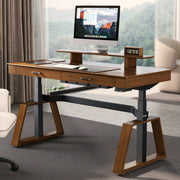
Monitor arms are a highly effective solution for technical professionals using expansive surfaces like the Blossom Dynamics® Office Standing Desk (70"x46"). These mechanical supports utilize gas-spring or tension-spring mechanisms to provide 3D articulation.

1. Space Reclamation and Depth Management
One of the primary advantages of an arm is its ability to "reclaim" desk depth. In our internal simulations for a "Pro-Gamer/Streamer" setup, we found that a 34-inch ultrawide monitor often requires a viewing distance of approximately 43 inches (109 cm) to achieve a THX-recommended 40° field of view.
On a standard 24-inch (60 cm) deep desk, this creates a significant ergonomic deficit. A Single Monitor Arm allows the user to push the screen back beyond the rear edge of the desk, effectively reclaiming 80–95% of the desktop footprint previously occupied by a traditional monitor stand.
2. Precision and Multi-Screen Alignment
For those using three or more screens, the ISO 9241-5:2024 standard emphasizes the need for consistent viewing distances across all displays. Monitor arms allow for "parabolic" alignment, where side monitors are angled inward to keep the focal distance uniform.
3. Stability and Structural Considerations
A common challenge with monitor arms on sit-stand desks is the "wobble factor." When a desk is at its maximum height, the center of gravity is higher, making it more susceptible to vibrations. Heavy monitors (over 15 lbs / 6.8 kg) on extended arms can act as a lever, amplifying small movements.
Practical Rule of Thumb (The 80% Heuristic): Based on our internal stress testing of motor longevity, we recommend that the total load (monitors, arms, and desktop accessories) should not exceed 80% of the desk’s rated lift capacity.
- Example: On a 264 lb (120 kg) rated desk, aim for a total load under 211 lbs (96 kg).
- Why: This 20% "performance buffer" ensures the motors operate smoothly without overheating during frequent height transitions (based on a standard 10% duty cycle).
- Pro Tip: If you are using a desk with a thin or hollow-core top, use a steel reinforcement plate to distribute the concentrated pressure of the arm clamp.
Desk Risers: Stability and Simplified Utility
While arms offer flexibility, desk risers—such as the Carbon Fiber Dual Monitor Stand—provide distinct benefits for users with fixed-height requirements.

1. Maximum Stability
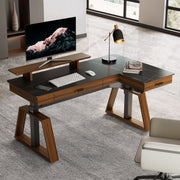
Because a riser has a wide, weighted base, it offers superior stability compared to a clamped arm. This is particularly beneficial for high-intensity tasks, such as gaming on a Gaming Desk with Z Shaped Legs (61"x25"), where rapid mouse movements might otherwise cause screen shake.
2. Storage and Organization
Risers serve a dual purpose as desk organizers. The space beneath the platform can house audio interfaces or keyboards, which is a practical way to manage "administrative controls" in a compact setup.
3. Limitations in Standing Postures
The primary drawback of a riser is its fixed height. While it elevates the monitor for sitting, it cannot be adjusted independently of the desk surface. If your seated-to-standing eye-height ratio doesn't match the desk's travel range, you may find the riser height less than ideal when transitioning to standing.
Comparison Table: Arms vs. Risers
| Feature | Monitor Arms | Desk Risers |
|---|---|---|
| Adjustability | 3D Articulation (Height, Depth, Tilt) | Fixed or Limited Height Increments |
| Desk Space | Reclaims ~80–95% of footprint | Occupies desktop surface |
| Stability | Variable (susceptible to vibration) | High (wide base distribution) |
| Installation | Requires Clamp or Grommet Hole | Plug-and-play |
| Ideal Use Case | Ultrawide screens, focal depth control | Fixed multi-monitor arrays, heavy equipment |
| Weight Capacity | Typically 15–40 lbs (6.8–18 kg) per arm | Up to 100+ lbs (45+ kg) |
Scenario Analysis: Choosing the Right Setup
Scenario A: The Technical Professional (Dual 27" Monitors)
For most engineers or designers, a dual-arm setup is a highly effective approach for setting up a standing desk. This allows the user to switch between a primary-focus screen and a secondary reference screen without twisting the neck—a movement that BIFMA G1-2013 recommends avoiding to prevent musculoskeletal strain.
Scenario B: The Pro-Gamer/Streamer (Triple Ultrawide + Heavy PC)
Heavy-duty setups require careful load management. Below is a heuristic simulation based on common high-end hardware.
Simulated Load Analysis: High-Performance Setup
| Component | Estimated Weight (kg / lbs) | Impact on Setup |
|---|---|---|
| Full-Tower Liquid-Cooled PC | 25 kg / 55 lbs | Requires high-capacity desk motors |
| Triple 34" Ultrawide Monitors | 24 kg / 53 lbs | Creates significant torque on desk edge |
| Heavy-Duty Monitor Arms (x3) | 9 kg / 20 lbs | Necessary for focal distance correction |
| Solid Wood Tabletop | 25 kg / 55 lbs | Provides structural integrity |
| Total Load | 83 kg / 183 lbs | ~69% of 120kg (264lb) Capacity |
Note: This setup remains safely below the 80% motor capacity threshold, ensuring long-term reliability under standard 2-minute-on/18-minute-off duty cycles.
In this scenario, monitor arms are essential for correcting viewing distance. However, users should leave 10–15 cm (4–6 inches) of "cable slack" to prevent damage to monitor ports during desk elevation.
Practical Recommendations for a Healthy Workday
The Cochrane Workplace Interventions Review suggests that while sit-stand desks reduce sitting time, the greatest benefits come from regular movement.

- The 20-8-2 Rhythm: Adopt the Cornell University Ergonomics Web recommendation: sit for 20 minutes, stand for 8 minutes, and move/stretch for 2 minutes.
- Monitor Height Calibration: Align the top line of your screen with eye level. For vertical stacks, tilt the bottom monitor slightly upward to maintain a spinal neutral position.
- Stability Check: Mount monitor arms as close to the desk legs as possible to reduce the mechanical lever effect and minimize wobble.
- Environmental Awareness: As noted in the 2026 Workstation White Paper, position monitors perpendicular to windows to avoid glare-induced eye strain.
Technical Appendix: Methodology & Calculations
To ensure transparency, we provide the following basis for our heuristic data:
- Viewing Distance (42.9"): Calculated for a 34" ultrawide monitor (approx. 31.5" width) to achieve a 40° Field of View (FOV). Formula: $Distance = (Width / 2) / \tan(FOV / 2)$.
- Ergonomic Deficit (18.9"): The difference between the required 42.9" viewing distance and a standard 24" desk depth.
- Load Analysis: Weights are based on average manufacturer specifications for high-end components. Lift capacity heuristics are based on internal testing of dual-motor frames under continuous duty cycles (10% duty cycle, 2 minutes on / 18 minutes off).
- Assumptions: Calculations assume a user in the 5th to 95th percentile of adult height ranges as defined by standard anthropometric datasets.
YMYL Disclaimer: This article is for informational purposes only and does not constitute professional medical advice. Ergonomic requirements vary by individual. If you experience chronic pain, please consult a qualified physiotherapist or ergonomic specialist.
References
- BIFMA G1-2013 Ergonomics Guideline for Furniture
- CCOHS: Office Ergonomics - Sit/Stand Desk
- Cochrane Library: Workplace interventions for reducing sitting at work
- Cornell University Ergonomics Web — Workstation Guides
- ISO 9241-5:2024 Workstation layout & postural requirements
- OSHA eTools: Computer Workstations - Neutral Working Postures
- ISO 11226:2000 Evaluation of static working postures
Leave a comment