

The Silent Constraint: Why Seat Depth Matters for Smaller Statures
It is a common scenario in the gaming community: after ninety minutes of an intense session, a player begins to shift uncomfortably. What starts as a mild restlessness soon evolves into a distinct "pins and needles" sensation in the lower limbs, followed by a heavy, lethargic feeling in the hamstrings. Often, the instinct is to blame the chair's height or the lack of a soft cushion. However, the physiological culprit is frequently more subtle: the seat depth gap.
For gamers with shorter statures—specifically those under 5'6" (approximately 168 cm)—standard ergonomic furniture often presents a significant mechanical mismatch. While the industry frequently focuses on weight capacity and backrest height, the horizontal dimension of the seat pan remains an overlooked factor that directly impacts blood circulation and musculoskeletal health. When a seat pan is too deep, it creates a "thigh gap" where the edge of the chair extends too far forward, pressing against the sensitive tissues behind the knee. This is not merely a matter of comfort; it is a mechanical obstruction to the body's primary circulatory pathways.
The Physiology of the Popliteal Fold and Static Load
To understand why seat depth is critical, one must examine the anatomy of the lower leg. The area directly behind the knee is known as the popliteal fold. This region houses the popliteal artery and vein, as well as the tibial and common peroneal nerves. These structures are relatively superficial, meaning they are susceptible to external pressure.
According to the Occupational Safety and Health Administration (OSHA) eTools on Neutral Working Postures, maintaining a neutral position is essential for preventing Musculoskeletal Disorders (MSDs). For the lower body, a neutral position requires the knees to be at approximately the same height as the hips, with the feet resting flat on the floor or a stable footrest.
When a gamer of shorter stature sits in a chair designed for the 50th or 95th percentile male, the seat pan is typically 20 to 24 inches deep. For a user in the 5th percentile of height (approximately 150 cm or 4'11"), the distance from the back of the buttock to the back of the knee—the popliteal length—is significantly shorter. If the seat pan exceeds this length, the user cannot sit all the way back to engage the lumbar support without the front edge of the chair digging into the popliteal fold.
The Circulatory Compromise
This physical interference triggers a cascade of physiological issues:
- Femoral Artery Compression: The pressure on the underside of the thighs restricts blood flow through the femoral and popliteal arteries. This reduces oxygen delivery to the lower leg muscles, leading to rapid fatigue.
- Venous Stasis: Pressure on the veins inhibits the return of blood to the heart. This can cause fluid accumulation (edema) in the ankles and increases the risk of deep vein thrombosis (DVT) during prolonged static sitting.
- Nerve Impingement: Compression of the nerves in the popliteal region causes the characteristic "tingling" or numbness that gamers often experience.
The ISO 11226:2000 standard for the evaluation of static working postures emphasizes that prolonged static loads are a primary risk factor for tissue degradation. For the shorter gamer, the deep seat pan creates a constant, high-pressure static load on the hamstrings and popliteal area, making it impossible to maintain a healthy posture for extended periods.
Quantifying the Ergonomic Gap: A Data-Driven Analysis
To demonstrate the severity of this mismatch, we can look at a theoretical calculation based on standard anthropometric data for a 5th percentile female gamer.
| Feature | 5th Percentile Female (150cm / 4'11") | Standard Gaming Chair / Desk | Ergonomic Gap |
|---|---|---|---|
| Recommended Seat Height | 40.0 cm (15.7 in) | 45.7 cm (18.0 in) | +2.3 inches |
| Popliteal Length (Seat Depth) | ~35.6 cm (14.0 in) | 50.8 - 61.0 cm (20-24 in) | +6.0 inches |
| Recommended Desk Height | 62.5 cm (24.6 in) | 73.6 cm (29.0 in) | +4.4 inches |
Values estimated based on standard industry anthropometric tables and ergonomic calculators.
As the data suggests, a standard setup is physically incompatible with a smaller frame. The 4.4-inch gap in desk height forces the user to raise their chair. However, raising the chair exacerbates the seat depth problem. If the feet cannot touch the floor because the chair is too high, the entire weight of the lower legs hangs from the front edge of the seat pan, intensifying the pressure on the popliteal fold. This "double-bind" is why many shorter gamers suffer from chronic lower back pain and leg fatigue.
The Misconception of "More Cushioning"
A frequent mistake made by users attempting to solve this issue is the addition of thick memory foam seat cushions or pillows. While these may provide initial softness, they often worsen the underlying mechanical problem.
Highly compressible cushions can "sink" under load, which effectively lengthens the seat depth as the user’s pelvis tilts backward. This phenomenon, noted in research published in Applied Ergonomics, suggests that heavier users or those using soft foam may need a nominal seat depth 1–2 inches shorter than static tables suggest to account for cushion compression. For the shorter gamer, a soft cushion often leads to an anterior pelvic tilt, which flattens the natural curve of the lumbar spine and increases the load on the intervertebral discs.
Engineering Solutions: Adjustable Seat Depth and Hybrid Design
The solution to the seat depth gap lies in furniture that adheres to the BIFMA G1-2013 Ergonomics Guideline. This guideline recommends that furniture should accommodate the 5th to 95th percentile of the population, which necessitates a high degree of adjustability.
1. Adjustable Seat Pan Depth
The most effective engineering control is a seat pan that can slide forward or backward. For gamers under 5'6", a chair that offers 2 to 4 inches of depth adjustment is non-negotiable. This allows the user to shorten the seat pan so that they can sit firmly against the backrest while maintaining the "Two-Finger Rule."
The Two-Finger Rule: After sitting all the way back in the chair, there should be a gap of approximately 1.5 inches (roughly the width of two fingers) between the front edge of the seat and the back of the knees. This ensures that the popliteal fold is entirely free from pressure, allowing for unrestricted blood circulation.
2. Dual-Backrest and Lumbar Support
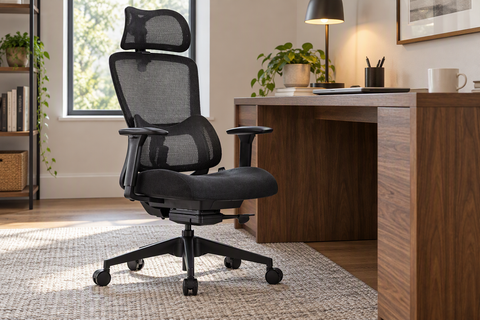
Because shorter users often have to sit further forward on deep chairs, they lose contact with the lumbar support. Advanced ergonomic designs, such as those discussed in The 2026 Workstation White Paper: Converging Ergonomic Science and Sustainable Engineering, utilize independent backrest segments. These segments can adapt to the user's movements, ensuring that even if the seat depth is slightly longer than ideal, the lumbar region remains supported.
3. The Angled Footrest
When a desk is too high (as shown in our 4.4-inch gap calculation), a footrest becomes an essential ergonomic tool. However, a flat footrest is often insufficient. An angled footrest (10–15 degrees) helps stabilize the pelvis and promotes better femoral artery circulation by slightly elevating the knees above the hips. This position reduces the static load on the lower back and encourages a more neutral spinal alignment.

Practical Guidelines for an Ergonomic Gaming Setup
Achieving the perfect setup requires a systematic approach. According to the Canadian Centre for Occupational Health and Safety (CCOHS), the goal is to create a workstation that fits the user, rather than forcing the user to fit the workstation.
Step 1: Set the Seat Height
Adjust your chair height so that your feet are flat on the floor (or footrest) and your thighs are parallel to the ground. Your knees should be at a 90-degree angle.
Step 2: Adjust Seat Depth
Slide the seat pan back until you satisfy the "Two-Finger Rule." If your chair does not have a sliding seat pan, you may need to use a firm, external lumbar roll to effectively "push" your body forward, though this is a secondary solution to a properly sized chair.
Step 3: Align the Monitor
Following the HSE guidelines for Display Screen Equipment (DSE), the top of your monitor should be at or slightly below eye level. This prevents neck strain and encourages you to keep your back against the chair's support system.

Step 4: Implement the 20-8-2 Rhythm
The Cornell University Ergonomics Web recommends the "20-8-2" rule for optimal health:
- 20 minutes of sitting in a neutral posture.
- 8 minutes of standing (using a height-adjustable desk).
- 2 minutes of moving or stretching.
For shorter gamers, this movement is even more critical. Because their circulatory system is more easily compromised by standard furniture dimensions, frequent "micro-breaks" help reset blood flow and reduce the accumulation of static load.
Scenario Analysis: The Petite Gamer vs. The Standard Setup
Scenario A: The Standard Setup (Non-Adjustable) A gamer who is 5'2" uses a standard racing-style gaming chair with a fixed 22-inch seat depth. To reach the desk, they must raise the chair, leaving their feet dangling. To avoid leg pain, they sit on the edge of the seat, losing all lumbar support. Result: Lower back strain within 30 minutes and leg numbness within an hour.
Scenario B: The Ergonomic Setup (Adjustable) The same gamer uses a chair with a sliding seat pan adjusted to 15 inches. They use an angled footrest to compensate for a standard desk height. They can sit fully back, engaging the dual-backrest system. Result: Consistent blood flow, maintained spinal curvature, and the ability to play for several hours without physiological distress.

Conclusion
The "thigh gap" and seat depth mismatch are not just minor inconveniences; they are significant physiological hurdles for gamers of shorter stature. By understanding the mechanical requirements of the popliteal fold and the importance of neutral posture, gamers can take proactive steps to protect their long-term musculoskeletal health.
Investing in furniture that meets ISO 9241-5:2024 standards for workstation layout and postural requirements is the most effective way to ensure performance and well-being. Remember that ergonomics is not a "one size fits all" field. True comfort is found in the ability to adjust a environment to the unique dimensions of the human body.
YMYL Disclaimer: This article is for informational purposes only and does not constitute professional medical advice. Individuals with pre-existing musculoskeletal conditions, chronic back pain, or circulatory issues should consult a qualified physiotherapist or medical professional before making significant changes to their workstation or exercise routine.
References
- BIFMA G1-2013 Ergonomics Guideline for Furniture
- CCOHS: Office Ergonomics - Sit/Stand Desk
- Cornell University Ergonomics Web — Workstation Guides
- HSE: Working safely with display screen equipment (DSE)
- ISO 9241-5:2024 Workstation layout & postural requirements
- OSHA eTools: Computer Workstations - Neutral Working Postures
- The 2026 Workstation White Paper: Converging Ergonomic Science and Sustainable Engineering




Leave a comment