

The Invisible Barrier to Productivity: Why Your Workspace Needs a "Deep Detox"
Quick Summary: Deep-cleaning cable trays is a critical but overlooked part of workspace maintenance. To protect air quality and hardware, use the "blow-and-catch" method (compressed air paired with a vacuum) and wipe cables with a damp microfiber cloth to neutralize static. For most home offices, a quarterly deep clean is recommended to prevent dust-related "brain fog" and equipment overheating.
As the seasonal transition toward spring prompts a global ritual of renewal, the home office often receives only a superficial glance. While we may wipe down monitor screens and organize desktop peripherals, a critical "nerve center" remains neglected: the cable management tray.
For remote professionals, this hidden compartment is more than an organizational tool; it can become a significant reservoir for fine particulate matter. When ignored, these "hidden" areas allow for the buildup of allergens that may trigger micro-inflammatory responses, potentially contributing to the afternoon fatigue often misattributed solely to poor posture.
Maintaining a clean workstation is a fundamental component of Musculoskeletal Health. While ergonomics focuses on the Neutral Position and Lumbar Support to prevent Repetitive Strain Injury (RSI), the air quality surrounding the user dictates the physiological ease with which they breathe and focus. A "Spring Desk Detox" is therefore a technical necessity for the modern professional.
The Physics of the "Dust Magnet": Electrostatic Charge and Air Quality
To understand why cable trays require specialized cleaning, one must look at how dust behaves in electronic environments. Most office dust consists of a complex mixture of skin cells, fabric fibers, and environmental pollutants. In the vicinity of power cables and high-performance computing components, this dust becomes an active participant in an electrostatic field.
The Electrostatic Trap
Dust particles often carry a fine, electrostatic charge. As electricity flows through cables, electromagnetic fields are generated, which can polarize nearby dust grains.
- Static Generation: Research into static electricity suggests that when dust grains collide in the micro-currents of a home office, they can generate static electricity.
- Insulation Effects: While home offices lack the high-voltage grids of industrial collectors, the plastic insulation of cables and polymer coatings of trays act as insulators.
- The Result: These surfaces hold onto charges, effectively turning your cable management system into a "dust magnet."
PM2.5 and Respiratory Stress
The size of these particles is a significant factor in indoor health. Fine particulate matter, known as PM2.5 (particles smaller than 2.5 micrometers), can bypass the body's natural filters.
The U.S. Environmental Protection Agency (EPA) suggests that for healthy indoor air quality, PM2.5 levels should be kept below an annual average of 12 µg/m³. When dust settles on cable trays, it doesn't always stay static. Adjusting a sit-stand desk or moving a peripheral can loft these fine particles back into your breathing zone. For many workers, this may lead to "sick building syndrome" symptoms like itchy eyes or sneezing, which adds a secondary stressor to the body.

Bridging Ergonomics and Hygiene: The Engineering Solution
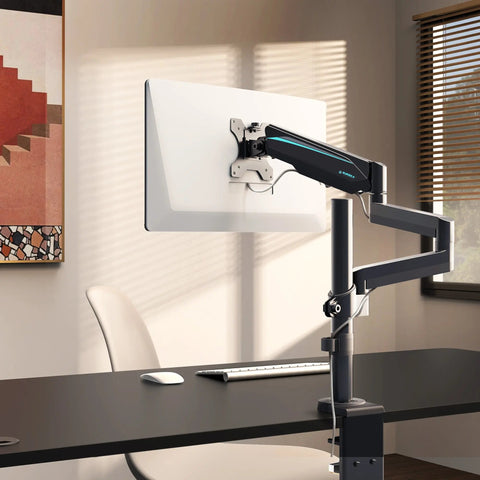
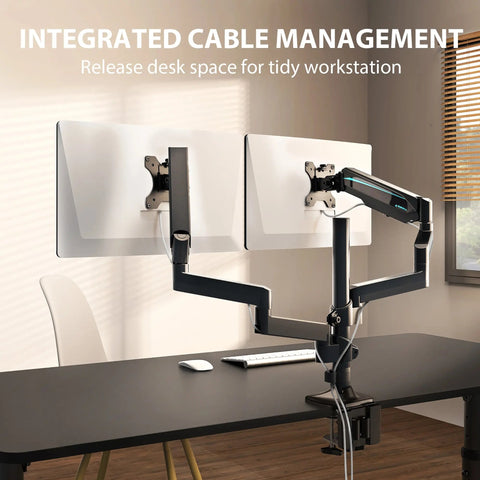
Modern ergonomic furniture is designed to solve the conflict between high-performance technology and human health. Features like integrated cable management systems and adjustable monitor arms are engineering controls designed to mitigate physical risks.
According to the Occupational Safety and Health Administration (OSHA), engineering controls are among the most effective ways to address ergonomic hazards. A well-designed cable tray ensures that cables do not snag when a user transitions between sitting and standing. However, the very design that protects our Blood Circulation and prevents trip hazards can also create a shelf for "overhead dust."
The "Visible Layer" Heuristic
In industrial safety, there are guidelines regarding dust accumulation on overhead surfaces. For the home office, we can adapt this into a practical rule of thumb: if you can see a visible layer of gray on your cable bundles, your air quality is likely being impacted. Regular maintenance prevents this accumulation from reaching a level where it can interfere with hardware cooling or respiratory comfort.
Modeling the "Allergy-Prone" Workstation
To illustrate how environment and hardware choices dictate cleaning requirements, we modeled a common high-performance scenario.
Scenario Note: The values below are illustrative estimates based on a typical dual-monitor sit-stand setup in a carpeted room. These serve as a heuristic for understanding how dust scales with complexity, rather than absolute measurements.
Parameter Illustrative Value Rationale Desk Type Sit-Stand (Dual Motor) Requires ~8–9ft of cable slack for full height range Environment Dry Climate / Carpet Can increase electrostatic charge and dust generation Hardware Load Dual Monitor + PC High thermal convection (PC fans) often draws dust upward Cable Surface Area ~10–13 sq. ft. Estimated total surface of a 10+ cable management bundle Static Voltage Low-level induction Common in plastic trays with unshielded power strips
Observation: In our experience with similar setups, users in dry, carpeted environments may notice a significant accumulation of dust within a few weeks. The heat generated by the PC and monitors creates "convection currents" that can pull dust from the floor into the cable tray area.
The "Air-and-Microfiber" Protocol: A Step-by-Step Guide
Clearing a cable tray requires more care than standard dusting. Using the wrong tools can redistribute dust or, in rare cases, risk static discharge to electronics.
1. The Professional "Blow-and-Catch" Method
A common mistake is using a vacuum cleaner directly on a cable tray. Vacuums can generate static discharge from plastic nozzles, which can be risky for sensitive ports.
- The Technique: Hold a vacuum nozzle about 3–4 inches away from the tray to act as a "collector." Use a can of compressed air to blow dust out of the crevices and directly into the vacuum's suction path. This helps prevent the dust from becoming airborne.
2. The Microfiber Advantage
For "clinging" dust, microfiber cloths are highly effective. Microfiber is designed to trap PM2.5 particles rather than pushing them around.
- The Damp Rule: Slightly dampen the cloth with water only. Avoid chemical cleaners on cable insulation, as they may cause certain plastics to become brittle over time.
- Static Neutralization: While a dry cloth might redistribute electrostatic charge, a slightly damp cloth helps neutralize it.
3. Airflow Optimization
When reassembling your cables, avoid the "tight bundle" mistake. While zip-tying cables into a single thick trunk looks neat, it can create stagnant air pockets where dust settles and heat builds up.
- The Heuristic: Leave a small gap (roughly the width of a finger) between major cable groups. This improves airflow, which can keep your devices cooler and makes the next cleaning cycle easier.

Practical Recommendations for a Healthy Office Rhythm
Maintaining a "detoxed" desk requires a shift in habits. The World Health Organization (WHO) emphasizes the importance of interrupting long periods of static behavior. We suggest using your movement breaks to perform quick visual inspections of your tray.
Recommended Cleaning Frequency
How often you should clean depends on your specific environment. Use the following table as a general guide:
| Climate / Floor Type | Recommended Cleaning | Logic |
|---|---|---|
| Dry / Carpeted | Monthly | Higher static potential; carpet acts as a reservoir |
| Humid / Hardwood | Quarterly | Lower static; dust tends to be heavier/less airborne |
| Pet Owners | Bi-monthly | Dander and hair increase particulate volume |
| High-Traffic Office | Monthly | Frequent movement lofts more floor dust |
The "Fan-Speed" Indicator
If you notice your computer fans are working harder or sounding louder than usual, it is often a sign of dust buildup. Dust acts as an insulator; when it coats cables and the back of your PC, it can impede heat dissipation. Checking your cable tray when your hardware feels "stressed" is a practical way to help prevent long-term component wear.
The Synergy of Cleanliness and Well-being
A truly ergonomic workspace is a holistic system. It starts with the structural integrity of the furniture—ensuring it meets standards like BIFMA G1-2013 for dimensional fit—and extends to the invisible air we breathe.
By performing a "Spring Desk Detox," you are addressing the engineering controls necessary for a high-performance life. Clearing the hidden dust from your cable trays reduces the physiological burden on your body, allowing you to maintain a Neutral Position with greater focus. As you refresh your environment this season, remember that the most impactful changes are often the ones that happen out of sight.
Disclaimer: This article is for informational purposes only and does not constitute professional medical, health, or safety advice. Always consult with a qualified professional regarding specific health concerns or the safe maintenance of electrical components. If you have pre-existing respiratory conditions, consider wearing a mask when cleaning high-dust areas.




Leave a comment