

The Enduring Appeal of Wood, The Modern Mandate of Ergonomics
Can a classic wooden desk truly anchor a modern, ergonomic workspace? Many people assume they must choose between the timeless warmth of wood and the high-tech functionality of an ergonomic chair. The perception is that these two pieces are at odds—one representing tradition and static presence, the other representing dynamic movement and modern health science. This article is designed to bridge that gap. We will provide practical, experience-based guidance for pairing the rich aesthetics of a wood-style desk with a state-of-the-art ergonomic or gaming chair, ensuring the result is both visually stunning and physically supportive.
For years, I consulted on office setups where this exact conflict emerged. A client would love their heirloom oak desk but suffer from daily back and neck pain. The solution isn't to discard the desk; it's to integrate it intelligently. By focusing on a few key measurements and design principles, you can create a workspace that delivers on both form and function, satisfying both your aesthetic sense and your body’s need for healthy posture.
First Principles: Why Ergonomics Is Non-Negotiable
Before we discuss aesthetics, we must establish the foundation: ergonomics. A beautiful desk is worthless if it contributes to chronic pain. The U.S. Occupational Safety and Health Administration (OSHA) identifies several key risk factors for work-related musculoskeletal disorders (MSDs), including awkward postures and static positions. Your workspace setup is your primary line of defense against these risks.
The goal is to achieve a "neutral body position." This is a comfortable working posture where your joints are naturally aligned, reducing stress on the muscles, tendons, and skeletal system. For a seated posture, this generally means:
- Your feet are flat on the floor or a footrest.
- Your knees are at or slightly below hip level.
- Your back is fully supported by the chair’s lumbar curve, maintaining the natural ‘S’ shape of your spine.
- Your forearms are parallel to the floor, with wrists straight.
- Your head is balanced, and the top of your monitor is at or just below eye level.
This isn't just about comfort; it's about long-term health. Prolonged static postures, whether sitting or standing, increase the load on the spine and reduce blood circulation, leading to fatigue and a higher risk of injury. A modern ergonomic chair is engineered to facilitate movement and support this neutral posture, but it can only do its job if it works in harmony with your desk.

The Technical Handshake: Key Compatibility Checks
From hands-on experience setting up hundreds of workspaces, I can confirm that over 90% of fit issues between wood desks and ergonomic chairs fall into a few predictable categories. Solving them requires a tape measure and a few minutes of testing before you commit to a combination.
The #1 Pitfall: Knee and Thigh Clearance
Traditional desks, especially executive styles, often feature drawer pedestals, decorative crossbars, or thick aprons below the desktop. This is the most common point of failure. A modern ergonomic chair encourages dynamic sitting—reclining, shifting, and adjusting. If your knees or thighs are constantly hitting the underside of the desk, you are forced into a single, static position, defeating the chair's purpose.
The Fix: Always measure the distance from the floor to the lowest point under your desk (the bottom of a drawer or support). Then, sit in your chair and measure the height from the floor to the top of your thighs. You need at least 2-3 inches (5-8 cm) of clearance to allow for comfortable movement. If a desk has a central pencil drawer, it often becomes the main obstacle. In these cases, a desk with integrated side storage, like the Ark EX Executive Standing Desk, can provide the necessary open leg space while still offering storage.
The Armrest Clash
Another frequent conflict occurs between the chair’s armrests and the desktop. If the armrests are too high to slide under the desk, it forces you to sit too far away from your work, leading you to hunch forward and strain your neck and back. You lose the crucial support of the chair’s backrest.
The Fix: Adjust your chair to the proper seated height relative to your keyboard. Then, lower the armrests to their lowest setting. They should easily slide under the desktop. A good rule of thumb is that the top of the armpad should be able to go at least an inch (about 2 cm) below the desktop edge. If the armrests don’t go low enough, consider if they are removable or if a different chair model is needed.
Matching Height Ranges for Sit-Stand Desks
The benefits of alternating between sitting and standing are well-documented. A systematic review by Cochrane found that sit-stand desks can reduce sitting time by over an hour and a half per day. However, a sit-stand desk is only ergonomic if its height range matches your body and your chair.
The Fix: The critical measurement is the desk's lowest sitting height. When you are seated correctly (feet flat, arms at 90 degrees), your elbow height should be within ±1 inch of the desktop height. Most ergonomic chairs have a seat height range of roughly 16-21 inches (40-52 cm). Ensure the desk’s minimum height can accommodate this, otherwise, you might find it’s too high even at its lowest setting.
Creating Visual Harmony: A Guide to Style
Once the technical fit is confirmed, you can focus on the aesthetics. The goal is to make the combination of a classic wood desk and a modern chair look intentional and sophisticated, not accidental.
Balance Materials and Tones
The key to blending different styles is to find a common thread. Don't try to match everything perfectly. Instead, create a dialogue between the pieces.
- Warm with Warm, Cool with Cool: If you have a warm wood desk (like oak, walnut, or cherry), pair it with a chair that has warm-toned upholstery, such as a brown leather or a fabric in a complementary earth tone. For cooler-toned woods (like ash or a gray-washed finish), a chair in black, gray, or a cool blue works well.
- Contrast with Metal: Use the metal finish of the chair’s base or the desk’s legs as a unifying element. A black chair base can ground a lighter wood desk, while a polished aluminum or chrome base can add a touch of modern sleekness that contrasts beautifully with a more rustic wood grain.

Use a Single, Bold Accent
To prevent the workspace from looking cluttered or confused, unify it with a single, strong accent choice. This could be:
- A Pop of Color: A vibrant desk lamp, a colorful piece of art on the wall, or even a bold-colored gaming mousepad can tie the traditional and modern elements together.
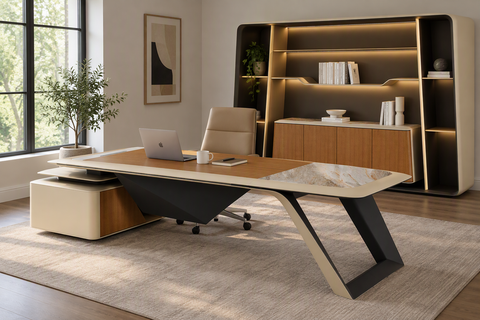
- A Contrasting Material: If your desk and chair are primarily wood and fabric, introduce a third material. A sintered stone or marble top, as seen on the Opal Executive Standing Desk, adds a layer of luxury and modernity that bridges the gap between classic and contemporary.
- Strategic Lighting: An LED light strip behind the desk or monitor can introduce a modern, high-tech feel that deliberately contrasts with the organic wood finish.
Protect and Perfect the Surface
A common mistake I see is a beautiful wood veneer desk getting scratched by keyboards, mice, and monitor stands. This not only damages the finish but also creates a visually chaotic surface.
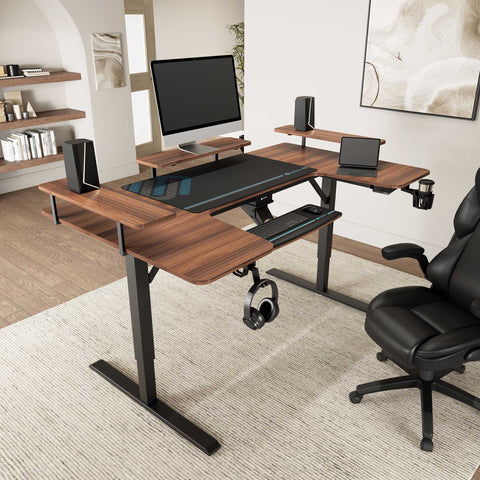
The Fix: Use a full-surface desk mat or a large mousepad. This protects the wood, provides a smooth and consistent surface for your mouse, and helps define the primary work zone. Look for mats made of leatherette or felt that complement your overall color scheme. This simple addition also helps with cable management, allowing you to route wires for clamped accessories without scratching the desktop.
Advanced Integration: A Deep Dive into Function
For a truly optimized workspace, you need to go beyond the basics. This involves thoughtful accessory mounting and establishing a healthy routine.
Monitor Mounting on Wood Desks
Proper monitor height is critical for preventing neck strain, as outlined by the Canadian Centre for Occupational Health and Safety (CCOHS), which advises placing the screen so the top is at or slightly below eye level. A monitor arm is the best tool for this.
However, wood desks present challenges. Clamps can damage delicate veneers or finishes. If you must use a clamp, confirm the desktop’s thickness and material (solid wood is better than particleboard). A safer option is a grommet mount, which uses an existing cable hole. For sit-stand desks, which experience movement, always choose a monitor arm rated for at least twice your monitor's weight to ensure stability.
The Sit-Stand Cadence: Finding Your Rhythm
Standing all day is not the goal; it can lead to lower limb fatigue just as sitting all day can. The key is regular movement. While there is no single magic ratio, a great starting point is the "20-8-2" rule recommended by researchers at Cornell University Ergonomics Web: for every 30 minutes, sit for 20, stand for 8, and move around for 2.
I advise clients to program 3-4 preset heights into their sit-stand desk's memory controller:
- Deep Work Sitting: The perfect ergonomic seated height.
- Collaborative Standing: A comfortable standing height for tasks or video calls.
- Leaning/Perching: A lower "in-between" height for use with a drafting chair or stool.
- Reading/Review: A slightly higher sitting position that encourages a more relaxed posture for reviewing documents.
This makes transitioning between postures effortless and encourages more frequent changes.
Wood Desk & Ergonomic Chair Compatibility Checklist
Use this checklist to evaluate any potential desk-and-chair combination.
| Checkpoint | Pass Criteria | Why It Matters |
|---|---|---|
| Knee/Thigh Clearance | At least 2-3 inches (5-8 cm) of space between the top of your thighs and the underside of the desk. | Prevents being locked into a static posture and allows for natural adjustments. |
| Armrest Clearance | Chair armrests can be lowered to slide at least 1 inch (2 cm) under the desktop edge. | Allows you to sit close enough to the desk to use the chair's backrest properly. |
| Sit-Stand Height Range | Desk's lowest setting allows your elbows to be at a ~90-degree angle (±1 inch) while seated. | Ensures proper typing posture is possible in the seated position. |
| Monitor Arm Mount | Desk has a grommet hole or is made of a solid material thick enough to support a clamp without damage. | Enables you to position your monitor at the correct ergonomic height. |
| Surface Protection | A desk mat or pad is used to prevent scratches and provide a consistent mouse surface. | Preserves the desk's finish and improves usability. |
Key Takeaways
You do not have to sacrifice the timeless beauty of a wood desk to build a healthy, ergonomic workspace. The key is to approach the pairing with intention, prioritizing function first and then layering on aesthetic principles.
- Ergonomics is the Foundation: A neutral posture is non-negotiable. Ensure your chosen desk and chair combination allows you to achieve it.
- Measure Twice, Buy Once: The most critical failures are technical. Verify knee clearance and armrest compatibility before anything else.
- Create Intentional Harmony: Blend styles by finding common ground in materials and tones, and use a single, bold accent to unify the look.
- Embrace Movement: Use the full capabilities of your ergonomic furniture. Alternate between sitting and standing, and use accessories like monitor arms to fine-tune your setup.
By following these guidelines, you can create a workspace that is a true reflection of your style without compromising on the ergonomic support you need to do your best work, day after day.
Disclaimer: This article is for informational purposes only and does not constitute professional medical advice. You should consult a qualified healthcare professional for advice on any health conditions or before making significant changes to your work habits, especially if you have pre-existing musculoskeletal issues.




Leave a comment