

During the peak of summer, many remote professionals notice subtle but concerning changes in their high-end workstations. A desk surface might feel unexpectedly tacky to the touch, or a drawer that glided effortlessly in the spring may suddenly stick. These are not merely seasonal inconveniences; they are the physical manifestations of atmospheric moisture interacting with furniture materials. For those who invest in premium, durable furniture, understanding the intersection of environmental physics and material science is highly beneficial for protecting that investment.
Seasonal shifts in humidity can cause structural damage if left unmanaged over long periods. This guide examines the physiological and physical principles of material stress, provides a framework for environmental control based on industry experience, and outlines actionable maintenance protocols to help support the longevity of professional-grade workstations.
The Science of Humidity: Why Materials React
The primary driver of furniture degradation in summer is hygroscopicity. According to the Britannica entry on Wood Hygroscopicity, wood is a hygroscopic material, meaning it possesses the ability to exchange water vapor with the surrounding atmosphere until it reaches an equilibrium moisture content (EMC).
When the relative humidity (RH) in a home office rises, the moisture content within the cellular structure of the wood increases. This leads to dimensional changes: the wood fibers swell. In solid wood, this movement is anisotropic, meaning it expands at different rates depending on the grain direction. For example, radial expansion is typically much less than tangential expansion. If this expansion is restricted by the desk's frame or if the moisture levels are inconsistent across the surface, the result can be warping, bowing, or surface checking.
Understanding MDF and Engineered Wood Sensitivity
A common misconception is that engineered materials like Medium-Density Fibreboard (MDF) are immune to humidity because they lack a natural grain. However, practical observations suggest the opposite. According to the Wikipedia overview of MDF properties, unsealed MDF and particleboard are highly hygroscopic due to their high surface area and the adhesive matrix used in their construction.
While solid wood expands and contracts, MDF tends to swell more irreversibly. If the relative humidity exceeds 60–65% for extended periods, moisture can penetrate small gaps in the edge banding or the underside of the desk. Once the internal fibers of MDF absorb enough moisture to reach the Fiber Saturation Point—a concept detailed in the USDA Wood Handbook—the material can lose its structural integrity, potentially leading to localized "bubbling" or swelling that is difficult to reverse by drying.

Material Sensitivity and Risk Factors
To manage a workstation effectively, one must recognize that different materials require distinct defensive strategies. The following table illustrates the typical sensitivity of common desk materials based on industry observations and material science principles.
| Material Type | Sensitivity Level | Primary Risk | Observed RH Vulnerability |
|---|---|---|---|
| Solid Wood (Oiled) | High | Warping, Anisotropic Expansion | >55% |
| Solid Wood (Lacquered) | Moderate | Finish Clouding, Surface Tacking | >60% |
| Veneered MDF | High | Edge Peeling, Core Swelling | >60% |
| Vacuum Thermoformed MDF | Low | Structural Softening (Rare) | >70% |
| Stone/Marble Inlays | Very Low | Condensation Staining | N/A |
Note: Observed RH Vulnerability represents empirical ranges where material stress often becomes noticeable; actual results may vary based on wood species and finish quality.
The "Sticky" Surface: Finish Failure and Chemical Reactions
In the summer, users often report a "sticky" or tacky feeling on their desk surface. This is rarely caused by actual spills; instead, it is often a chemical reaction between the finish and high ambient moisture.
High humidity can soften certain types of lacquers and varnishes. Furthermore, a common maintenance mistake involves the use of silicone-based polishes. On oil-finished woods, silicone can create a non-breathable barrier that traps moisture beneath the surface. This trapped moisture can lead to "blushing"—a milky white discoloration where water vapor is caught in the finish layer.
Additionally, the use of non-breathable desk pads (such as those made of heavy vinyl or rubber-backed materials) can create a localized high-humidity microclimate. These pads can trap evaporating moisture from the wood or ambient air against the surface, which may accelerate warping in solid wood and adhesive failure in veneers.
Environmental Engineering: Room Layout and Airflow
Protecting a workstation requires looking beyond the desk itself to the entire office environment. Professional maintenance begins with spatial planning and climate control.
The Airflow Buffer Strategy
Based on interior design best practices for premium furniture, air circulation is a highly effective preventative measure. For a standard 30-inch deep executive desk, a room depth of at least 108 inches (9 feet) is often recommended to allow for movement and ventilation. In a typical 12-foot deep room (144 inches), this leaves a 36-inch surplus.
This surplus is not just for movement; it serves as a critical air circulation buffer. Placing a desk directly against an exterior wall or near a window in summer can create "dead zones" where moisture accumulates. Maintaining a distance from exterior walls—ideally up to 3 feet where space permits—allows for more consistent humidity levels across the entire desk surface, helping to prevent the localized swelling that leads to warping.
Dehumidification vs. Spot Treatment
While spot-treating a desk with wax or oil is helpful, room-level dehumidification is generally considered the superior engineering control. According to the OSHA hierarchy of controls, engineering controls that remove the hazard (excess moisture) are more effective than administrative controls (frequent cleaning).
Aiming for a consistent indoor humidity level between 40% and 60% is recommended by many furniture manufacturers. Frequent fluctuations outside this range cause the most material stress. A dedicated dehumidifier is often necessary in coastal or humid regions to maintain this balance.

Proactive Summer Maintenance Protocol
To support the longevity of a high-end workstation during the humid months, users can adopt this structured maintenance checklist based on industry experience.
- Humidity Monitoring: Install a digital hygrometer near the workstation. If the reading consistently exceeds 60%, consider activating a dehumidifier.
- Controlled Cleaning: Avoid water-based cleaning sprays during high-humidity days. According to the CCOHS guide on office ergonomics, cleanliness is important for hygiene, but in high humidity, liquid water can be driven into the wood substrate faster via capillary action. Use a dry, microfiber cloth for daily dusting.
- Edge Sealing: For desks with MDF cores, inspect the edges and the underside. Applying a targeted sealant or a penetrating oil to these vulnerable areas—especially if the factory seal is compromised—creates an active moisture barrier.
- Heat Management: Ensure that laptops and monitors are properly ventilated. Excessive localized heat from electronics can cause rapid moisture loss in the wood directly beneath the device, leading to localized stress and potential cracking when the surrounding humidity fluctuates. Practical Tip: Use a ventilated laptop stand to keep heat from transferring directly to the desk surface.
- Condensation Control: Immediately wipe away condensation from cold drinks. On veneered or MDF desks, even small amounts of standing water can cause localized swelling near seams within hours in high-humidity environments.
Ergonomics and Movement: The Human Factor
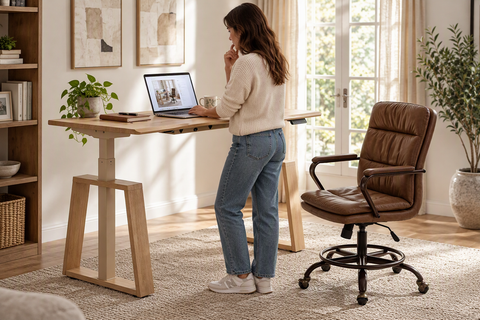
While maintaining the furniture is vital, the primary purpose of a high-quality workstation is to support the health of the user. The Cochrane systematic review on workplace interventions notes that sit-stand desks are effective tools for reducing sedentary time, but they must be used correctly.
In humid environments, users may find themselves shifting between sitting and standing more frequently to avoid "sticking" to the chair or desk surface. The Cornell University Ergonomics Web recommends the "20-8-2" rhythm: 20 minutes of sitting in a neutral posture, 8 minutes of standing, and 2 minutes of moving or stretching.
Setting the Ideal Height
Proper setup is essential to help prevent Musculoskeletal Disorders (MSDs). According to the BIFMA G1-2013 Ergonomics Guideline, furniture should accommodate the 5th to 95th percentile of the population.
- Seated Position: The desk height should allow the elbows to be at approximately a 90-degree angle while the shoulders remain relaxed. The ISO 9241-5:2024 standard emphasizes that the feet must be flat on the floor or supported by a footrest.
- Standing Position: The desk should be raised so that the forearms are parallel to the floor. A common mistake is setting the standing height too high, which can cause shoulder strain and increase pressure on the wrists.

Long-Term Value and Sustainability
Investing in a premium workstation is a commitment to long-term well-being and productivity. As detailed in The 2026 Workstation White Paper: Converging Ergonomic Science and Sustainable Engineering, the durability of a product is a key component of its environmental impact. A desk that lasts decades due to proper maintenance has a lower carbon footprint than a cheaper alternative that must be replaced every few years due to humidity-induced warping.
The energy cost of operating a workstation's ergonomic features is relatively low. Based on standard motor wattage and standby power consumption, a high-quality standing desk is estimated to consume between 10 and 15 kWh per year depending on usage—a negligible amount compared to the gaming PC or high-performance workstation it supports, which can consume over 1,000 kWh annually.
Scenario Analysis: Maintenance for Different Environments
Scenario A: The Modern Coastal Home In high-humidity coastal regions (RH 65%+), users should prioritize active dehumidification. Field reports from these regions suggest that desks placed near open windows often show signs of edge-banding failure or finish "clouding" significantly faster than those in the interior of the home. A daily inspection of the desk's underside for any signs of moisture accumulation is recommended.
Scenario B: The Climate-Controlled Executive Office In an office where central air conditioning maintains a steady 45% RH, the primary risk shifts from humidity to dryness or temperature extremes. The user should focus on avoiding direct heat from electronics and ensuring that cleaning products do not contain harsh solvents that could strip the protective finish.
Summary of Best Practices
Protecting a desk surface from summer humidity is a multi-faceted task that combines environmental control with specific material care. By aiming for a consistent 40–60% RH, ensuring proper airflow with an intentional buffer, and avoiding water-based or silicone-heavy cleaners, users can help prevent the most common causes of furniture failure.
For those seeking to deepen their understanding of office health and equipment longevity, exploring resources like the HSE guide on display screen equipment can provide additional checklists for a safe and durable home office setup.
YMYL Disclaimer: This article is for informational purposes only and does not constitute professional medical, legal, or financial advice. The ergonomic recommendations provided are based on general industry standards. Individuals with pre-existing musculoskeletal conditions or specific health concerns should consult a qualified healthcare professional or a certified ergonomist before making significant changes to their workstation setup or routine.
References
- BIFMA G1-2013 Ergonomics Guideline for Furniture
- CCOHS: Office Ergonomics - Sit/Stand Desk
- Cochrane: Workplace interventions for reducing sitting at work
- Cornell University Ergonomics Web — Workstation Guides
- HSE: Working safely with display screen equipment (DSE)
- ISO 9241-5:2024 Workstation layout & postural requirements
- USDA Wood Handbook, Chapter 04: Moisture Relations
- The 2026 Workstation White Paper: Converging Ergonomic Science and Sustainable Engineering
- Britannica: Wood Hygroscopicity
- Wikipedia: Medium-density fibreboard




Leave a comment