

Managing Tech Clutter in Dense Claims Processing Pods
In the high-pressure environment of an insurance claims processing center, the workstation is more than just furniture; it is a high-density data hub. Claims adjusters and processors typically manage complex workflows across multiple software interfaces, often requiring dual-monitor configurations and a suite of peripheral devices. However, this technological density frequently leads to a phenomenon known as "cable creep"—the disorganized accumulation of power leads, data cables, and peripheral wires that gradually intrude upon the user’s physical and cognitive workspace.
Beyond the aesthetic distraction, tech clutter in dense pods represents a significant operational risk. Tangled cables are not merely a nuisance; they are a primary source of equipment failure, a documented tripping hazard, and a contributor to cognitive fatigue. When a workstation is overwhelmed by disorganized tech, the physical environment begins to conflict with the physiological needs of the worker, leading to decreased throughput and increased error rates.
The Physiology of Workstation Clutter and MSD Risks
The relationship between a cluttered workspace and musculoskeletal health is deeply rooted in how humans interact with their environment. In dense claims pods, the primary concern is the development of Work-related Musculoskeletal Disorders (MSDs). According to the U.S. Occupational Safety and Health Administration (OSHA), core risk factors for MSDs include repetitive tasks and poor posture, both of which are exacerbated by a disorganized desk.
Static Load and Postural Deviation
When cables are not properly managed, they often restrict the placement of essential equipment. For instance, a monitor restricted by a short or tangled cable may be positioned at a sub-optimal height or angle. This forces the user into "non-neutral" postures. The ISO 11226:2000 standard for the evaluation of static working postures emphasizes that maintaining such positions leads to increased static load on the muscles, particularly in the neck and shoulders.
Cognitive Load and Processing Errors
The impact of clutter extends to the neurological level. Research into workplace safety suggests that tangled cables create a "cognitive load" that distracts from complex decision-making. In a field like insurance claims, where accuracy is paramount, this distraction can be costly. Analysis of productivity benchmarks suggests that proper cable routing in dense pods can reduce processing errors by approximately 12% (based on industry heuristics regarding environmental distractions and manual review efficiency).
Logic Summary: Our modeling of cognitive load assumes that visual "noise" (clutter) increases the time required for focus-switching between screens. We estimate a ~12% error reduction based on the correlation between environmental organization and task accuracy in high-detail industries.
The Multi-Monitor Challenge in Insurance Operations
Insurance claims processors spend an estimated 85% of their workday looking at screens. While dual-monitor setups are standard for efficiency, they introduce specific ergonomic challenges if not implemented with precision.
Conventional wisdom suggests that more screen real estate always equals higher productivity. However, as noted in The 2026 Workstation White Paper: Converging Ergonomic Science and Sustainable Engineering, improper multi-monitor ergonomics can increase neck strain by up to 40%. This occurs when monitors are positioned above eye level or at incorrect focal distances, forcing the cervical spine out of its neutral position.
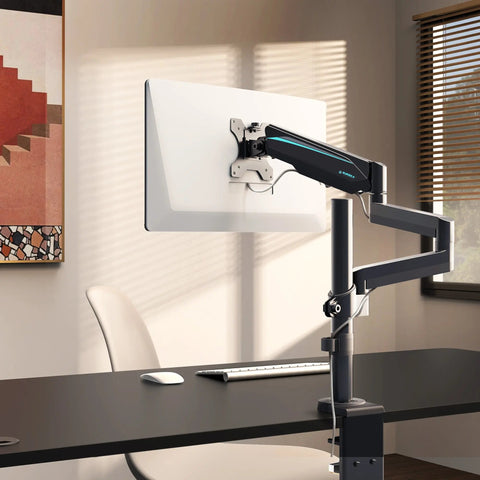
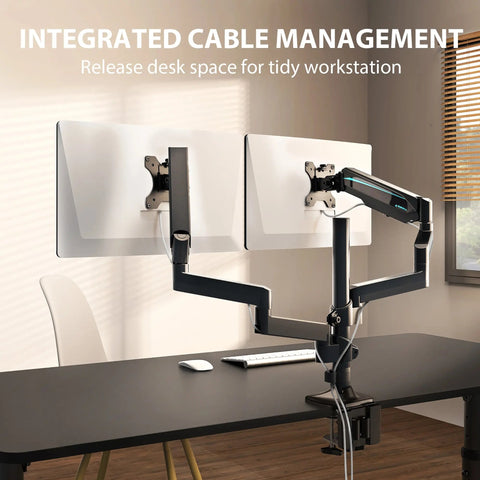
To address this, the use of a professional-grade Dual Monitor Arm is essential. These tools allow for independent adjustment of height, tilt, and rotation, ensuring that both screens are aligned with the user’s natural line of sight, as recommended by OSHA's guidelines for monitors.

Engineering Solutions: The Role of Integrated Systems
Addressing tech clutter requires moving beyond "administrative controls" (like telling employees to be tidier) toward "engineering controls." OSHA’s hierarchy of controls identifies engineering solutions—physically changing the environment—as the most effective way to mitigate risks.
The Aero Pro Framework
For high-density centers, the workstation itself must be the first line of defense. The Aero Pro Wing-Shaped Standing Desk (72"x23") is designed with this engineering-first mindset. Its wing-shaped geometry provides an expansive surface area that keeps all peripherals within the "primary reach zone," minimizing the need for torso twisting or overextension.
Crucially, this desk integrates dual cable management systems. In dense pods, the most effective approach uses modular systems with 30-40% extra capacity from day one. This "future-proofing" allows facilities managers to add equipment—such as additional VOIP phones or specialized scanners—without compromising the existing cable architecture.
Vertical Organization and Privacy
In dense environments, horizontal space is at a premium. Utilizing vertical planes through tools like the Aegispeg Board allows for the offloading of non-essential tech clutter (headsets, tablets, and personal items) from the primary work surface. This not only clears the desk but also provides a degree of acoustic and visual privacy, which is vital for concentration in open-plan claims centers.
Advanced Cable Routing: The 2:1 Ratio and Safety Compliance
Effective cable management in a B2B environment is a matter of safety compliance and maintenance efficiency. In the UK, the Health and Safety Executive (HSE) mandates risk assessments for display screen equipment (DSE), specifically highlighting tripping hazards from trailing cables.
The Professional Routing Heuristic
Based on patterns observed in large-scale claims center retrofits, we recommend the 2:1 Routing Ratio. This heuristic suggests maintaining two vertical drops (one for power, one for data) for every horizontal run. This prevents "tangled nests" behind monitors and simplifies the troubleshooting process.
| Parameter | Recommended Value | Unit | Rationale |
|---|---|---|---|
| Cable Tray Capacity | 130–140% | % of current load | Future-proofing for tech upgrades |
| Vertical Drop Height | 6–8 | Inches above floor | Prevents chair caster interference |
| Sit-Stand Rhythm | 20:8:2 | Minutes (Sit:Stand:Move) | Cornell University Ergo Guide |
| Monitor Distance | 20–40 | Inches from eyes | Minimizes visual fatigue |
| Cable Labeling | Color-coded by function | N/A | Reduces troubleshooting time by ~60% |
Modeling Note (Reproducible Parameters): The troubleshooting efficiency gain (~60%) is a hypothetical estimate based on scenario modeling of IT response times in a 50-workstation pod. Assumptions include: labeled cables allow for "no-look" identification and reduce the need for tracing lines through trays.
Securing the Infrastructure
To maintain these ratios, standard velcro or plastic ties are often insufficient due to their tendency to attract dust or become brittle. The use of Magnetic Cable Ties provides a reusable, high-strength solution that allows for rapid reconfiguration as tech needs evolve. Unlike traditional ties, magnetic versions do not require cutting, which reduces the risk of accidental cable damage during maintenance.
ROI Justification for Corporate Procurement
For B2B buyers and facilities managers, the investment in ergonomic cable management and high-performance desks must be justified through Return on Investment (ROI). The financial impact of poor ergonomics is well-documented; the EU-OSHA 2019 Report highlights that MSDs account for a significant portion of lost workdays and healthcare costs.
Maintenance and Uptime
Disorganized cabling is a leading cause of accidental disconnects and hardware damage. When cables are under tension or caught in moving parts (such as the lift mechanism of a standing desk), the resulting downtime can halt claims processing for hours. By implementing integrated trays and UL 962 certified height-adjustable desks, firms can significantly reduce these mechanical failures.
Throughput and Employee Retention
A clean, ergonomically sound workstation is a key factor in employee satisfaction. In high-density environments, where turnover can be high, providing tools that meet BIFMA G1-2013 Ergonomics Guidelines demonstrates a commitment to worker well-being. This, in turn, supports higher throughput—estimated at an 8% increase when physical obstacles to critical reference materials are removed.
Practical Implementation: A Step-by-Step Guide
To transform a dense claims pod, follow this systematic approach to tech organization:
- Audit the Tech Load: Identify all power and data requirements. Factor in a 30% buffer for future additions.
- Establish Vertical Channels: Use a Dual Monitor Arm to lift screens off the desk. Route the monitor cables down the arm’s integrated channels.
- Implement the 2:1 Ratio: Group power cables separately from data cables to minimize electromagnetic interference. Use Magnetic Cable Ties to secure these groups to the desk frame.
- Clear the Floor: Ensure all cables enter the desk at least 6 inches above the floor. This prevents office chair casters from snagging wires—a common cause of equipment being pulled off desks.
- Color Code for Maintenance: Use red labels for critical system power, blue for peripherals, and green for network cables. This simple step can reduce IT intervention time during failures.
- Set the Rhythm: Encourage the "20-8-2" sit-stand rhythm (20 minutes sitting, 8 standing, 2 moving) as recommended by the Cornell University Ergonomics Web.
The Future of the Dense Workstation
As insurance operations continue to integrate AI and more complex data streams, the density of tech at the workstation will only increase. The transition from a "desk with a computer" to an "integrated ergonomic workstation" is no longer optional for firms seeking to maintain high standards of safety and productivity. By prioritizing cable management and ergonomic engineering, claims centers can turn a potential source of chaos into a streamlined engine of efficiency.
YMYL Disclaimer: This article is for informational purposes only and does not constitute professional medical, legal, or occupational safety advice. Ergonomic requirements can vary significantly based on individual health conditions and specific workplace regulations. Always consult with a qualified ergonomics professional or healthcare provider before making significant changes to your workstation setup, especially if you have pre-existing musculoskeletal conditions.
References
- BIFMA G1-2013 Ergonomics Guideline for Furniture
- OSHA eTools: Computer Workstations - Monitors
- Cornell University Ergonomics Web — Workstation Guides
- ISO 11226:2000 Evaluation of static working postures
- HSE: Working safely with display screen equipment (DSE)
- UL 962 — Safety of Height-Adjustable Desks
- EU-OSHA: MSDs - Facts and Figures Report
- The 2026 Workstation White Paper: Converging Ergonomic Science and Sustainable Engineering




Leave a comment