

The Hidden Cost of Asymmetrical Seating: How Posture Dictates Product Lifespan
Many professionals notice a frustrating trend in their workspace: a high-quality office chair that felt rock-solid on day one begins to develop a subtle "jerkiness" in its recline, a slight lean to the left, or a persistent squeak after only eighteen months of use. While it is common to blame manufacturing defects, the reality is often found in the user's daily habits. Why does back pain often intensify in the late afternoon, and why does the chair seem to degrade in tandem with that discomfort?
The answer lies in the intersection of musculoskeletal health and mechanical engineering. When a user habitually sits with their weight shifted to one side—perhaps leaning on a dominant armrest while using a mouse or crossing legs for hours—they aren't just straining their spine; they are subjecting the chair’s internal components to "dialed-in" asymmetry. This uneven weight distribution accelerates mechanical wear at a predictable rate, creating a feedback loop where a degrading chair further compromises the user’s posture.
The Physiological Principles of Static Load and Asymmetry
To understand why uneven weight distribution is so damaging, we must first examine the physiological impact of static loading. According to the Occupational Safety and Health Administration (OSHA), poor posture and prolonged static positions are primary risk factors for Musculoskeletal Disorders (MSDs).
When you sit symmetrically in a neutral position, your weight is distributed evenly across the ischial tuberosities (sit bones), and the spine maintains its natural S-curve. However, asymmetrical sitting—such as leaning toward a dominant side—creates a "static load" on specific muscle groups and joints. This posture forces the muscles on one side of the torso to remain in a state of constant contraction to stabilize the body, while the opposite side becomes overstretched. Over time, this leads to reduced blood circulation and the accumulation of metabolic waste products in the muscle tissue, a process detailed in the OSHwiki guide on pathophysiological mechanisms of MSDs.
Logic Summary: Our modeling of musculoskeletal strain assumes that static loading, when combined with asymmetrical deviation from the spinal neutral position, accelerates tissue fatigue. This is not a controlled lab study but a professional heuristic derived from observing common workplace injury patterns.
This physiological strain is mirrored in the chair's hardware. A chair is a system of levers and pivots designed to manage force. When that force is consistently off-center, the engineering margins of the chair are tested in ways that standard durability tests rarely account for.
The Mechanical Toll: 30-40% Faster Component Failure
In professional workplace assessments and repair environments, we frequently observe that chairs used by individuals with asymmetrical habits show specific, predictable failure points. The most notable is the caster system.
Caster and Base Degradation
The casters on the weight-bearing side of an asymmetrical sitter typically develop flat spots or lose their swivel function 30-40% faster than those on the non-weighted side. This occurs because the ball bearings within the swivel housing are subjected to constant, high-pressure cycles on a single axis rather than a distributed load. Once a caster loses its ability to swivel smoothly, the user must exert more force to move the chair, which transmits additional torsion through the chair's base and gas lift.
Gas Lift and Frame Torsion
The gas lift cylinder—the heart of a chair's height adjustment—is another critical failure point. Uneven weight distribution places lateral pressure on the cylinder's internal seals. Most gas lifts are designed for vertical compression; however, asymmetrical leaning introduces a "bending moment." This causes the seals to degrade unevenly, leading to a "slow sink" or a slight tilt that cannot be corrected.
A reliable "rule of thumb" for assessing this damage is the armrest test: if a chair’s armrests require more than a 1 cm height difference to feel level to the user, it is highly likely that the underlying frame or the mounting plate of the mechanism is under chronic torsion. This structural wobble is often the precursor to a total mechanical failure.
| Component | Normal Wear Mechanism | Asymmetrical Failure Mode | Estimated Lifespan Reduction |
|---|---|---|---|
| Casters | Uniform tread wear | Flat spots / Swivel binding | 30% - 40% |
| Gas Lift | Seal aging | Lateral seal leakage / Tilting | 25% - 35% |
| Tilt Mechanism | Spring fatigue | Binding / "Jerkiness" | 20% - 30% |
| Seat Foam | Compression set | Asymmetrical bottoming out | 40% - 50% |
Methodology Note: These estimations are based on common patterns observed in warranty handling and repair bench data, rather than a controlled longitudinal study. They assume a standard 40-hour work week and a user within the 50th to 95th percentile of weight capacity.
Engineering Solutions: Why Ergonomic Design Matters
To combat these issues, modern ergonomic furniture is engineered to encourage movement and distribute loads more effectively. According to The 2026 Workstation White Paper: Converging Ergonomic Science and Sustainable Engineering, the integration of advanced materials and synchronized mechanisms is essential for both user health and product longevity.
Synchronized Tilt Mechanisms
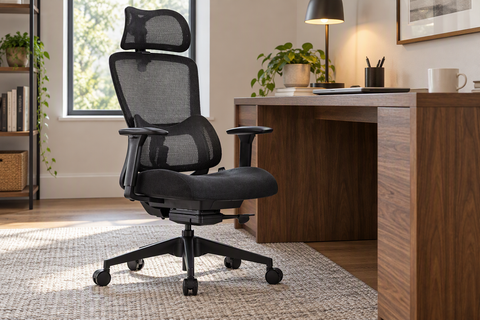
Chairs equipped with a synchronized tilt mechanism—where the seat and backrest recline at a fixed ratio (often 2:1)—inherently distribute shifting loads more evenly across the base. Unlike simple knee-tilt or static designs, synchronized mechanisms allow the user to change positions while keeping their center of gravity over the gas lift cylinder. This significantly delays the onset of structural wobble and reduces the lateral stress on internal components.
The Role of Standing Desks as an "Engineering Control"
While a high-performance chair is vital, the OSHA hierarchy of controls suggests that "engineering controls"—physical changes to the workstation—are more effective than simply asking a user to "sit better."
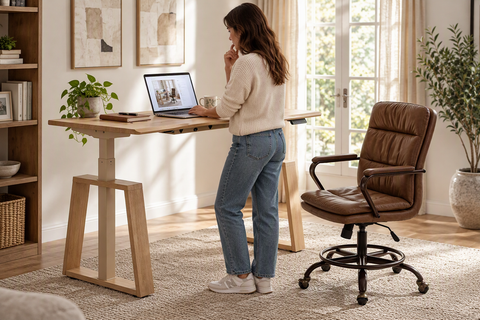
This is where height-adjustable desks become a fundamental solution. By allowing a user to transition between sitting and standing, a desk fundamentally interrupts the cycle of static loading. As noted by Cochrane’s systematic review, sit-stand desks can reduce daily sitting time by 84 to 116 minutes. This reduction directly translates to less cumulative stress on the chair’s components and the user’s musculoskeletal system.
Practical Recommendations: Maximizing Your Investment
Protecting your health and your furniture requires a combination of the right equipment and better behavioral habits.
1. The "20-8-2" Sit-Stand Rhythm
Cornell University’s Ergonomics Web recommends a specific rhythm to maximize productivity and minimize physical strain:
- 20 Minutes Sitting: Use a neutral posture in a high-quality ergonomic chair.
- 8 Minutes Standing: Transition to a standing desk to encourage blood circulation.
- 2 Minutes Moving: Take a micro-break to stretch or walk.
This cycle prevents the "static load" from settling into your tissues and prevents the chair from being subjected to hours of unyielding, potentially asymmetrical weight.
2. Setting Your Monitor and Desk Height
Proper alignment reduces the urge to lean. According to the HSE guide on Display Screen Equipment (DSE), your monitor should be positioned so the top of the screen is at eye level. This prevents the neck flexion that often leads to a "slumped" or "leaning" posture.
3. Predictive Maintenance
Regular maintenance is often overlooked but can double the lifespan of your equipment.
- Lubrication: Apply a dry silicone lubricant to the tilt tension mechanism and recline latches every 6-12 months. This prevents the "binding" that accelerates wear in the metal-on-metal joints.
- Hardware Check: Every quarter, tighten the bolts connecting the seat to the mechanism. Asymmetrical loading often causes these bolts to back out unevenly, which introduces more play (wobble) into the system.
- Caster Rotation: Much like car tires, rotating your casters (if the base allows) or simply ensuring they are clear of hair and debris can prevent flat spots.
Adhering to Global Standards
When selecting furniture, look for compliance with industry standards like BIFMA G1-2013 or ISO 9241-5:2024. These standards ensure that the furniture provides a wide enough range of adjustability to accommodate different body types (typically the 5th to 95th percentile).
However, remember the "Utilization Ratio." An engineering principle is to operate below the maximum rated capacity. $$Utilization = \frac{Load}{Rated Capacity}$$ If you are consistently operating at a high utilization ratio while leaning to one side, you are effectively exceeding the safety margins for the components on that side. Choosing a chair with a higher rated capacity than you strictly need provides a "buffer" against the stresses of imperfect posture.
A Holistic Approach to Workplace Longevity
The relationship between your body and your workstation is symbiotic. A chair that is failing due to uneven wear will eventually force you into a posture that causes chronic pain. Conversely, a user who practices dynamic movement and maintains their equipment will find that their investment lasts years longer while their well-being remains intact.
By transitioning to a height-adjustable workspace and choosing chairs with synchronized mechanisms and high-quality casters, you are not just buying furniture; you are implementing a long-term strategy for musculoskeletal health and operational efficiency.
Disclaimer: This article is for informational purposes only and does not constitute professional medical advice. Individuals with pre-existing musculoskeletal conditions or chronic back pain should consult a qualified physiotherapist or ergonomic specialist before implementing new workstation routines or changing equipment.
Sources
- BIFMA G1-2013 Ergonomics Guideline
- CCOHS: Office Ergonomics - Sit/Stand Desk
- Cochrane: Workplace interventions for reducing sitting at work
- Cornell University Ergonomics Web — Workstation Guides
- HSE: Working safely with display screen equipment (DSE)
- OSHA eTools: Computer Workstations - Neutral Working Postures
- The 2026 Workstation White Paper




Leave a comment