

Why does a "standard" ergonomic chair often feel like a torture device by 3 PM for a 6'3" engineer or a 5'2" designer? The answer lies in the "myth of the average." Most office furniture is designed to accommodate the 50th percentile of the population, leaving those at the height extremes—the 5th percentile and the 95th percentile—to navigate a landscape of chronic discomfort and Musculoskeletal Disorders (MSDs).
If you find yourself constantly shifting in your seat, leaning forward to reach your desk, or feeling a "pins and needles" sensation in your thighs, your chair isn't just uncomfortable; it is mechanically misaligned with your biology. Achieving a true Spinal Neutral Position requires more than just pulling a lever; it requires a systematic "tune-up" based on anthropometric data. This guide provides the biomechanical blueprint for adapting your workspace to your specific frame, ensuring that your furniture supports your health rather than compromising it.
The Biomechanics of Height Disparity
To understand why height-specific tuning is necessary, we must look at the physiological principles of static load and blood circulation. When a chair does not fit, the body compensates through "postural fixing." For a tall user, this often manifests as "perching" at the edge of the seat because the seat pan is too short. For a short user, it manifests as "dangling feet," which places immense pressure on the underside of the thighs.
According to the ISO 9241-5:2024 standard on workstation layout and postural requirements, the goal of ergonomic seating is to facilitate frequent posture changes while maintaining support for the spine’s natural curves. When you sit, your spine should maintain its natural "S" shape. However, for users at height extremes, standard chairs often force the pelvis into a posterior tilt (rolling backward), which flattens the lumbar curve and increases intradiscal pressure.
In my experience auditing hundreds of home offices, the most common mechanical failure isn't the chair's quality, but the user's failure to account for "popliteal height"—the distance from the floor to the crease behind the knee. If this measurement is ignored, blood circulation is restricted, and the risk of developing repetitive strain injuries (RSI) increases significantly.
The Tall User Blueprint: Solving the Seat Depth Crisis
For users standing 6'1" and above, the primary enemy is insufficient seat depth. When the seat pan is too short, it fails to support the full length of the femur. This concentrates the body's entire weight on the ischial tuberosities (sit bones) and the buttocks, leading to rapid fatigue and a tendency to slouch forward to find stability.
1. The "Clenched Fist" Heuristic
A critical finding in the GSA Ergonomic Seating Adjustment Guide is the requirement for seat-to-knee clearance. For a tall user, you should ensure there is a gap of approximately 2 to 3 inches (roughly the width of a clenched fist) between the front edge of the seat and the back of your calves. If the gap is larger than 4 inches, your thighs lack support, increasing pressure on the lower back.
2. Lumbar Support Elevation
A mistake I frequently observe is tall users setting their lumbar support too low. Because your torso is longer, the apex of your lumbar curve is higher than that of an average user. The support should be positioned to maintain firm contact with your lower back even when you lean slightly forward for intensive typing. If the support loses contact when you move two inches forward, it is likely set too low or lacks sufficient depth.
3. The Elbow-to-Desk Gap
Applying ANSI/HFES anthropometric ratios, a 95th percentile male (~6'3") requires a sitting desk height of approximately 30.8 inches. Most standard desks are fixed at 29 inches. This 1.8-inch discrepancy forces tall users to hunch their shoulders or "shrimp" their spines to reach the keyboard. To solve this, you must raise your chair until your elbows form a 90-110 degree angle, and then use a height-adjustable desk or desk risers to bring the work surface to you.
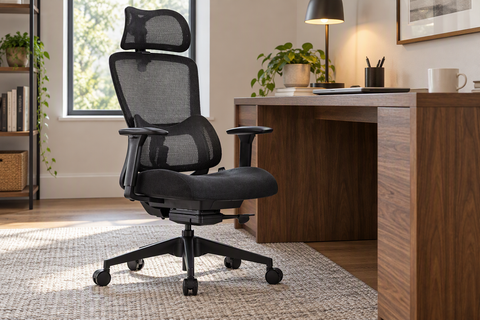
For those requiring extensive seat depth and sophisticated adjustment ranges, the Lira, Ergonomic Office Chair is an ideal reference point, as its adjustable seat depth allows for the precise femur support that taller frames require.
The Short User Blueprint: Eliminating the "Dangle"
For users under 5'4", the world is often built too large. The most significant ergonomic hazard for shorter users is the "dangling foot" syndrome. When feet do not rest flat on the floor, the weight of the legs pulls the pelvis forward, causing the user to lose contact with the backrest and creating a "hollow" lower back.
1. The Non-Negotiable Footrest
As noted by the Canadian Centre for Occupational Health and Safety (CCOHS), if your feet do not reach the floor after you have adjusted the chair height to match your desk, a footrest is mandatory. An adjustable footrest allows your knees to remain level with or slightly below your hips. This prevents the pelvis from rolling backward, which is the root cause of afternoon lower back pain.
2. Armrest Traps
Short users often struggle with armrests that are too wide or too high. If the armrests force your shoulders to "shrug" or stay elevated, you are at high risk for trapezius strain. I recommend adjusting armrests so they are slightly below elbow height when your shoulders are relaxed. In some cases, if the chair's armrests do not go low enough, it is better to remove them entirely or use a chair with highly adjustable 3D or 4D arms.
3. Seat Pan Length
If the seat pan is too deep, the front edge will press into the back of your knees (the popliteal fossa), cutting off circulation and potentially leading to nerve compression. If you cannot sit all the way back against the lumbar support without the seat edge hitting your calves, the chair is mechanically incompatible with your frame. You need a chair with a shorter seat pan or a highly adjustable "sliding" seat.
For users who need targeted, dynamic support that adapts to smaller frames, the Flex, Dual-Backrests Ergonomic Office Chair offers an innovative solution. Its dual-backrest design moves independently, ensuring that even if you have a shorter torso, the support remains centered on your musculature.

The Engineering Audit: A Calculated Cheat Sheet
To move beyond guesswork, we can use derived projections based on BIFMA G1-2013 Ergonomics Guidelines. The following table provides a baseline for your "tuning" process.
| User Height | Calculated Seat Height (Floor to Seat) | Calculated Desk Height (Sitting) | Primary Risk Zone |
|---|---|---|---|
| 5'1" (Short) | 14.5" - 15.5" | 23.5" | Posterior Pelvic Tilt / Foot Dangle |
| 5'9" (Average) | 17.0" - 18.5" | 27.5" | Static Load Fatigue |
| 6'3" (Tall) | 19.5" - 21.0" | 30.8" | Ischial Pressure / Thoracic Kyphosis |
Note: Calculations include a standard 1-inch shoe correction factor as suggested by ISO 9241-5. If you work barefoot, subtract 1 inch from these targets.
The 5-Minute Mechanical Audit Checklist
Once you have adjusted your chair, perform this physical verification. If you fail any of these points, your "tuning" is incomplete:
- The Fist Test: Can you fit a clenched fist between the seat edge and your calf? (If no, seat is too deep; if gap is > 5 inches, seat is too shallow).
- The Eye Level Check: Close your eyes, sit comfortably, and open them. You should be looking at the top third of your monitor. If you are looking at the top edge or above, your monitor is too low, causing neck extension.
- The Elbow Float: Relax your shoulders. Are your elbows supported by the armrests without your shoulders being pushed upward?
- The Lumbar Contact: Lean forward 5 degrees as if typing intensely. Does the lumbar support still feel firm against your spine? According to the OSHA eTools for Computer Workstations, maintaining this contact is the only way to prevent the "flattening" of the lumbar curve during active work.
For those looking for a versatile "starter" chair that provides the essential 4-level lumbar adjustment needed for this audit, the Exis, Ergonomic Office Chair provides a reliable foundation for building a healthier workspace.

Integrating the "20-8-2" Rhythm
No matter how perfectly you tune your chair, the human body was not designed for prolonged static sitting. The Cornell University Ergonomics Web recommends the "20-8-2" rule: for every 30 minutes of work, sit for 20 minutes, stand for 8 minutes, and move or stretch for 2 minutes.
For tall users, standing is often a relief for the hips, but it places a higher load on the lower back if the desk is too low. For short users, standing can lead to "locking" the knees. In both cases, the transition between sitting and standing should be seamless. Learn more about optimizing this transition in our guide on Adjusting Your Chair for Gaming vs. Office Work.
Symptom Decoder: Mapping Pain to Mechanical Causes
If you are experiencing specific pain, use this table to identify the likely mechanical culprit in your chair setup:
| Symptom | Likely Mechanical Root Cause | Recommended Adjustment |
|---|---|---|
| Burning in shoulder blades | Armrests too high or desk too high. | Lower armrests; ensure 100° elbow angle. |
| Numbness in feet/toes | Seat pan too deep or seat too high. | Use a footrest; check seat-to-calf gap. |
| Sharp lower back pain | Lumbar support too low or missing. | Raise lumbar support to the "small" of the back. |
| Wrist pain/Tingling | "Drop-off" at the desk edge (extension). | Align chair height so wrists remain neutral. |
Maximizing Your Ergonomic Investment
Tuning your chair for your specific height is not a one-time event; it is an ongoing process of refinement. As you change footwear, move between tasks, or even experience changes in your physical health, your chair settings must evolve. By moving beyond the "one size fits all" mentality and applying the anthropometric standards discussed here, you transform your chair from a piece of furniture into a precision tool for productivity.
For a deeper dive into the technical specifications that make a chair truly supportive, refer to our comprehensive Ergonomic Office Chair Guide. Remember, the most expensive chair in the world will fail to protect your health if it is not tuned to the unique geometry of your body.
Frequently Asked Questions
Can I use a pillow if my lumbar support is too low?
While a pillow can provide temporary relief, it often lacks the structural density required to maintain the lumbar curve over several hours. It also tends to shift, leading to inconsistent support. It is better to invest in a chair with a height-adjustable backrest or a dedicated external lumbar cushion designed for ergonomic use.
Why do my legs hurt after I start standing at my desk?
This is common for both very tall and very short users. It often results from "static standing." Ensure you are using an anti-fatigue mat and shifting your weight frequently. Standing is not a substitute for movement; it is simply a different form of posture.
Is seat tilt important for height extremes?
Yes. A slight forward tilt (1-3 degrees) can help shorter users maintain a neutral pelvis. For taller users, a slight rearward tilt can help distribute weight more evenly across the thighs, provided the feet remain flat on the floor.
YMYL Disclaimer: This article is for informational purposes only and does not constitute professional medical advice, diagnosis, or treatment. The ergonomic recommendations provided are based on general population standards and may not be suitable for individuals with pre-existing musculoskeletal conditions, chronic pain, or recent surgeries. Always seek the advice of a qualified healthcare professional or a certified professional ergonomist before making significant changes to your workstation or physical routine, especially if you are experiencing persistent pain or discomfort.
Sources
- BIFMA G1-2013 Ergonomics Guideline for Furniture
- Canadian Centre for Occupational Health and Safety (CCOHS): Office Ergonomics
- GSA Ergonomic Seating Adjustment Guide
- ISO 9241-5:2024 Workstation layout & postural requirements
- OSHA eTools: Computer Workstations - Neutral Working Postures
- Cornell University Ergonomics Web — Workstation Guides




Leave a comment