

Many professionals invest in high-end office chairs only to find that chronic lower back pain persists. If you have ever felt a dull ache in your lumbar region or a strange tingling behind your knees after a few hours of work, a common but overlooked culprit is a fundamental mechanical misalignment: seat depth.
Proper seat depth is the foundational "fit" of an ergonomic workstation. It is the distance between the back of the chair and the front edge of the seat pan. When this distance is incorrect, the body’s weight is distributed unevenly, forcing the spine out of its neutral alignment and rendering even the most advanced lumbar support systems ineffective. This guide explores the biomechanical principles of seat depth, provides data-driven adjustment protocols, and explains how to optimize this setting for long-term musculoskeletal health.
The Biomechanics of Seat Depth: Why It Matters
The primary physiological goal of an ergonomic chair is to maintain the spine's natural "S" curve while minimizing static load on the intervertebral discs. According to the Occupational Safety and Health Administration (OSHA) eTools on Computer Workstations, a chair must allow the user to sit against the backrest to provide adequate lumbar support while maintaining a small gap behind the knees.
When seat depth is too long, the front edge of the seat presses against the back of the knees (the popliteal fold). This pressure can restrict blood circulation and compress the nerves in the lower legs. To avoid this discomfort, most users instinctively slide forward. This "perching" behavior creates a gap between the user's back and the chair’s lumbar support, leading to a posterior pelvic tilt. In this position, the lower spine flattens or rounds (kyphosis), which significantly increases the mechanical load on the L4 and L5 vertebrae.
Conversely, if the seat depth is too shallow, the thighs are not adequately supported. This concentrates the body's weight onto the ischial tuberosities (the "sit bones"), leading to localized pain and increased fatigue as the leg muscles work harder to stabilize the torso.
Popliteal Length and the "Two-Finger Rule"
In ergonomic engineering, "popliteal height" is the metric for seat height, but "popliteal length" (the distance from the buttocks to the back of the knee) determines seat depth.
While precise measurements are ideal, a reliable practical heuristic used by our support team and professional ergonomists is the "two-finger rule." After sitting fully back against the backrest, you should be able to fit roughly two to three fingers (about 1 to 2 inches) between the front edge of the seat and the back of your knee. This gap ensures that the seat does not impede circulation while still providing maximum thigh support.
Calculated Utility: The Anthropometric Data Framework
To understand why a fixed seat depth fails a large portion of the population, we must look at standardized anthropometric modeling. Applying data derived from the BIFMA G1-2013 Ergonomics Guideline, we can project the required seat depths for different body types.
Seat Depth Adjustment: Calculated Cheat Sheet
The following table provides derived projections based on ANSI/HFES and BIFMA standards.
How we calculated these values: These estimates use the 5th, 50th, and 95th percentile anthropometric data for popliteal length. We then apply a "clearance deduction" of approximately 1.5 inches (3.8 cm) to ensure the seat edge does not contact the popliteal fold, in accordance with ISO 9241-5:2024 principles.
| User Height | Estimated Popliteal Length | Recommended Seat Depth | Ergonomic Risk Zone |
|---|---|---|---|
| 5'0" (152 cm) | ~14.0" (35.6 cm) | 12.5" – 13.0" | High risk of knee pressure and slouching. |
| 5'5" (165 cm) | ~16.0" (40.6 cm) | 14.5" – 15.0" | Standard fixed seats often exceed this. |
| 5'10" (178 cm) | ~17.5" (44.5 cm) | 16.0" – 16.5" | The "average" design point for many chairs. |
| 6'2" (188 cm) | ~19.5" (49.5 cm) | 18.0" – 18.5" | High risk of inadequate thigh support. |
Note: Individual limb-to-torso ratios vary. Use these figures as a starting point for adjustment.
As the data shows, there is a 5.5-inch (14 cm) variance between the 5th percentile female and the 95th percentile male. A chair with a fixed 17-inch seat depth will be physically impossible for a shorter user to use correctly without losing lumbar contact, while a very tall user may feel unstable.
Seat Depth as a Force Multiplier for Lumbar Support
One of the most significant findings in biomechanical research is the relationship between back support and spinal disc pressure. Classic studies in spinal biomechanics (e.g., Nachemson et al.) have demonstrated that sitting in a slumped, unsupported position can increase intradiscal pressure by significantly more than standing. Conversely, utilizing an effective lumbar support can reduce this pressure by up to 20% to 40% compared to unsupported sitting, depending on the degree of recline and support placement.
However, this reduction is entirely dependent on the user's back actually making contact with the support. If your seat depth is too long, the lumbar pad will track incorrectly along the spine. Instead of nesting in the natural curve of your lower back (the L3-L4 region), the support may hit your sacrum, or you may slide forward so far that the support provides no benefit.
Editor’s Note: While the following examples feature Eureka Ergonomic products to illustrate these features, the principles of adjustability apply to any high-quality ergonomic chair.
Chairs like the Exis, Ergonomic Office Chair emphasize adjustable lumbar systems. The Exis features a 4-level adjustable lumbar support that adapts to your posture, but its effectiveness is maximized only when you have correctly established your seat depth first.

The Adjustment Sequence
To optimize your setup, follow this clinical best-practice sequence:
- Feet: Plant feet flat on the floor (or use a footrest).
- Seat Height: Adjust so thighs are parallel to the floor (hips slightly higher than knees).
- Seat Depth: Use the sliding seat pan to achieve the "two-finger rule."
- Lumbar Support: Align the curve of the chair with the curve of your spine.
Structured Asset: The Symptom Decoder
If you are experiencing discomfort, use this table to identify if seat depth is the likely mechanical cause.
| Symptom | Potential Mechanical Root Cause |
|---|---|
| Lower Back Tightness | Seat too deep; user is slouching forward to avoid knee pressure, losing lumbar support. |
| Numbness in Toes/Calves | Seat too deep; front edge is compressing the popliteal artery and nerves behind the knee. |
| "Sit Bone" (Ischial) Pain | Seat too shallow; body weight is concentrated on a small surface area of the thighs. |
| Shoulder Tension | Seat depth causing slouching, which leads to "forward head posture" and trapezius strain. |
Scenario Stress-Testing: The Outlier Dilemma
Scenario 1: The 5th Percentile Petite User (152 cm / 5'0")
For a shorter user, many standard office chairs are simply too deep.
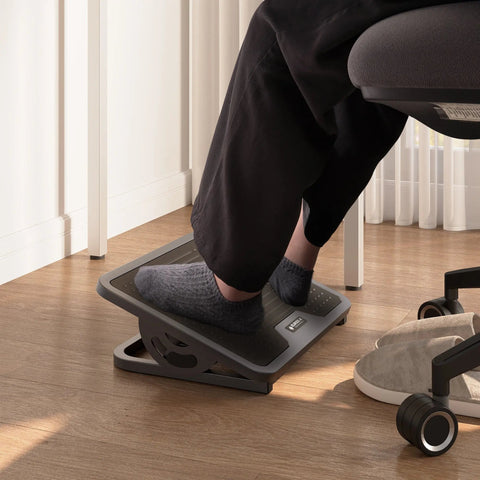
- The Mechanical Fix: If the chair's seat pan does not slide back far enough, a Adjustable Ergonomic Footrest becomes essential. By elevating the feet, the user can sit further back into the chair, allowing the lumbar support to engage while reducing the pressure behind the knees.

Scenario 2: The 95th Percentile Tall User (188 cm / 6'2")
Taller users face the opposite problem. A standard seat depth often supports only a portion of their thighs, which can create a "sliding" sensation.
- The Mechanical Fix: A chair with an extended seat pan is required. Without it, the tall user will experience increased static load on the lower back muscles as they subconsciously "grip" the chair to stay in place.
Real-World Implementation Nuance
- Fabric Tension: In mesh chairs, "hammocking" (sagging) can occur over time. If the mesh sags, your effective seat depth increases because your pelvis sinks deeper and further back.
- Clothing Thickness: Heavy denim or thick winter layers can add up to half an inch of bulk, potentially making a "borderline" seat depth feel too long.
- Task-Based Variability: A slightly shallower seat depth is often better for focused, forward-leaning tasks, while a deeper setting may be more comfortable for reclined reading.
When to See a Doctor (Red Flags)
While ergonomic adjustments can alleviate discomfort caused by poor posture, they are not a substitute for medical intervention. If you experience any of the following "red flag" symptoms, consult a healthcare professional immediately:
- Radiating Pain: Sharp or "electric" pain that travels down the leg (sciatica).
- Progressive Weakness: Difficulty lifting your foot (foot drop) or weakness in the legs.
- Numbness: Loss of sensation in the "saddle area" (inner thighs/groin).
- Bowel/Bladder Changes: Any sudden changes in control or function.
- Unrelenting Pain: Pain that does not improve with rest or changes in position.
Practical Recommendations for a Pain-Free Workspace
Perform a mechanical audit of your current setup using this checklist:
- Check the Gap: Sit fully back. Can you fit two fingers between the chair and your knees?
- Verify Lumbar Contact: Does the lumbar support feel like it is "filling" the gap in your lower back?
- Evaluate Circulation: Do your legs feel heavy or tingly by the afternoon?
- Integrate Movement: Follow the "20-8-2" rule recommended by Cornell University Ergonomics: sit for 20 minutes, stand for 8 minutes, and move/stretch for 2 minutes.
For those who cannot adjust their chair's seat pan, accessories like the Adjustable Ergonomic Footrest are the most effective way to "shorten" the effective depth and bring the body back into a neutral, supported position.

Key Takeaways for Lower Back Relief
- Seat depth is the foundation of lumbar support: If the depth is wrong, the lumbar support cannot function correctly.
- The "Two-Finger Rule" is your guide: Aim for a 1-2 inch gap to protect circulation.
- Anthropometry matters: There is a significant difference in requirements between short and tall users; adjustability is key.
- Use engineering controls: If your chair lacks a sliding seat pan, use a footrest to correct your posture.
YMYL Disclaimer: This article is for informational purposes only and does not constitute professional medical advice, diagnosis, or treatment. Always seek the advice of your physician or other qualified health provider with any questions you may have regarding a medical condition or musculoskeletal pain. Ergonomic adjustments are intended to reduce risk factors but may not resolve pre-existing injuries.
References
- BIFMA G1-2013 Ergonomics Guideline for Furniture
- OSHA eTools: Computer Workstations - Chairs
- ISO 9241-5:2024 Workstation layout & postural requirements
- Cornell University Ergonomics Web — Workstation Guides
- Nachemson, A. L. (1981). The Lumbar Spine: An Orthopaedic Challenge. Spine. (Classic study on intradiscal pressure).




Leave a comment