

Why does your lower back feel as though it is collapsing by 2 PM? For many professionals, particularly those with larger frames or higher body weights, the standard office chair is not just uncomfortable—it is a mechanical failure. Most commercial seating is designed for the "average" user, typically falling within the 5th to 95th percentile of the general population. However, for a "heavy user"—defined here as individuals over 250 lbs or those with taller statures—standard components like foam density, gas lift ratings, and lumbar depth often fall short of providing the necessary counter-force to maintain spinal integrity.
When a chair fails to support a heavy user, it leads to a cascade of Musculoskeletal Disorders (MSDs). The issue isn't merely "softness"; it is the physics of static load and spinal compression. Without adequate support, the pelvis tilts posteriorly, the lumbar curve flattens, and intradiscal pressure skyrockets. This article serves as an engineering audit of what heavy users truly need in a chair to safeguard their musculoskeletal health and long-term productivity.
The Biomechanics of Heavy Loading: Why Standard Chairs Fail
To understand why a specialized chair is necessary, we must look at the physiological principles of the spinal neutral position. In a neutral posture, the spine maintains its natural "S" curve, which distributes weight evenly across the intervertebral discs. According to the Occupational Safety and Health Administration (OSHA) eTool on Neutral Working Postures, maintaining this alignment is the primary defense against nerve compression and muscle fatigue.
For heavy users, two specific physical principles dominate the seating experience:
- The "Bottoming Out" Effect: Standard seat cushions often use low-density foam. Under a heavier load, this foam compresses completely, leaving the user sitting essentially on the hard plastic or metal seat pan. This creates localized pressure points on the ischial tuberosities (sit bones), restricting blood circulation and causing "numb butt" syndrome.
- Static Load and Disc Compression: Research published in PubMed regarding lumbar spine intradiscal pressure indicates that sitting increases disc pressure significantly compared to standing. For individuals with more body mass, this pressure is amplified. If the backrest lacks the structural tension to provide a counter-force, the spine slumps, leading to a "C-shaped" posture that strains the posterior ligaments.

The Fast Numbers Framework: Calculated Seating Projections
To bridge the gap between "standard" furniture and ergonomic reality, we can use derived projections based on ANSI/HFES anthropometric ratios. The following table illustrates the "Ergonomic Gap" created by standard 29-inch fixed-height desks when paired with different user profiles.
Calculated Ergonomic Cheat Sheet
| User Profile | Stature | Ideal Seat Height | Ideal Desk Height | Ergonomic Risk Zone |
|---|---|---|---|---|
| 95th Percentile Male | 74.5 in (189 cm) | 19.3 in (49 cm) | 30.8 in (78.2 cm) | 1.8-inch Deficit: Forces shoulder elevation and increases lower back compression. |
| 50th Percentile Female | 63.5 in (161 cm) | 16.3 in (41.4 cm) | 26.0 in (66 cm) | 3.0-inch Surplus: Causes "shrugging" of shoulders and trapezius strain. |
| Heavy User (Standard) | Varied | Adjusted for Foam Compression | Calculated per Elbow Height | The Sink Factor: Gas lifts may drop 0.5–1 inch under load, requiring higher initial settings. |
Note: Calculations include a 2.5cm shoe correction factor derived from ISO 9241-5:2024 standards.
As demonstrated, a tall or heavy user facing a 1.8-inch desk height deficit will naturally lean forward or "slump" to reach their keyboard, negating any benefit the chair's backrest might provide. This highlights that for heavy users, the chair must be the primary tool to correct the "ergonomic ecosystem."
Critical Features: What to Look for in a Heavy-Duty Chair
When evaluating a chair for back support, heavy users should move past aesthetic marketing and focus on the mechanical specifications that ensure durability and spinal alignment.
1. Reinforced Lumbar Support with Depth Travel
Static lumbar pads are often insufficient for heavy users. As body mass increases, the natural inward curve (lordosis) of the lower spine requires more pronounced support to prevent flattening. According to the BIFMA G1-2013 Ergonomics Guideline, adjustable features are critical to accommodating the 5th to 95th percentile. For heavy users, independent adjustable units that offer at least 2 inches of depth travel are essential. This allows the support to "meet" the spine rather than forcing the user to lean back into a void.
2. High-Density Foam and Seat Pan Width
To avoid the "bottoming out" effect mentioned earlier, look for high-density foam in the range of 1.8 to 2.5 lb/ft³. This ensures the cushion retains its shape and support over years of use. Additionally, the seat pan width should exceed 20 inches to allow for comfortable hip placement without pressing against the armrest supports.
3. Class 4 Gas Lifts and 5-Point Bases
Safety is a paramount concern. Heavy-duty chairs typically utilize a Class 4 gas lift, which is designed to handle higher pressure and more frequent adjustments. This should be paired with a 5-point base—often reinforced with aluminum or heavy-duty nylon—and dual-wheel casters to ensure lateral stability during recline.
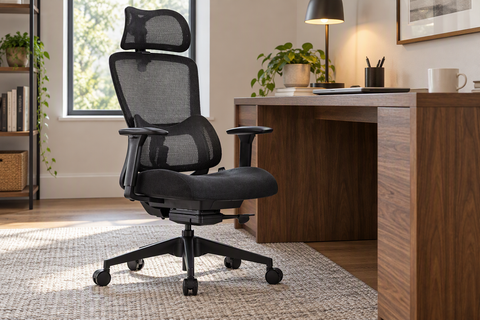
For those seeking a balance of high-performance support and modern aesthetics, the Exis, Ergonomic Office Chair provides a 4-level adjustable lumbar support system and a spring-foam seat cushion designed to resist sagging.

Scenario Analysis: The Outlier Anthropometry
Expertise in ergonomics requires looking at how extreme cases interact with furniture. Let's compare two distinct scenarios to see how chair mechanics must adapt.
Scenario 1: The 95th Percentile Tall User
A user standing 6'2" (188 cm) or taller faces a "backrest height" problem. In standard chairs, the "lumbar" support often ends up hitting the user's sacrum (tailbone) rather than the small of the back. This user requires an extended backrest and a deeper seat pan. If the seat pan is too shallow, it leaves the thighs unsupported, increasing the load on the lower spine. A deeper seat pan (or an adjustable one) ensures weight is distributed across the entire length of the femur.
Scenario 2: The "Visual Ergonomics" Dilemma
Heavy users often utilize larger monitors or multi-screen setups to match their physical scale. However, a standard desk depth may not provide the necessary viewing distance. Applying SMPTE 30° field-of-view standards, a large 32-inch monitor requires significant depth to avoid neck strain. In this case, the chair's recline function becomes a primary lever. A reclined posture (100–110° hip angle) with robust lumbar support reduces disc pressure and allows for a more comfortable viewing angle for large-format displays.
The Symptom Decoder: Mapping Pain to Mechanical Causes
If you are experiencing specific discomfort, your chair setup—rather than the chair itself—might be the culprit. Use this table to identify the mechanical root cause of your pain.
| Symptom | Mechanical Root Cause | Recommended Adjustment |
|---|---|---|
| Burning between shoulder blades | Desk/Armrests too high; shoulders are "shrugged." | Lower armrests or raise seat height. Ensure elbows are at 90-100°. |
| Sharp pain in lower back | Lumbar support is too low or lacks depth. | Raise lumbar support to the "small" of the back; increase depth. |
| Numbness in back of thighs | Seat pan is too deep or seat is too high. | Use a footrest to relieve pressure on the popliteal (behind knee) area. |
| Neck stiffness by 4 PM | Monitor is too low, causing "Forward Head Posture." | Raise monitor to eye level; check if chair headrest is pushing head forward. |
For a deeper dive into the initial configuration, see our guide on Setting Up Your Ergonomic Chair for Maximum Comfort.
The Friction Points: Real-World Implementation Nuances
Manuals often skip the "feel" of a good setup. Here are three non-obvious details for heavy users:
- The Recline Tension: Many heavy users tighten the recline tension to the maximum to avoid feeling like they are "falling." However, this creates a rigid backrest that doesn't move with you. The goal is to set the tension so the chair supports you in an upright position but allows you to recline with a slight push, encouraging "dynamic sitting."
- Armrest Width: For broader individuals, armrests that only move up and down are insufficient. You need "3D" or "4D" armrests that can pivot or slide outward to accommodate shoulder width without forcing the elbows into a cramped position.
- The "Sink" Factor: When you sit, the gas lift and the foam will compress. Always measure your ergonomic angles while seated in the chair, not while it is empty. A chair that looks perfectly level with your desk when empty might drop 1.5 inches once you sit down.
The Flex, Dual-Backrests Ergonomic Office Chair addresses these friction points through an innovative dual-backrest design. Unlike rigid single-back chairs, the dual backrests move independently, adapting to the user's micro-movements and providing targeted support to both sides of the lower back simultaneously.

5-Minute Mechanical Audit Checklist
Before investing in a new chair, or to optimize your current one, perform this quick audit:
- Feet Flat?: Are your feet fully supported on the floor? If your heels are lifting, your seat is too high, placing a massive load on your lower back.
- The Two-Finger Rule: Can you fit two fingers between the edge of the seat pan and the back of your knees? If not, the seat is too deep, which will cut off circulation.
- Elbow Alignment: With your hands on the keyboard, are your elbows at an open angle (100–110°)? This opens the ulnar tunnel and reduces nerve compression.
- Lumbar Contact: Do you feel the chair's support in the natural curve of your lower back? If there is a gap, you need to adjust the depth or height of the lumbar unit.
- Eye Level: Is the top third of your monitor at eye level? This prevents the "turtle neck" posture that leads to cervical spine strain.
For those who find their feet don't quite reach the floor after adjusting for desk height, an Adjustable Ergonomic Footrest is a critical accessory to maintain the 90-degree hip angle required for spinal health.
The ROI of Ergonomic Investment
While a high-quality ergonomic chair represents a higher upfront cost, it should be viewed as a health investment. According to a meta-analysis by Santos et al. (2025), ergonomic interventions significantly reduce work-related musculoskeletal pain. For a professional, preventing just one week of lost productivity due to back pain can often cover the entire cost of a premium chair.
Furthermore, choosing products with certifications like UL GREENGUARD Gold ensures that the materials in your home office are not off-gassing harmful Volatile Organic Compounds (VOCs), contributing to a healthier indoor environment.
Key Takeaways for Heavy Users
- Prioritize Support Over Softness: Look for high-density foam (1.8-2.5lb/ft³) to prevent "bottoming out" and maintain support throughout the day.
- Demand Adjustability: Ensure the lumbar support has both height and depth adjustments to accommodate your specific spinal curve.
- Check the Ratings: Verify that the chair uses a Class 4 gas lift and has a weight rating that provides a safety buffer for your actual weight.
- The Ecosystem Matters: A great chair cannot fix a desk that is the wrong height. Use the "Calculated Cheat Sheet" to identify if you need to raise your desk or use a footrest.
- Dynamic Movement: Use the 20-8-2 rule (20 minutes sitting, 8 minutes standing, 2 minutes moving) as recommended by Cornell University to prevent the risks associated with prolonged static sitting.
Frequently Asked Questions
How do I know if a chair's weight limit is "real"? Look for ANSI/BIFMA X5.1 certification. This industry standard involves rigorous testing for safety, durability, and structural adequacy. A chair that meets or exceeds BIFMA standards is built to handle the advertised load under repeated use, not just a one-time static weight.
Can a chair actually "heal" back pain? No chair has "healing" properties. Instead, a high-quality chair reduces the risk factors—such as spinal compression and muscle load—that cause pain. As noted in the Cochrane Library review on workplace interventions, furniture is most effective when combined with behavioral changes like taking regular breaks and maintaining a neutral posture.
Is a mesh back better than a padded back for heavy users? Mesh provides superior breathability, which is often a priority for heavy users. However, ensure the mesh is high-tenacity and won't sag over time. Padded backs offer more "cradling" support but can trap heat. The choice often comes down to personal preference for "firm" vs. "soft" support.
YMYL Disclaimer: This article is for informational purposes only and does not constitute professional medical advice. If you have pre-existing back conditions, chronic pain, or are recovering from surgery, please consult a qualified physiotherapist or medical professional before making significant changes to your workstation or adopting a new seating routine.




Leave a comment