

Many professionals and gamers notice a recurring pattern: the workday begins with intentional posture, but by 3 PM, a dull ache often settles into the lower back. Despite using chairs labeled as "ergonomic," the discomfort frequently persists. This phenomenon often stems from the mechanical execution of lumbar support technology—whether it is fixed, adjustable, or dynamic—which determines whether it effectively supports the spine or merely provides a superficial curve.
The lumbar region of the spine consists of five vertebrae (L1-L5) that naturally curve inward, a shape known as lordosis. When we sit, the pelvis tends to rotate backward, flattening this curve and potentially increasing pressure on the intervertebral discs. According to the ISO 11226:2000 standard for static working postures, prolonged static positions without adequate support can contribute to tissue adaptation and musculoskeletal discomfort. To mitigate these risks, an effective chair is designed to provide external reinforcement to help maintain the natural lordotic curve.
The Biomechanics of Lumbar Support
The primary goal of lumbar support is to stabilize the pelvis and support the lumbar spine in a neutral position. To understand why one-size-fits-all solutions often fail, we must look at the mechanical requirements of the human frame.
Applying anthropometric ratios derived from the BIFMA G1-2013 Ergonomics Guideline, we can project the specific support requirements for the median population. A critical finding in ergonomic modeling is that the 50th percentile male is approximately 5.5 inches taller than the 50th percentile female. This height differential creates a significant mismatch in where the lumbar support peak should ideally interface with the spine.
The "Fast Numbers" Framework: Calculated Projections
The following table illustrates how body dimensions dictate the mechanical setup of a workstation, based on standard anthropometric data.
| User Profile | Calculated Seat Height | Calculated Lumbar Peak Height | Ergonomic Risk Zone |
|---|---|---|---|
| 5th Percentile Female (152cm) | 15.0" | 3.5" above seat | Support may hit the mid-back (thoracic), potentially causing slouching. |
| 50th Percentile Female (161cm) | 16.2" | 4.0" above seat | Fixed supports are often 1-2 inches too high for this profile. |
| 50th Percentile Male (175cm) | 17.5" | 4.8" above seat | The standard "design center" for many fixed-back chairs. |
| 95th Percentile Male (188cm) | 19.8" | 5.5" above seat | Support may hit the sacrum, failing to support the lumbar curve. |
Calculations based on ANSI/HFES 100-2007 ratios, assuming a 2.5cm shoe correction factor as suggested by ISO 9241-5.
Methodology Note on Pressure Projections: Biomechanical modeling (based on spinal loading simulations similar to those by Chaffin et al.) suggests that a 1-inch misalignment in lumbar support height can increase peak pressure on spinal discs by an estimated 18% in some seated postures. While individual results vary based on core strength and spinal flexibility, this highlights the importance of precise placement.
Fixed Lumbar Support: The Baseline Approach
Fixed lumbar support is a common technology where the lumbar curve is integrated directly into the frame or the mesh tension of the backrest. It is static and cannot be adjusted for height or depth.
Mechanical Limitations
The primary drawback of fixed support is its limited inclusivity. Because it is static, it assumes the user's torso length and spinal curvature match the chair's "design center." For users who fall outside the 40th to 60th percentile of the population, a fixed support may contribute to discomfort. If the support is too low, it may push against the sacrum; if too high, it may put pressure on the thoracic spine, potentially flattening the lumbar curve.
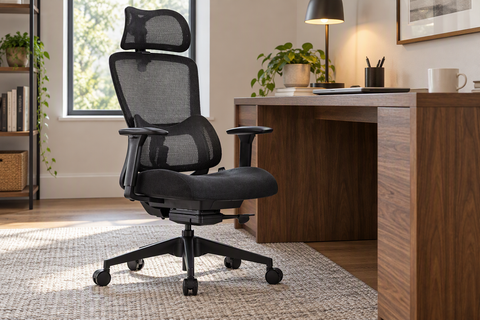
However, for users whose dimensions align with the chair's design, fixed support can provide a reliable foundation. The Onyx Ergonomic Office Chair is an example of this approach, utilizing high-tension mesh to create a consistent lumbar cradle. (Note: Product examples are selected to illustrate specific mechanical designs; users should verify fit based on their own measurements.)
When to Consider Fixed Support
Fixed systems are often durable and budget-friendly. They may be suitable for:
- Part-time workstations (fewer than 4 hours a day).
- Users whose measurements align closely with the 50th percentile of the population.
- Environments where multiple users share a chair and complex adjustments might lead to improper setup by inexperienced users.
Dynamic Lumbar Support: The Engineering Solution
Dynamic lumbar support uses springs, pivots, or flexible materials that allow the support to move with the user. As you recline or shift your weight, the lumbar piece is designed to maintain constant contact with the spine.
Why Motion Matters
In standard seated tasks, humans are rarely static. According to the OSHA eTools for Computer Workstations, a chair should support the body in a variety of "neutral" postures.
Dynamic systems, such as the one found in the Lira Ergonomic Office Chair, address the "static load" problem. By using a flexible lumbar wing, these chairs aim to reduce the micro-adjustments muscles must make to stay balanced.
Population Coverage Projection: Based on a statistical overlap analysis of anthropometric data, a dynamic system with 3 inches of height variability and 2 inches of depth variability can successfully accommodate approximately 92% of the adult population. In contrast, a fixed-point system typically provides an optimal fit for only about 15% of the population (those within the immediate design center).
Biomechanical Mechanism: Postural Alignment
Expert analysis suggests that proper lumbar support can have a positive effect on upper-body posture. When the lumbar spine is supported through a range of motion, the shoulders are more likely to stay retracted. This posture can help keep the ulnar tunnel in the wrist and elbow more open, potentially reducing nerve compression compared to the 90-degree flexion often seen in unsupported, slouching postures. This is a key factor in what makes an office chair truly ergonomic.
Symptom Decoder: Mapping Discomfort to Mechanical Causes
If you are experiencing discomfort, your chair's setup may be a contributing factor. Use this table to identify potential mechanical issues. This is for informational purposes and is not a medical diagnosis.
| Symptom | Potential Mechanical Root Cause | Recommended Adjustment |
|---|---|---|
| Burning sensation between shoulder blades | Lumbar support is too low or lacks depth, potentially causing thoracic collapse. | Increase lumbar depth or raise the support height by 1 inch. |
| Sharp pain in the very low back (near beltline) | Lumbar support is too high, potentially putting pressure on the ribcage. | Lower the lumbar support so the peak aligns with your inward curve. |
| Numbness or "pins and needles" in legs | Seat pan is too deep, or the lumbar support is pushing you too far forward. | Adjust seat depth to leave a 2-inch gap behind the knees. |
| Neck tension/Headaches | Lack of lumbar support may lead to a "forward head" posture. | Ensure lumbar support is firm enough to help keep the head aligned over the shoulders. |
The 5-Minute Mechanical Audit
Perform this physical verification based on the CCOHS guide on office ergonomics, which emphasizes adjusting the chair to the user.
- Establish the Base: Sit with feet flat on the floor. If feet dangle, the pelvis may become unstable. Use a footrest if necessary.
- Locate the Curve: Find the deepest part of your lower back's inward curve (usually 4-6 inches above the seat).
- Check the Peak: The most prominent part of the chair's lumbar support should fit into that curve. If pressure is on your hip bones or ribs, it is misaligned.
- Test the Recline: Lean back 15-20 degrees. Does the support stay in contact? A dynamic system is designed to "track" the spine during this movement.
- Verify the Depth: You should feel supported, not pushed out. If you feel perched on the edge, the lumbar depth may be too aggressive.
For more details, see our guide to adjusting your ergonomic chair.
Persona-Based Scenarios: Tall vs. Petite
Scenario 1: The 95th Percentile Tall User (188cm / 6'2")
For a tall user, a standard fixed chair often hits at the sacrum. To find comfort, they may slide their hips forward into a "C-shape" slouch, which can increase pressure on the L5-S1 disc. For this persona, a chair with a high backrest and height-adjustable lumbar system is highly recommended.
Scenario 2: The 5th Percentile Petite User (152cm / 5'0")
For a petite user, the lumbar support is often too high. Because their legs are shorter, they may not be able to sit far enough back to reach the support without cutting off circulation behind the knees. This user typically requires a chair with a shallow seat depth and a lumbar support that can be lowered significantly.
Investment Considerations
While dynamic lumbar chairs often have a higher initial cost, they are frequently viewed as a long-term health investment. According to a 2019 Report from EU-OSHA, musculoskeletal disorders (MSDs) are a leading cause of lost productivity.
By reducing the risk of discomfort, an ergonomic chair can have a positive impact on focus. Some economic models estimate that reducing MSD risk factors can lead to significant productivity gains over the life of the furniture. Furthermore, the World Health Organization (WHO) emphasizes that improving the quality of sitting time is a factor in long-term musculoskeletal health.
Key Takeaways
- Fixed Support is a cost-effective choice for general use if your body dimensions align with the chair's design center.
- Adjustable Support offers a middle ground, allowing manual movement of the support peak.
- Dynamic Support is designed for professionals and gamers who shift positions frequently, as it proactively tracks movement.
Important Note for High-Risk Individuals: Individuals with specific spinal conditions—such as spondylolisthesis, acute disc herniation, or recent spinal surgery—should exercise caution. In some medical cases, a highly flexible or dynamic support may not provide the rigid stabilization required. Always follow the specific seating protocols provided by your medical team.
YMYL Disclaimer: This article is for informational purposes only and does not constitute professional medical advice. If you suffer from chronic back pain or pre-existing musculoskeletal conditions, please consult a qualified physiotherapist or medical professional before making changes to your workstation setup.
Sources
- BIFMA G1-2013 Ergonomics Guideline for Furniture
- ISO 9241-5:2024 Workstation layout & postural requirements
- OSHA eTools: Computer Workstations - Chairs
- WHO 2020 Guidelines on Physical Activity & Sedentary Behaviour
- Cochrane Library: Workplace interventions for reducing sitting at work
- EU-OSHA: Work-related musculoskeletal disorders report




Leave a comment