

In the high-stakes environment of competitive first-person shooters (FPS), a single millimeter of crosshair displacement often dictates the boundary between a successful elimination and a critical failure. Many players attribute "shaky aim" or jittery tracking to psychological pressure or hardware latency. However, a rigorous analysis of human biomechanics reveals that precision is frequently compromised by a fundamental ergonomic failure: the lack of appropriate forearm and shoulder stabilization.
When the arm is improperly supported, the musculoskeletal system must compensate for gravity and the weight of the limb. This introduces "muscular noise"—micro-tremors caused by the constant engagement of the trapezius and deltoid muscles. Understanding the physiological principles behind these tremors is the first step toward achieving the "pixel-perfect" stability required at the highest levels of play.
The Physiology of Precision: Why Muscles "Shake"
The primary culprit behind inconsistent aim is often the "static load" placed on the upper extremities. According to the U.S. Occupational Safety and Health Administration (OSHA), static loading occurs when muscles are held in a fixed position for prolonged periods, leading to fatigue and an increased risk of musculoskeletal disorders (MSDs).
In gaming, this manifests when a player "hovers" their arm or uses a desk that is too high, forcing the shoulders to shrug. This elevation engages the upper trapezius, which is not designed for fine motor control but for gross movement and stability. When these large muscle groups are over-taxed, they begin to twitch—a physiological response known as muscle fatigue-induced tremor. This tremor translates directly through the forearm to the mouse, resulting in a shaky crosshair.
Furthermore, the OSHwiki regarding pathophysiological mechanisms of MSDs explains that prolonged static sitting can impair blood circulation, reducing the delivery of oxygen to the small muscles of the hand and wrist. Without adequate oxygenation, the "fine-tuning" muscles lose their ability to perform micro-adjustments, making smooth tracking nearly impossible.

The Armrest as a Precision Instrument
To mitigate muscular noise, the arm must reach a "neutral position." This is a state where the joints are naturally aligned, and muscular activity is minimized. The Canadian Centre for Occupational Health and Safety (CCOHS) emphasizes that for a workstation to be truly ergonomic, it must support the natural curvature of the spine and allow the arms to hang naturally by the sides.
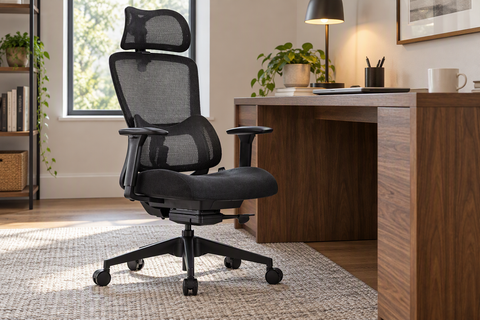
For FPS gamers, the armrest is not merely a comfort feature; it is a dampening system for the body’s internal vibrations. A high-quality 4D armrest system allows for four dimensions of adjustment—height, depth, width, and pivot—which are critical for aligning the forearm with the mousepad surface.
The "Float Test" and the 90-100 Degree Rule
A practical heuristic used by ergonomic auditors to determine correct armrest height is the "Float Test." While seated, close your eyes and lift your arm slightly off the rest, then relax. The arm should settle back onto the pad without the shoulder shifting or the elbow seeking a different lateral position.
Standard guidelines, such as those from BIFMA G1-2013, recommend that the elbow form an angle between 90 and 100 degrees. However, for precision aiming, this angle may need to be slightly wider (>100°) for low-sensitivity players who require large horizontal sweeps, or more acute (<90°) for high-sensitivity players who rely on vertical wrist flicks.
Case Study: The "Tall Gamer" Ergonomic Mismatch
To demonstrate the impact of furniture dimensions on performance, we analyzed a theoretical "Tall Professional Gamer" scenario. Standard furniture is often designed for the 50th percentile of the population, leaving those in the 95th percentile (approximately 190cm or 6'3") at a significant disadvantage.
| Metric | Standard Desk (Fixed) | Tall Gamer Requirement | Impact on Aim |
|---|---|---|---|
| Desk Height | 73.6 cm (29 in) | 78.5 cm (30.9 in) | Forces shoulder shrugging; increases jitter. |
| Mouse Sensitivity | 800 DPI (Standard) | 400 DPI (Pro Low-Sens) | Requires 1.3m+ of travel; armrest friction is critical. |
| Elbow Angle | Often <80° (Cramped) | 95°–105° (Neutral) | Neutral angle reduces trapezius "noise." |
| Stabilization | Static/Soft Plastic | 4D Locked / Damped Foam | Prevents lateral drift during flick shots. |
Data Context: Values estimated based on anthropometric data for the 95th percentile male and pro-standard low-sensitivity settings (130.7cm/360).
In this scenario, a fixed-height desk forces the tall player into a "crunched" posture. Their deltoids must work 15–20% harder just to keep the arm level with the desk. By utilizing a height-adjustable desk and a chair with high-range 4D armrests, the player can align the desk surface exactly with the armrest height, creating a seamless bridge from the elbow to the mousepad. This "Glass Box" logic shows that the hardware isn't just about comfort—it's about removing the biological barriers to precision.
The Mechanical Advantage of 4D Adjustability
Advanced ergonomics often involve features that seem redundant until tested in a competitive environment. For instance, the ability to lock the swivel function on an armrest is vital for "flick" aiming. If the armrest pivots during a high-velocity horizontal movement, the "pivot point" of the forearm shifts, causing the crosshair to overshoot the target.
Conversely, for "tracking" scenarios (common in games like Apex Legends or Overwatch), unlocking the swivel can allow for subtle rotational adjustments from the elbow, facilitating a smoother arc of motion. As noted in The 2026 Workstation White Paper: Converging Ergonomic Science and Sustainable Engineering, the integration of high-precision mechanical adjustments in furniture is becoming as critical as the sensors in the mice themselves.

Surface Materials and Damping
The material of the armrest also plays a role in aim stability. Hard plastic surfaces can cause the skin to "stick" due to perspiration or "slide" unpredictably. Memory foam or high-density padded leather offers a "dampened" pivot point. This slight compression helps to absorb the micro-vibrations of the arm, much like a shock absorber in a vehicle, providing a more consistent feel during micro-adjustments.
Practical Recommendations for Performance Optimization
Achieving a stable aim requires a holistic approach to the workstation. Beyond simply buying an ergonomic chair, you must calibrate the environment to your specific physiology.
1. Establish the "Neutral Triangle"
Ensure your monitor, keyboard, and chair are synced. According to HSE guidelines on DSE (Display Screen Equipment), the top of your monitor should be at eye level to prevent neck strain. If you are looking down, your neck muscles engage, which can indirectly increase tension in your shoulders and arms.
2. The 20-8-2 Rhythm
To maintain blood circulation and prevent the "static load" tremors mentioned earlier, adopt the Cornell University Ergonomics Web recommendation:
- 20 Minutes of sitting in a neutral posture.
- 8 Minutes of standing (using a sit-stand desk).
- 2 Minutes of moving or stretching.
This cycle prevents the "pooling" of blood in the lower extremities and keeps the nervous system alert, which is essential for maintaining fast reaction times.
3. Monitor Arm Flexibility
Static monitor stands often limit the depth of your desk. Using a dual monitor arm allows you to push the screens back, creating more "real estate" for your forearms to rest on the desk or armrests without hitting the monitor base. This is particularly important for low-sensitivity players who need a wide range of motion.

Addressing Pathological Shakiness
It is important to distinguish between ergonomic "noise" and medical conditions. If aim shakiness persists despite a perfect ergonomic setup, it may be related to conditions like "Essential Tremor" or "Intention Tremor." According to medical research on tremors, intention tremors specifically occur during guided movement toward a target. If you experience persistent, involuntary shaking that interferes with daily life, consult a healthcare professional.
Optimizing Your Setup: A Checklist
Before your next competitive session, run through this ergonomic audit:
- [ ] Armrest Height: Level with the desk surface; shoulders are relaxed (not shrugged).
- [ ] Elbow Angle: Between 90° and 105°.
- [ ] Monitor Height: Top line of text at eye level.
- [ ] Feet Placement: Flat on the floor or a footrest to stabilize the pelvis.
- [ ] Armrest Pivot: Locked for flick-heavy games; unlocked for tracking-heavy games.
Summary of Engineering Controls
In the hierarchy of hazard control, OSHA suggests that "Engineering Controls"—such as adjustable furniture—are more effective than "Administrative Controls" like taking breaks. By physically changing the workstation to fit the user, you remove the source of the strain rather than just managing the symptoms.
For the competitive gamer, an ergonomic chair with 4D armrests and a height-adjustable desk represent the ultimate engineering control. They transform the body from a source of unstable "noise" into a stable platform for precision execution.
YMYL Disclaimer: This article is for informational purposes only and does not constitute professional medical advice. The ergonomic recommendations provided are based on general industry standards and may not be suitable for individuals with pre-existing musculoskeletal conditions. Always consult with a qualified physiotherapist or healthcare provider before making significant changes to your physical routine or workstation setup.





Leave a comment