

The Afternoon "Neck Burn": Why Standard Setups Fail Tall Users
For many high-performance gamers and remote professionals, the workday or gaming session often ends with a localized, burning sensation at the base of the skull or between the shoulder blades. This discomfort is frequently dismissed as a byproduct of "long hours," yet for those with a longer torso, the root cause is often a fundamental mechanical failure in workstation geometry. The most common misconception in workplace design is that ergonomic features are universally effective regardless of user stature. In reality, a headrest that is even two inches too low ceases to be a support and instead becomes a "neck-pusher," forcing the cervical spine into chronic forward flexion.
This issue is particularly acute for the 95th percentile of the population—users standing 190cm (approximately 6'3") or taller. When a headrest is set too low, it typically makes contact with the upper shoulders or the mid-cervical spine rather than the occipital bone. This misalignment creates a "support gap" that triggers a cascade of postural compensations. As the head is pushed forward, the neck muscles must work overtime to stabilize the skull, leading to what is colloquially known as "gamer neck." Understanding the physiological principles of this strain is the first step toward reclaiming performance and long-term musculoskeletal health.
The Biomechanics of the Support Gap
The human head weighs approximately 10 to 12 pounds in a neutral position. However, for every inch the head moves forward from its center of gravity, the effective weight on the neck muscles increases significantly. For a long-torso user, an improperly aligned headrest acts as a fulcrum that accelerates this forward translation.
According to the Canadian Centre for Occupational Health and Safety (CCOHS), the cervical and thoracic spine are biomechanically linked. When a tall user lacks adequate upper-back and head support, the increased neck flexion leads to an increase in thoracic kyphosis (the rounding of the upper back). This, in turn, flattens the lumbar lordosis (the natural inward curve of the lower back). By attempting to solve a "neck problem" without addressing the height and depth of the support structure, users inadvertently overload their lumbar discs and muscles.
Research into the pathophysiological mechanisms of musculoskeletal disorders suggests that prolonged static loading—even at low intensities—can lead to tissue adaptation and chronic pain. For the long-torso gamer, the "static load" is not just the weight of the head, but the constant muscular tension required to fight a headrest that is positioned too low. This is why a "one-size-fits-all" approach to chair design often fails power users; without sufficient vertical travel and depth adjustment, the chair becomes an instrument of postural degradation rather than correction.
The Automotive Fallacy vs. Ergonomic Reality
A frequent marketing claim suggests that gaming chairs are "ergonomically designed like race cars." While this sounds impressive, it ignores a critical distinction between automotive safety and workstation ergonomics. Automotive head restraints are governed by standards like FMVSS 202a, which are engineered specifically for rear-impact crash protection—limiting head-to-torso rotation during high-velocity events.
As noted in the 2026 Workstation White Paper: Converging Ergonomic Science and Sustainable Engineering, automotive safety logic does not translate to static sitting comfort. In a car, the headrest is a safety device you rarely touch; at a desk, the headrest should be a comfort device that facilitates a neutral spinal position. For gamers, the goal is to maintain the eyes roughly level with the top third of the monitor, requiring the neck to stay within a 0°–15° flexion range. Relying on "racing-style" headrests that lack depth adjustment often forces the head forward, particularly when wearing bulky over-ear headsets.

Quantitative Analysis: The 95th Percentile Challenge
To demonstrate the gap between standard furniture and the needs of a tall, long-torso user, consider the following data derived from anthropometric simulations for a 190cm (6'3") male. These calculations use ANSI/HFES 100-2007 standards as a baseline for workstation geometry.
| Metric | 95th Percentile User (190cm) | Standard Fixed Setup | Delta (The Gap) |
|---|---|---|---|
| Ideal Seated Desk Height | 78.5 cm (30.9 in) | 73.6 cm (29 in) | -4.9 cm (-1.9 in) |
| Ideal Standing Height | 116.5 cm (45.9 in) | ~110 cm (Typical Max) | +6.5 cm (+2.5 in) |
| Setup Load (Pro Streamer) | 94 kg (207 lbs) | 75 kg (Single Motor) | +19 kg (Overload) |
| Viewing Distance (49" UW) | 128.5 cm (50.6 in) | 76.2 cm (30 in) | -52.3 cm (-20.6 in) |
Note: Values estimated based on 95th percentile male anthropometric ratios and standard liquid-cooled triple-monitor hardware loads.
This data reveals a "triple threat" for the tall user:
- The Height Deficit: Standard 29-inch desks force the user to hunch or lower their chair to a point where their knees are higher than their hips, destroying lumbar alignment.
- The Load Deficit: High-end setups (full-tower PCs and ultrawide monitors) often exceed the capacity of entry-level single-motor standing desks, leading to motor fatigue and instability.
- The Distance Deficit: Large screens require greater viewing distances. On a standard 30-inch deep desk, the user is forced to sit too close, which increases neck strain as they "scan" the screen, making the headrest position even more critical.
Engineering the Solution: Beyond Basic Adjustability
To address these challenges, the workstation must be viewed as an integrated system. For the long-torso user, this means prioritizing furniture that offers "extreme" adjustability ranges that align with ISO 9241-5:2024 requirements for workstation layout and postural health.
1. The Dynamic Headrest
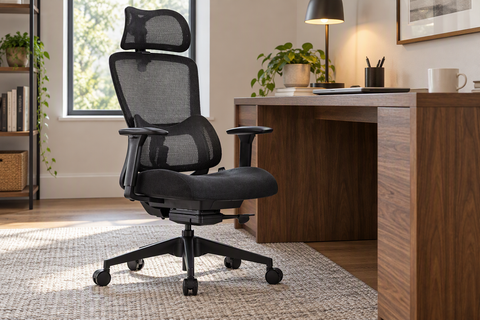
A headrest for a tall gamer must do more than move up and down. It requires depth adjustment (4D or 5D functionality). For those wearing headsets, a headrest with sufficient depth allows the user to maintain support without the ear cups being pushed forward, which can degrade sound quality and create painful pressure points. The correct contact point is the occipital bone at the base of the skull, not the neck itself.
2. Dual-Motor Stability
Given that a professional gaming setup can weigh nearly 100kg, a dual-motor standing desk is not a luxury—it is a structural necessity. Dual-motor systems provide the torque required to reach the 116cm+ heights needed by tall users while maintaining the stability required for precision gaming. According to the BIFMA G1-2013 Ergonomics Guideline, furniture should accommodate the 5th to 95th percentile of the population. Most "standard" desks only reach the 75th percentile, leaving tall users in a "stability dead zone."
3. Independent Monitor Articulation
When the desk height is corrected for the torso, the monitor height must follow. A gas-spring monitor arm is essential for long-torso users to ensure the top line of text is at or slightly below eye level, as recommended by OSHA eTools for Computer Workstations. This prevents the "forward head tilt" that renders even the best headrest useless.

Practical Recommendations for Calibration
Achieving a neutral position requires a systematic approach to adjustment. Use the following protocol to calibrate your setup for a long torso:
The "Eyes Closed" Heuristic
To find your natural neutral position without being biased by your current screen height:
- Sit upright in your chair with your feet flat on the floor.
- Close your eyes and take a deep breath, allowing your shoulders to drop.
- Slowly lean your head back until you feel it is balanced over your spine.
- While keeping your head in that position, open your eyes. The headrest should be adjusted to meet your occipital bone (the curve at the base of your skull) at exactly that point. If you have to "reach" back for the headrest, it is too far back; if it pushes your chin toward your chest, it is too far forward.
The 20-8-2 Sitting Rhythm
Even the most perfect setup cannot negate the risks of static posture. Cornell University Ergonomics recommends the "20-8-2" workflow:
- 20 minutes of sitting in a neutral position.
- 8 minutes of standing (using a height-adjustable desk).
- 2 minutes of moving or stretching.
For tall users, the "moving" phase is critical to re-lubricate the intervertebral discs that are under higher pressure due to the longer lever arm of a tall torso.
Monitor Height and Tilt
For those with a long torso, the monitor often needs to be significantly higher than standard stands allow. Ensure your monitor arm has at least 20 inches of vertical travel. Tilt the monitor slightly upward (10°–20°) if you are in a reclined gaming position. This maintains a perpendicular line of sight without requiring you to tuck your chin, which preserves the cervical "S" curve.

Addressing the "Forward Lean" Habit
During intense gaming sessions, many users subconsciously lean forward, completely disengaging from their chair's support system. This is an "administrative" hazard that no piece of equipment can fully solve alone. However, a well-calibrated headrest should feel so natural and restorative that returning to a neutral position feels like a relief rather than a chore. If you find yourself avoiding your headrest, it is a clear signal that the depth or height is misaligned with your anthropometry.
Conclusion: Investing in the 95th Percentile
Ergonomics is often marketed as a luxury, but for the long-torso professional, it is a functional requirement for career longevity. By moving away from "standard" dimensions and embracing high-travel, high-load, and high-adjustability components, you can eliminate the mechanical stress that leads to chronic MSDs.
Whether you are a competitive gamer or a remote executive, your workstation should be a tool that enhances your physiology, not a constraint that forces it to adapt. Prioritize the "continuity of support"—from the lumbar to the C7 vertebra and finally to the occipital bone—to ensure that your setup is truly tailored to your stature.

YMYL Disclaimer: This article is for informational purposes only and does not constitute professional medical advice, diagnosis, or treatment. The ergonomic recommendations provided are based on general industry standards and may not be suitable for individuals with pre-existing musculoskeletal conditions. Always seek the advice of a qualified healthcare provider or physical therapist before making significant changes to your workstation or physical routine, especially if you are experiencing chronic pain.
References
- BIFMA G1-2013 Ergonomics Guideline for Furniture
- CCOHS: Office Ergonomics - Positioning the Monitor
- ISO 9241-5:2024 Workstation layout & postural requirements
- OSHA eTools: Computer Workstations - Monitors
- Cornell University Ergonomics Web — Workstation Guides
- Herman Miller: Supporting the Spine When Seated
- ISO 11226:2000 Evaluation of static working postures




Leave a comment