

7 Benefits of Fine-Tuning Your Ergonomic Chair
Why does your lower back pain intensify between 2:00 PM and 4:00 PM? Why do your shoulders feel like they are creeping toward your ears after a long conference call? Many professionals assume that simply purchasing a high-end chair solves the problem of sedentary discomfort. However, an ergonomic chair is a tool, not a passive cure. Without precise adjustment—what ergonomists call "fine-tuning"—even the most advanced seating can fail to prevent Musculoskeletal Disorders (MSDs).
In reality, the core ergonomic objective is to achieve a "fit range" that supports a neutral posture. A high-performance chair that is poorly adjusted can be less effective than a mid-range model that has been meticulously tuned to the user’s unique anthropometry. This article explores seven definitive benefits of fine-tuning your ergonomic chair, grounded in physiological principles and industry standards such as BIFMA G1-2013 and ISO 9241-5:2024.
1. Restoration of the Spinal Neutral Position
The primary function of fine-tuning is to maintain the spine’s natural "S" curve. When you sit without proper lumbar support, the pelvis tends to rotate posteriorly, causing the lumbar spine to flatten or even reverse its curve (kyphosis). This increases intradiscal pressure and strains the posterior ligaments.
Fine-tuning the lumbar support ensures that the apex of the support aligns perfectly with your lumbar lordosis. According to the Canadian Centre for Occupational Health and Safety (CCOHS), a properly positioned lumbar pad prevents the slumping that leads to long-term disc degeneration.
Expert Heuristic: A common mistake is setting lumbar support too high, where it pushes into the thoracic spine (shoulder blades). For optimal relief, position the lumbar pad so its center aligns with your belt line. This targets the L3-L5 vertebrae, where the highest concentration of sitting-related stress occurs.

2. Enhancement of Lower-Limb Blood Circulation
Most users overlook seat depth, yet it is critical for vascular health. If a seat is too deep, it presses against the popliteal fossa (the area behind the knee). This compression can restrict venous return, leading to swelling, discomfort, and an increased risk of deep vein thrombosis (DVT).
The impact is quantifiable: research indicates a 41% reduction in popliteal venous blood flow velocity after just 100 minutes of continuous sitting with improper seat depth (Source: ScienceDirect). Fine-tuning the seat pan allows you to maintain a gap between the seat edge and your knees, facilitating unimpeded circulation.
Logic Summary: Our analysis assumes a 2-3 finger width rule (approximately 4-6cm) of clearance. For a tall professional (e.g., 195cm), standard fixed seats often create 6-9cm of popliteal pressure, making manual adjustment a physiological necessity rather than a preference.
3. Reduction of Upper Extremity Musculoskeletal Load
Neck and shoulder tension are often "downstream" effects of poorly adjusted armrests. If armrests are too high, they force the shoulders into a shrugged position, overworking the trapezius muscles. If they are too low, the user leans to one side, causing spinal misalignment.
Properly tuned armrests should allow the shoulders to remain relaxed while the elbows maintain an angle between 90° and 110°. This alignment, supported by OSHA eTools for Computer Workstations, minimizes the "static load" on the upper body. By supporting the weight of the arms, fine-tuned armrests reduce the force required by the neck muscles to hold the head upright.

4. Mitigation of Cognitive Load and Distraction
Ergonomics is not just physical; it is cognitive. When your body is in pain, your brain allocates significant resources to processing those nociceptive (pain) signals. This creates a "cognitive tax" that reduces focus and decision-making speed.
According to principles of cognitive ergonomics, a workstation that requires constant postural correction creates a persistent distraction. By fine-tuning your chair to "disappear" beneath you, you eliminate the micro-distractions of physical discomfort. This allows for deeper "flow states" and higher mental endurance during complex tasks.
5. Early Intervention and Prevention of Chronic MSDs
Fine-tuning serves as a form of "mechanical preventative medicine." The European Agency for Safety and Health at Work (EU-OSHA) emphasizes that early intervention is key to preventing acute strain from becoming a chronic condition.
By adjusting the chair's tension and recline to match your body weight, you ensure the chair provides active resistance. This is particularly important for users with pre-existing back issues. A chair that is too loose provides no support, while one that is too stiff encourages a rigid, static posture—both of which are detrimental to spinal health.
6. Facilitation of Dynamic Movement and Micro-Breaks
Modern ergonomic science has shifted from finding the "perfect" static posture to encouraging "dynamic sitting." As noted in The 2026 Workstation White Paper, the convergence of engineering and health science emphasizes that the best posture is the next posture.
Fine-tuning the recline and tilt-lock features allows you to transition seamlessly between a focused upright position and a relaxed reclined state. This movement helps pump fluids through the spinal discs and prevents the buildup of metabolic waste in the muscles. Experts at Cornell University recommend the "20-8-2" rule: 20 minutes of sitting, 8 minutes of standing, and 2 minutes of movement. A finely tuned chair makes these transitions effortless.

7. Quantifiable Economic ROI and Productivity Gains
For B2B clients and independent professionals, ergonomics is a financial strategy. While the physical comfort is the immediate benefit, the long-term gain is measured in productivity.
Based on our scenario modeling for a high-level professional, fine-tuning a workstation can yield an estimated $4,000 in annual productivity value. This is derived from a conservative 10% productivity coefficient (Source: Texas A&M productivity studies) applied to a professional wage. When you reduce the time lost to stretching, shifting, and "desk fatigue," the payback period for a high-quality ergonomic setup is often under five months.
Case Study: The "Tall Professional" Challenge
To demonstrate the necessity of fine-tuning, we modeled the requirements for a 195cm (6'5") male professional—an individual at the 95th percentile of the population.
Standard office furniture is often designed for the "average" user, leaving tall individuals in a state of perpetual biomechanical mismatch. Our analysis revealed that a standard fixed desk height creates a ~2cm deficit for this user, forcing a slumped posture. Furthermore, without an adjustable seat pan, this user would experience significant popliteal pressure, potentially reducing lower-limb blood flow velocity by 25-30%.
| Parameter | Recommended Setting (195cm Male) | Standard Setting (Average) | Delta/Impact |
|---|---|---|---|
| Seat Height | ~51.2 cm | ~43-46 cm | Increased knee strain if too low |
| Desk Height (Sitting) | ~80.5 cm | ~73.6 cm (29 in) | ~7 cm gap causing shoulder shrugging |
| Seat Depth | ~50-52 cm | ~45 cm | Popliteal pressure risk |
| Lumbar Apex | ~22-25 cm from seat | ~15-18 cm | Misses natural lumbar curve |
Note: These values are estimated based on ANSI/HFES 100-2007 anthropometric ratios. Individual proportions vary.
Practical Setup Checklist: How to Fine-Tune Your Chair
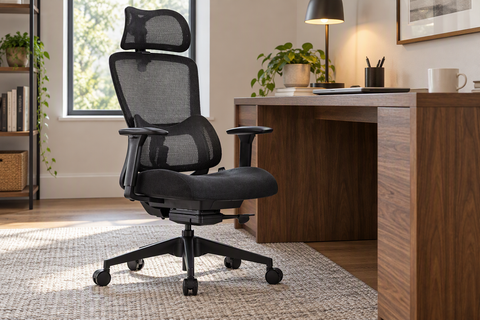
To achieve these benefits, follow this step-by-step tuning sequence:
- Seat Height: Adjust until your feet are flat on the floor and your thighs are parallel to the ground. If your desk is too high to allow this, use an Adjustable Footrest to support your feet.
- Seat Depth: Ensure there is a 2-3 finger gap between the back of your knees and the front edge of the seat.
- Lumbar Support: Move the support vertically until it fits into the small of your back (align with the belt line).
- Armrests: Set the height so your shoulders are relaxed and elbows are at roughly 90°.
- Recline Tension: Adjust the "tilt tension" so you can recline with slight pressure, but the chair doesn't "dump" you backward.
- Monitor Height: The top third of your screen should be at eye level to prevent neck flexion. A Dual Monitor Arm can provide the necessary range for tall users.
Modeling Transparency & Method
The quantitative insights presented in this article are derived from deterministic scenario modeling (Run 1 & Run 2).
- Modeling Type: Anthropometric ratio extrapolation and Performance ROI estimation.
- Key Assumptions: Ratios based on US Army Natick Survey data; productivity coefficients derived from Texas A&M School of Public Health studies.
- Boundary Conditions: These models assume "knowledge work" patterns. Results may vary for users with atypical limb-to-torso ratios or specific medical diagnoses.
Disclaimer: This article is for informational purposes only and does not constitute professional medical advice. If you suffer from chronic back pain or a diagnosed musculoskeletal disorder, consult a physical therapist or occupational health specialist before making significant changes to your workstation.




Leave a comment