

The Physiological Cost of the Afternoon Slump
Why does lower back pain often intensify between 2:00 PM and 4:00 PM? For many professionals, this discomfort is not merely a sign of a long day; it is a physiological response to static muscle loading. When you sit in a chair that lacks proper support, your muscles must work harder to maintain your posture against gravity. Over time, this results in Musculoskeletal Disorders (MSDs), a category of injuries affecting the muscles, nerves, and tendons.
According to the Occupational Safety and Health Administration (OSHA), core risk factors for MSDs include excessive force, repetitive tasks, and, most critically for office workers, poor posture. Prolonged static sitting restricts blood circulation and places a "static load" on the spine. This is why a chair is more than a piece of furniture—it is a piece of health infrastructure. However, with thousands of options on the market, how can a buyer distinguish between a chair that merely looks ergonomic and one that is engineered for long-term safety? The answer lies in BIFMA certification.
What is BIFMA Certification?
BIFMA stands for the Business and Institutional Furniture Manufacturers Association. It is a non-profit organization that creates voluntary standards for the furniture industry. While these standards are voluntary, they are recognized globally as the "gold standard" for safety, durability, and structural adequacy.
A BIFMA-certified chair has undergone a battery of rigorous tests that simulate years of heavy use. These tests include drop tests (to ensure the base doesn't shatter), pull tests (to verify armrest strength), and cycle tests (to ensure the reclining mechanism doesn't fail after thousands of uses). For a professional or a gamer spending 8 to 12 hours a day in a seat, these certifications provide a baseline of trust that the product will not fail catastrophically under pressure.
Decoding the Standards: ANSI/BIFMA X5.1 vs. X5.11
When reviewing a product’s technical specifications, you will likely encounter two primary standards for office chairs. Understanding the difference is crucial for ensuring the chair matches your specific body type and usage patterns.
ANSI/BIFMA X5.1: The General-Purpose Standard
This is the most common certification. It applies to general-purpose office chairs and is designed to accommodate users weighing up to 275 lbs (approximately 125 kg). The testing protocols for X5.1 focus on ensuring the chair can withstand the typical rigors of an 8-hour workday.
ANSI/BIFMA X5.11: The Large Occupant Standard
A common oversight among "Big & Tall" buyers is relying on a chair's "static load rating" (e.g., "tested to 1,000 lbs"). As noted by BIFMA’s own technical position memos, a static load rating does not account for cyclic fatigue. A chair might hold a heavy weight once, but fail after six months of daily use. The ANSI/BIFMA X5.11 standard is specifically designed for users up to 400 lbs (181 kg). It utilizes higher static and fatigue loads to ensure the chair remains safe and comfortable for larger individuals over its entire lifespan.
| Feature | ANSI/BIFMA X5.1 | ANSI/BIFMA X5.11 |
|---|---|---|
| Primary User Weight | Up to 275 lbs (125 kg) | Up to 400 lbs (181 kg) |
| Target Audience | 5th to 95th percentile general population | Large occupant / Heavy-duty use |
| Testing Intensity | Standard cyclic fatigue loads | Enhanced static and dynamic loads |
| Stability Requirement | 5-caster base minimum | Reinforced base and cylinder |
The Science of Seating: Neutral Position and Adjustability
Structural safety is only half of the equation. A chair must also facilitate a "neutral position" to be truly ergonomic. According to the Canadian Centre for Occupational Health and Safety (CCOHS), a neutral posture is one where the joints are naturally aligned, reducing stress and strain on the muscles.
To achieve this, BIFMA G1-2013 guidelines recommend specific dimensions for furniture to fit at least 90% of the population (from the 5th percentile female to the 95th percentile male). Key adjustable features to look for include:
- Seat Height: Your feet should rest flat on the floor with your knees at a 90-degree angle.
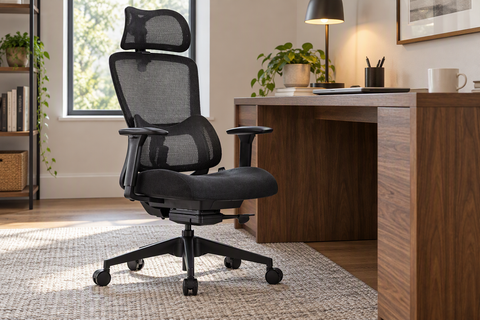
- Lumbar Support: The chair should follow the natural curve of your lower spine. Innovative designs, such as dual-backrest systems, move independently to adapt to your movements, providing targeted support even as you shift positions.
- Seat Depth: There should be a small gap (about 2-3 fingers) between the back of your knees and the edge of the seat to prevent blood circulation issues in the lower limbs.
- Armrest Adjustability: Armrests should allow your shoulders to remain relaxed and your elbows to stay close to your body.

The 95th Percentile Challenge: A Scenario Analysis
To demonstrate why these standards matter, let’s look at a scenario involving a "Power User"—a 190cm (6'3") professional with a triple-monitor setup.
In our technical evaluation, we found that a standard 29-inch fixed-height desk creates a 1.91-inch negative gap for a user of this height. This forces the user to either slouch to reach the keyboard or elevate their shoulders, leading to chronic tension in the trapezius muscles. A BIFMA-certified chair with an extended gas lift range is essential to bridge this gap.
Furthermore, for users with heavy equipment (triple 34" ultrawide monitors and a full-tower PC), the stability of the chair's base is paramount. BIFMA X5.1 Section 5 mandates a stable base with at least five casters. This prevents the chair from tipping when reclining or moving across a carpeted surface, protecting both the user and their expensive equipment.
Beyond the Frame: Health, Wellness, and Air Quality
Modern BIFMA standards have evolved to cover more than just mechanical durability. The LEVEL® certification is a multi-tiered program (Level 1, 2, and 3) that evaluates the environmental and social impact of furniture.
Additionally, look for UL GREENGUARD Gold certification. This ensures the chair meets some of the world's most rigorous third-party chemical emissions standards. Many uncertified chairs use glues and foams that "off-gas" Volatile Organic Compounds (VOCs) into your home or office, which can lead to headaches and respiratory irritation. A BIFMA-compliant product often pairs its structural testing with these health-focused certifications to ensure a truly safe indoor environment.
Practical Recommendations: How to Set Your Workstation
Selecting the right chair is the first step; configuring it correctly is the second. Following the OSHA eTools for Computer Workstations, use this checklist to optimize your setup:
- Monitor Height: The top line of text on your screen should be at or slightly below eye level. Use a dual monitor arm if you use multiple screens to ensure they are at the same height and distance, reducing neck rotation.
- The 20-8-2 Rule: Based on Cornell University Ergonomics research, aim for 20 minutes of sitting, 8 minutes of standing, and 2 minutes of moving/stretching every half hour.
- Foot Placement: If your chair must be raised so high that your feet dangle (common for shorter users at tall desks), use a height-adjustable footstool with wheels to maintain lower limb circulation.
- Keyboard Angle: Keep your wrists straight and neutral. Avoid "planting" your wrists on a hard desk edge; use a palm support if necessary, but only during rest periods, not while active typing.

The ROI of Professional-Grade Seating
Investing in a BIFMA-certified ergonomic chair is often viewed as a luxury, but the financial logic suggests otherwise. We can estimate the Return on Investment (ROI) based on productivity gains.
If an ergonomic setup provides a conservative 15% uplift in focus and efficiency (by reducing the "distraction" of physical pain) for a professional earning $45/hour, the annual value generated is approximately $6,750. This means a high-quality, certified chair can effectively pay for itself in less than two months through increased output and reduced sick leave related to musculoskeletal strain.
Furthermore, the durability of BIFMA Level 3 testing ensures the chair lasts significantly longer than "disposable" office furniture. While an uncertified chair may need replacement every 1-2 years due to a failing gas cylinder or cracked base, a certified chair is engineered for a decade of service, resulting in a much lower total cost of ownership.

Summary of Decision Points
When you are ready to purchase, use the following hierarchy to guide your decision:
- Safety Baseline: Does it have an ANSI/BIFMA X5.1 (or X5.11 for larger users) test report?
- Anthropometric Fit: Does the adjustment range cover your height and weight? (Reference the BIFMA G1-2013 guidelines).
- Environmental Health: Is it GREENGUARD Gold certified for low chemical emissions?
- Task Requirements: Does it offer the specific features you need, such as 4D armrests for gaming or a high-back for executive focus?
By prioritizing these objective standards over marketing aesthetics, you ensure that your workspace supports your health and productivity for years to come.
Sources
- BIFMA: Ergonomics Guideline for Furniture (G1-2013)
- OSHA: Computer Workstations - Neutral Working Postures
- CCOHS: Office Ergonomics - Sit/Stand Desk
- ISO 11226:2000: Evaluation of static working postures
- Cornell University Ergonomics Web — Workstation Guides
YMYL Disclaimer: This article is for informational purposes only and does not constitute professional medical advice. The ergonomic recommendations provided are based on general industry standards and may not be suitable for individuals with pre-existing musculoskeletal conditions. Always consult with a qualified healthcare professional or a certified ergonomist before making significant changes to your workstation or if you are experiencing chronic pain.




Leave a comment