

Why does a professional workstation that feels sturdy on the first day begin to wobble, squeak, or tilt after only six months of use? For facility managers and B2B procurement officers, the answer often lies in the invisible gap between "consumer-grade" aesthetics and "contract-grade" engineering. In an environment where furniture must support 24/7 operations, heavy hardware, and diverse user demographics, the cost of failure extends far beyond the price of a replacement. It manifests in decreased productivity, increased liability, and the prevalence of workplace injuries.
The Business and Institutional Furniture Manufacturers Association (BIFMA) serves as the gatekeeper for these standards. Understanding these rigorous testing protocols is not merely a technical exercise; it is a fundamental requirement for ensuring long-term Return on Investment (ROI) and user safety.
The Physiological Cost of Substandard Equipment
The human body is not designed for the static loads imposed by modern office work. Prolonged sitting or standing in poorly supported positions leads to Musculoskeletal Disorders (MSDs), which remain a primary driver of workplace absenteeism. According to the EU-OSHA 2019 Report on MSDs, these conditions represent a significant economic burden due to healthcare costs and lost productivity.
When a chair lacks adequate lumbar support or a desk cannot be adjusted to the user’s spinal neutral position, the body compensates. This compensation triggers a cascade of physiological issues:
- Static Load: Muscles remain contracted to maintain posture, restricting blood circulation and leading to localized fatigue.
- Tissue Adaptation: Over time, ligaments and tendons may shorten or lengthen unnaturally, making the user more susceptible to Repetitive Strain Injury (RSI).
- Disc Pressure: Improper seating increases the intradiscal pressure in the lumbar spine, accelerating degenerative changes.
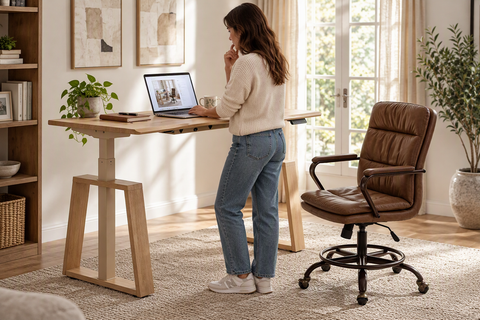
Interventions such as sit-stand desks have been shown to mitigate these risks. A systematic review by Cochrane (2018) concluded that sit-stand desks can significantly reduce sitting time by approximately 84 to 116 minutes per day. However, the effectiveness of these tools depends entirely on their structural integrity and adjustability range.
Decoding the BIFMA Framework: Beyond the Logo
BIFMA standards are the industry benchmark for safety, durability, and structural adequacy. Unlike basic weight capacity claims—which often only measure what a product can hold before collapsing—BIFMA tests simulate years of aggressive use.
ANSI/BIFMA X5.1: The Gauntlet for Office Seating
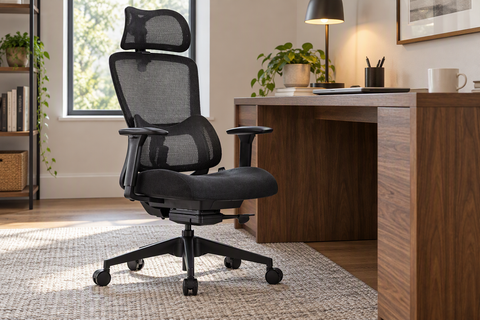
For ergonomic office chairs, the X5.1 standard is the definitive guide. It includes a series of tests that address the most common failure points identified by professional auditors.
- Seat Durability Test: A 225-pound impactor is dropped onto the seat thousands of times. Experts note that failure rarely occurs in the foam itself; instead, the seat pan substrate or the mounting hardware typically fails first. This leads to the characteristic "squeak" or instability that plagues low-quality seating.
- Backrest Strength: This test applies heavy force to the backrest to ensure it can support users who lean back forcefully without the mechanism snapping or the frame deforming.
- Cyclic Testing: Components like casters and swivel mechanisms are subjected to tens of thousands of cycles to ensure they remain functional over a 5-to-10-year lifespan.
ANSI/BIFMA X5.5: Stability and Safety for Desks
When evaluating height-adjustable desks, the X5.5 standard focuses on stability under load. A critical component is the Tip-Over Test, where a 220-pound load is applied at the desk's edge.
| Test Category | BIFMA Standard Requirement | Real-World Implication |
|---|---|---|
| Stability (Static) | 220-lb load at edge without tipping. | Prevents accidents if a user leans heavily on the desk. |
| Concentrated Load | Force applied to the most vulnerable points (not just the center). | Ensures the frame doesn't buckle under heavy monitor arms. |
| Cycle Testing | Thousands of height adjustments under full load. | Guarantees motor and drive-screw longevity. |
| VOC Emissions | ANSI/BIFMA M7.1 compliance. | Ensures indoor air quality by limiting off-gassing. |
Note: Values are based on standard BIFMA X5.5 and M7.1 protocols.

Information Gain: The Enterprise Power User Scenario
To demonstrate the necessity of these standards, consider a "Power User" setup common in financial trading floors or engineering studios. These environments often exceed the testing parameters of standard consumer furniture.
The Setup Logic:
- Equipment: Three 34" ultrawide monitors, a full-tower liquid-cooled workstation, and heavy-duty monitor arms.
- Tabletop: Solid wood or high-density laminate (approx. 25 kg).
- Total Calculated Load: 94 kg (Equipment: 69 kg + Tabletop: 25 kg).
In this scenario, a standard single-motor desk with an 80 kg capacity reaches 117.5% utilization, representing a significant safety risk. The motor is likely to burn out, and the lack of structural reinforcement may lead to "monitor wobble," a common frustration that causes visual fatigue.
Conversely, a professional-grade dual-motor system with a 120 kg capacity operates at 78.33% utilization. This remains within the recommended 80% safety margin, ensuring smooth movement and long-term stability. Furthermore, choosing a desk with low-standby power (0.5W) as per modern sustainability standards can save approximately 14.78 kg of CO2 per unit annually compared to generic models with 5W standby draws.
The Hidden Risks: Static vs. Dynamic Forces
A common misconception in procurement is that a "passed" static test guarantees safety in all scenarios. As noted by industry researchers, standard BIFMA tests like the ANSI/BIFMA X5.5-2021 are primarily static procedures. They may not fully account for dynamic forces, such as a user suddenly catching themselves on the edge of a desk during a trip or the impact of a heavy object being dropped.
Facility managers should look for furniture that exceeds these minimums through:
- Wider Stance Bases: A wider footprint significantly lowers the center of gravity, mitigating tipping risks.
- Reinforced Leg-to-Frame Connections: Using higher-gauge steel and superior welding techniques prevents the "stress fractures" that often develop at weld points after months of real-world use.
- Safety Sensors: Anti-collision technology in electric desks acts as a secondary safety layer, preventing mechanical failure when the desk encounters an obstruction.

Practical Recommendations for Procurement and Setup
Selecting BIFMA-compliant furniture is the first step. The second is ensuring it is implemented according to established ergonomic principles.
1. The 20-8-2 Rhythm
According to the Cornell University Ergonomics Web, the ideal workday rhythm is not "sitting vs. standing," but rather constant movement. They recommend:
- 20 Minutes Sitting: In a neutral, supported posture.
- 8 Minutes Standing: To encourage blood flow and muscle engagement.
- 2 Minutes Moving: Gentle stretching or walking to reset the musculoskeletal system.
2. Monitor and Interface Alignment
Even the best desk cannot fix a poorly placed monitor. Following the OSHA eTools for Monitors, the top line of text should be at or slightly below eye level. This prevents the "forward head carriage" that leads to neck strain. Similarly, the CCOHS guide on office ergonomics emphasizes that the keyboard and mouse should be positioned so the wrists remain straight and the elbows are at a 90-degree angle.
3. Verification Checklist for Facility Managers
When reviewing bids for office furniture, use the following technical criteria to ensure compliance:
- Standard Specificity: Look for the specific version (e.g., BIFMA X5.1-2017) rather than a generic logo.
- Adjustment Range: Ensure desks meet the BIFMA G1-2013 Ergonomics Guideline, which covers the 5th to 95th percentile of the population.
- Air Quality: Confirm UL GREENGUARD Gold or BIFMA M7.1 certification to protect employees from Volatile Organic Compounds (VOCs).
- Anti-Tip Compliance: For storage units or desks with drawers, ensure compliance with CPSC STURDY / 16 CFR Part 1261.
Beyond Compliance: The ROI of Quality
Investing in BIFMA-tested furniture is a strategy for cost avoidance. While the initial capital expenditure may be higher than consumer-grade alternatives, the lifecycle cost is significantly lower. Professional furniture reduces the frequency of replacement cycles, minimizes the risk of workers' compensation claims related to MSDs, and supports a culture of wellness that can improve employee retention.
For more insights on how these standards impact the modern workspace, refer to our detailed guide on Why BIFMA Compliance Matters for Office Furniture ROI or explore the Health & Safety Checklist for Your Next Desk Purchase.
Disclaimer: This article is for informational purposes only and does not constitute professional medical, legal, or occupational safety advice. Ergonomic needs vary by individual; those with pre-existing musculoskeletal conditions should consult a qualified healthcare professional or ergonomist before making significant changes to their workstation setup.
Sources
- BIFMA Standards Overview
- CCOHS: Office Ergonomics - Sit/Stand Desk
- Cochrane: Workplace interventions for reducing sitting at work
- Cornell University Ergonomics Web — Workstation Guides
- EU-OSHA: Work-related musculoskeletal disorders report
- OSHA eTools: Computer Workstations
- WHO 2020 Guidelines on Physical Activity & Sedentary Behaviour




Leave a comment