

Note: This guide includes product examples from our Eureka Ergonomic collection to illustrate material principles in real-world professional setups.
Minimalist Textures: Choosing Fabrics That Won't Moiré on Cam
For content creators, streamers, and remote professionals, the visual quality of a video feed is a critical component of professional authority. However, a recurring technical frustration often emerges during high-definition broadcasts: a distracting, wavy, or shimmering pattern that appears to crawl across the back of an office chair. This phenomenon, known as the moiré effect, can undermine the visual clarity of a 4K stream and distract viewers from the content itself.
While many creators attempt to solve this through lighting adjustments or software filters, the root cause is often physical rather than digital. The interaction between the intricate weave of a chair’s fabric and the pixel grid of a high-resolution camera sensor creates a visual interference pattern that is difficult to eliminate in post-production. Understanding the material selection principles is essential for building a workstation that is both ergonomically sound and visually optimized.
The Physics of Visual Interference: Why Moiré Occurs
The moiré effect is a manifestation of spatial aliasing. In digital imaging, a camera sensor captures a scene by sampling light at discrete points (pixels). According to the Nyquist-Shannon sampling theorem, to accurately represent a pattern, the sampling frequency must be at least twice the frequency of the pattern itself.
When the repetitive pattern of a fabric weave—such as the grid of a mesh chair or the fine lines of a twill—approaches the spatial frequency of the camera's pixel sensor, the two grids "clash." This results in a new, lower-frequency pattern that does not exist in reality: the moiré pattern.
The Shift Toward High-Resolution Sensors
Ironically, the move toward higher-resolution cameras (4K and 8K) has exacerbated this issue. Modern cameras often omit the Optical Low-Pass Filter (OLPF), also known as an anti-aliasing filter, to maximize image sharpness. While this results in crisper details, it removes the hardware-level "blur" that traditionally prevented moiré. Consequently, the burden of preventing visual interference has shifted from the camera hardware to the physical environment and material choices.
Heuristic Note (Visual Interference Modeling): This table outlines a practical model of spatial frequency interaction based on standard professional streaming configurations.
Parameter Value/Range Unit Rationale / Source Category Camera Resolution 3840 x 2160 Pixels Standard 4K UHD output Pixel Pitch ~3.9–4.3 µm Typical for modern mirrorless sensors Viewing Distance 1.2–1.8 Meters Common distance for "talking head" setups Thread Density 120–250 TPI Range for standard upholstery fabrics Lighting Angle 30–45 Degrees Standard three-point lighting setup Practical Boundary: This model assumes a static camera. Moiré risk often increases with subject movement, as the pattern "crawls" across the sensor grid.
Material Analysis: Mesh vs. Leather vs. Fabric
Choosing a chair material requires balancing three often-conflicting goals: thermal comfort (breathability), musculoskeletal support, and visual performance. As detailed in The 2026 Workstation White Paper: Converging Ergonomic Science and Sustainable Engineering (Eureka Ergonomic Research), the integration of material science is now a core pillar of professional workstation design.
1. Mesh: The High-Risk Geometry
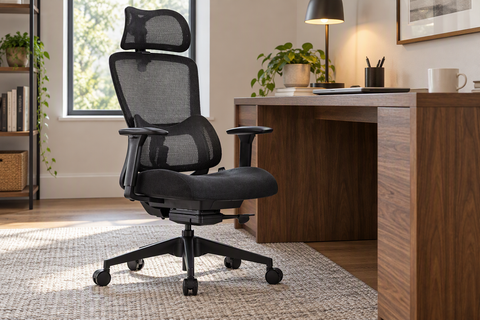
Mesh is favored for its airflow and ability to distribute pressure. However, from a visual standpoint, mesh is often the most challenging material for moiré. The regular, geometric nature of the weave—often featuring diamond or hexagonal patterns—interacts aggressively with camera sensors.
In our observations of professional setups, larger, more open diamond patterns are highly likely to produce moiré on 4K cameras. Conversely, a fine, micro-perforated mesh or a high-density hexagonal pattern is significantly safer. The Lira, Ergonomic Office Chair (Manufacturer Example) utilizes a modern silhouette with a mesh back designed to balance these requirements, but creators should always perform a camera test with their specific lighting.

2. Leather and Synthetic Alternatives: The Visual Safe Haven
For creators prioritizing a "clean" look, leather and high-quality synthetic alternatives are often the most reliable. Because these materials lack a visible woven grid, they are highly resistant to moiré patterns.
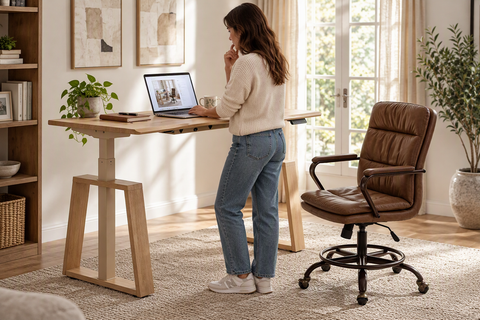
The primary concern with leather is glare. High-gloss finishes can reflect studio lights, creating "hot spots." A matte finish is critical. The Alto, Silicone Leather Executive Office Chair (Manufacturer Example) is an excellent example of a material choice that avoids both moiré and distracting glare. Silicone leather, in particular, offers a soft, matte texture that remains visually stable under intense studio lighting.
Similarly, the Regal, PU Leather Home Office Chair (Manufacturer Example) uses a suede-like texture that provides a non-reflective surface ideal for video production.
3. Fabric and Suede: The Thread Count Rule
If a fabric chair is preferred, the weave tightness becomes the primary determinant of visual quality.
The 180 TPI Heuristic: As a practical rule of thumb derived from studio testing, fabrics with a thread count above 180 threads per inch (TPI) tend to perform better on camera. Looser weaves below this threshold often create interference patterns that modern sensors cannot resolve correctly. Note: This is a heuristic/experience-based value; actual performance depends on your camera's sensor density and distance.
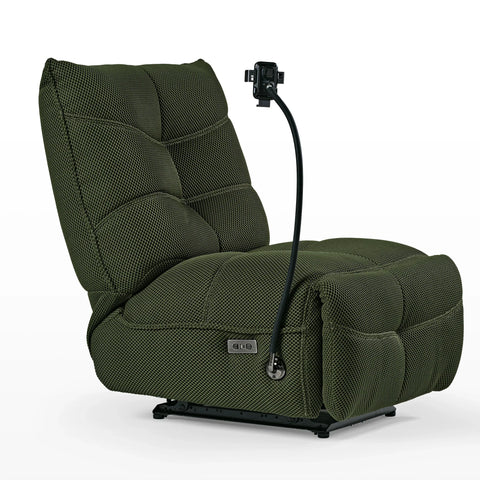
Materials like faux suede or velvet are excellent choices because their "pile" (the raised surface of the fabric) is irregular. This irregularity breaks up the geometric grid that causes moiré. The Becky, Ultra Soft Cushion Home Office Chair (Manufacturer Example) features a luxurious faux suede that offers a visually "quiet" background for streams.

Visual Comparison: What to Look For
When reviewing your footage, look for these two distinct visual signatures:
- Aliasing (The Shimmer): A flickering effect on the fabric as you move. This indicates the weave is right at the threshold of your sensor's resolution.
- Moiré (The Rainbow/Wave): Large, swirling patterns that may appear orange or blue. This is a sign of a high-contrast, regular weave that is incompatible with your current focal distance.
Ergonomic Integration: Beyond the Visuals
While visual performance is vital, it must not come at the expense of musculoskeletal health. A chair that looks perfect on camera but fails to support the spine can lead to discomfort or chronic pain.
Neutral Position and Support
According to the Occupational Safety and Health Administration (OSHA), an ergonomic chair must allow the user to maintain a neutral body position. This includes:
- Lumbar Support: The backrest should follow the natural curve of the lumbar spine.
- Adjustability: Seat height, armrests, and backrest tilt should be adjustable. The BIFMA G1-2013 Ergonomics Guideline provides recommended dimensions that cover the majority of the population.
- Dynamic Seating: The ISO 9241-5:2024 standard emphasizes that workstation layouts should encourage posture changes to reduce static load.
The Impact of Prolonged Sitting
The World Health Organization (WHO) 2020 Guidelines on Physical Activity and Sedentary Behaviour recommend interrupting long periods of static behavior. For content creators, choosing a chair that facilitates micro-movements—such as one with a responsive tilt mechanism—is essential.

Practical Recommendations for Camera-Ready Workstations
To ensure your setup is both professional and comfortable, follow these actionable steps derived from common patterns in professional studio environments.
The Pre-Purchase "Camera Test"
Static photos are often deceptive. Moiré often becomes pronounced only with subtle movement. If possible, perform a camera test:
- Use Your Actual Gear: Test with the exact camera and lens you intend to stream with.
- Match Output Resolution: Set the camera to your standard recording resolution (e.g., 4K at 60fps).
- Capture Movement: Record a short clip of the chair while moving the camera slightly or shifting your weight in the chair.
- Review Large: Review footage on a 27-inch+ display; moiré that is invisible on a small camera screen may be glaringly obvious to your viewers.
Optimizing the Studio Environment
If you already own a chair that produces slight moiré, you can mitigate the effect:
- Lighting Softness: Use large softboxes to diffuse light. Hard light emphasizes the shadows within a fabric weave, making the pattern more distinct.
- Depth of Field: Use a wider aperture (lower f-stop, like f/1.8). By slightly defocusing the background, you can blur the fabric weave enough to break the moiré pattern while keeping yourself sharp.
- Camera Angle: A slight shift in the camera’s angle (even 5–10 degrees) can change the relationship between the fabric grid and the sensor grid.
Ideal Setup Checkpoints
| Feature | Recommendation | Rationale |
|---|---|---|
| Material | Matte Leather or Tight-Knit Fabric | Minimizes glare and visual aliasing |
| Thread Count | >180 TPI (Heuristic) | High frequency reduces moiré risk in most setups |
| Lumbar Support | Adjustable Height/Depth | Aligns with OSHA Neutral Posture |
| Armrests | 3D or 4D Adjustment | Reduces trapezius strain during typing |
| Seat Edge | Waterfall Design | Maintains blood circulation in the lower limbs |

Balancing Aesthetics and Physiology
For the professional content creator, the workstation is more than just furniture; it is a production tool. Selecting a chair like the Regal, PU Leather Home Office Chair (Manufacturer Example) demonstrates an understanding that visual integrity and physical well-being are linked.
A chair that does not distract the viewer allows the creator's expertise and message to remain the focal point. By adhering to established ergonomic standards and applying the physics of material science, creators can build a sustainable, high-performance environment.
YMYL Disclaimer: This article is for informational purposes only and does not constitute professional medical advice. Ergonomic requirements vary significantly based on individual physical conditions. If you experience chronic musculoskeletal pain, consult a qualified physiotherapist or ergonomic specialist before making significant changes to your workstation.
References
- BIFMA G1-2013 Ergonomics Guideline for Furniture
- ISO 9241-5:2024 Workstation layout & postural requirements
- OSHA eTools: Computer Workstations - Chairs
- WHO 2020 Guidelines on Physical Activity & Sedentary Behaviour
- The 2026 Workstation White Paper: Converging Ergonomic Science and Sustainable Engineering
- Solving the Mystery of Moiré - Printwear & Promotion




Leave a comment