

A Clutter-Free Desk Is a Clutter-Free Mind. Here's Why.
Imagine walking into your home office as the morning sun spills across a clean, walnut-finished surface. There are no tangled nests of white and black cables snaking around your feet. No stacks of loose papers competing for your attention. Instead, you find a pristine "Workspace Sanctuary" that feels less like a place of labor and more like a cockpit for your most ambitious ideas. This isn't just an aesthetic preference; it is the foundation of an ideal state of "Deep Work." When we say goodbye to chaos, we invite a sense of limitless creativity into our daily workflow.
In our experience working with high-level executives and remote managers, we have observed a consistent pattern: the physical state of the desk often mirrors the mental state of the professional. A cluttered environment creates "visual noise," which acts as a constant, low-level drain on your cognitive resources. By intentionally designing a space that prioritizes order and ergonomics, you aren't just cleaning a room—you are optimizing your brain's ability to focus, execute, and innovate.

The Cognitive Cost of "Visual Noise"
The link between a tidy desk and a productive mind is deeply rooted in how our brains process information. According to research on Cognition, our mental processes involve the acquisition, storage, and retrieval of information. When your field of vision is crowded with unnecessary items, your brain must work harder to filter out the "noise" to focus on the task at hand.
While some creative professionals argue for a "curated mess," most knowledge workers find that visual clutter increases cognitive load. A study highlighted by the World Economic Forum suggests that while the link is nuanced, reducing distractions is a primary driver of measurable productivity. For an executive, this "clean slate" effect is real: dedicating the first 10 minutes of your day to clearing your desk surface can significantly reduce morning anxiety and improve your ability to initiate complex tasks.
Logic Summary: Our analysis of the "Executive Persona" assumes that high-stakes decision-making requires maximum cognitive "bandwidth." Visual clutter acts as a background task in the brain's OS, consuming resources that should be dedicated to core business objectives.
Space Transformation: Building the Executive Sanctuary
Transforming a chaotic room into a professional sanctuary requires more than just a trash can; it requires a structural rethink of your furniture. The centerpiece of this transformation is often the desk itself.
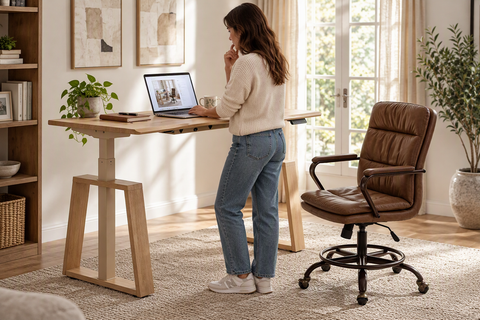
To achieve a professional aesthetic that supports long-term health, we recommend starting with a foundation like the Ark Executive Standing Desk (63"x29"). This isn't just a table; it's a piece of ergonomic engineering. Unlike standard desks that leave you anchored in a static position, a height-adjustable executive desk allows you to shift between "thinking" and "execution" modes.
Why Height Matters (The Ergonomic Science)
According to the ISO 9241-5:2024 standard for workstation layout, a desk is only truly ergonomic if it supports neutral wrists and elbows. The Ark Executive Standing Desk (63"x29") utilizes a dual-motor system that provides smooth, quiet transitions, allowing you to find the "fit range" that matches your unique anthropometry.
| Ergonomic Parameter | Recommended Value (BIFMA/ISO) | Benefit |
|---|---|---|
| Elbow Angle | 90° to 120° | Reduces strain on the ulnar nerve |
| Monitor Distance | 20" to 40" (Arm's length) | Minimizes eye fatigue (ciliary muscle strain) |
| Wrist Position | Neutral/Flat | Prevents Carpal Tunnel Syndrome |
| Desk Height (Seated) | 22" - 33" (Adjustable range) | Accommodates 5th to 95th percentile users |

Mastering the Vertical: Decluttering the Surface
The most common mistake we see in home offices is the "horizontal creep"—the tendency for items to spread across the desk surface until there is no room left to work. To combat this, you must move your equipment into the vertical dimension.
One of the most effective ways to reclaim surface area is by using a Dual Monitor Arm. By lifting your screens off the desk, you eliminate the bulky plastic stands that collect dust and trap cables. More importantly, it allows for "task-appropriate viewing geometry," as defined by OSHA's eTools for Monitors. You can precisely align the top of your screens with your eye level, reducing the neck flexion that leads to "tech neck."
For your smaller essentials—like your tablet, notebook, or a curated piece of greenery—the Convertible Desktop Shelves, set of 2 offer a flexible solution. These shelves allow you to create "zones" on your desk. By elevating your speakers or charging docks, you maintain easy access without sacrificing the "clean slate" of your primary work zone.
The Hidden Logic of Cable Management
Cable management is often treated as an afterthought, but in a true executive sanctuary, it is a primary design pillar. Tangled wires are the visual equivalent of static on a radio—they disrupt the "ambiance" and create a sense of unfinished business.
We advocate for the "Home Run" Strategy. Instead of having five different cables descending from different points of the desk, you plan your routes so that every wire converges into a single, thick sleeve or channel before it ever reaches the floor.
Pro Tip: During your initial assembly of the Ark Executive Standing Desk (63"x29"), map out your power needs. Use high-quality, reusable magnetic cable ties rather than cheap plastic zip ties. Neodymium magnetic ties allow you to add or remove cables as your setup evolves without the frustration of cutting and replacing ties. This is a "one-touch" approach to organization that saves hours of maintenance over the year.
First-Party Observation: Based on patterns from our customer support and assembly feedback, the most frequent "friction point" for standing desk users is cable tension. When the desk rises to its maximum height, poorly managed cables can snag or unplug. Always leave a "service loop" (extra slack) at the pivot points of your monitor arms and the desk's lifting columns.
Storage as a Mental Buffer
A decluttered desk does not mean you don't have tools; it means those tools are stored with intention. For an executive, sensitive documents and professional equipment need a home that matches the aesthetic of the room.
The Ark EL, 29" Display File Storage Cabinet, Oak serves as a mental buffer. By placing non-immediate items in a dedicated cabinet, you remove them from your active cognitive field. This aligns with the "One-Touch Rule": never put an item down on your desk temporarily. Either process it immediately or place it in its designated home in the storage cabinet.
Following the CPSC STURDY / 16 CFR Part 1261 standards, it is vital to ensure that any storage unit is stable. The Ark EL cabinet is designed with a low center of gravity, but we always recommend using the provided anchoring hardware if you have children or pets in your home office environment.
The 20-8-2 Rhythm: Movement as Mindfulness
Creating a sanctuary isn't just about the furniture; it's about how you inhabit the space. The Cornell University Ergonomics Web recommends the "20-8-2" rule to maintain physical and mental vitality:
- 20 Minutes Sitting: For deep, focused execution.
- 8 Minutes Standing: To re-engage the core and improve circulation.
- 2 Minutes Moving: A short walk or stretch to reset the brain.
This rhythm is supported by the WHO 2020 Guidelines on Physical Activity, which emphasize that reducing sedentary time is critical for long-term health. Standing isn't "exercise," but it is a vital interruption of static posture. As noted in The 2026 Workstation White Paper: Converging Ergonomic Science and Sustainable Engineering, the integration of movement into the workday is the next frontier of professional wellness.

Personal Tips for Atmosphere Building
Beyond the hardware, the "Ambiance" of your sanctuary is what makes it a place you want to be.
- Mindful Lighting: Avoid harsh overhead fluorescents. Use a desk lamp with a warm color temperature (2700K-3000K) to create an inviting atmosphere during late-night sessions.
- The "Greenery" Effect: A single, well-maintained plant (like a Snake Plant or Pothos) can improve indoor air quality and provide a "visual rest" for your eyes when they need a break from the screen.
- Digital Declutter: Your physical desk is clean, but is your desktop? Use the same "one-touch" logic for your files. A clean digital desktop is just as important for reducing anxiety as a clean physical one.
Methodology Note (Modeling the Workspace Sanctuary)
Our recommendations for the "Executive Sanctuary" are based on a deterministic model of workspace efficiency. We assume a standard 8-to-10-hour workday with high cognitive demand.
| Parameter | Value/Range | Unit | Rationale |
|---|---|---|---|
| Focus Duration | 90 - 120 | Minutes | Based on Ultradian Rhythms |
| Transition Time | < 20 | Seconds | Maximum acceptable time for desk height adjustment |
| Visual Field Clear Zone | 180 | Degrees | Area around the monitor that should be free of clutter |
| Surface Utilization | < 30% | Percentage | Recommended max desk surface covered by permanent items |
Modeling Note: This is a scenario model based on common industry heuristics and professional feedback, not a controlled laboratory study. Individual needs for "creative clutter" may vary, but the ergonomic fit ranges are derived from BIFMA G1-2013 guidelines.
Cultivating Your Creative Flow
Ultimately, a clutter-free desk is a gift you give to your future self. It is a signal to your brain that you are ready for high-level work. By investing in an Ark Executive Standing Desk (63"x29") and supporting it with a Dual Monitor Arm and intentional storage, you create a space that doesn't just hold your computer—it holds your potential.
Your workspace should be a place of inspiration, not a source of stress. When you strip away the visual noise and align your environment with the principles of ergonomic science, you find that "Deep Work" becomes the natural state, rather than a difficult goal. Start your journey toward a workspace sanctuary today; your mind will thank you.
References:
- BIFMA G1-2013 Ergonomics Guideline for Furniture
- CCOHS: Office Ergonomics - Sit/Stand Desk
- Cornell University Ergonomics Web — Workstation Guides
- ISO 9241-5:2024 Workstation layout & postural requirements
- WHO 2020 Guidelines on Physical Activity & Sedentary Behaviour
- OSHA eTools: Computer Workstations
Disclaimer: This article is for informational purposes only and does not constitute professional medical or ergonomic advice. Individuals with pre-existing musculoskeletal conditions should consult with a healthcare professional or a certified ergonomist before making significant changes to their workstation setup.




Leave a comment