

Stop Making These 7 WFH Desk Setup Mistakes Right Now
Is your home office reaching its full potential, or is it quietly undermining your health and productivity? For the modern executive, the transition to remote work often meant replicating a professional environment within a residential space. However, a "professional look" does not always equate to professional ergonomics. Even the most meticulously designed workspaces frequently harbor hidden configuration errors that lead to chronic fatigue, musculoskeletal strain, and diminished cognitive focus.
This guide identifies the seven most prevalent errors found in high-end home office setups. By applying rigorous ergonomic principles and architectural engineering standards, we will examine why these mistakes occur and how to rectify them using a science-first approach. As detailed in The 2026 Workstation White Paper: Converging Ergonomic Science and Sustainable Engineering, the integration of advanced mechanical support with human-centric design is no longer optional—it is a prerequisite for long-term professional endurance.
1. The "Statue" Trap: Relying on Static Posture
The most significant misconception in office ergonomics is the search for a single "perfect" posture. Many professionals invest in high-end furniture only to remain in a fixed position for eight hours. This creates a "static load" on the musculoskeletal system, which restricts blood circulation and leads to metabolite accumulation in the muscle tissues.
According to the ISO 11226:2000 standard for the evaluation of static working postures, maintaining any fixed joint angle for prolonged periods increases the risk of Musculoskeletal Disorders (MSDs). The physiological reality is that the human body is designed for movement. Static sitting compresses the intervertebral discs and reduces the efficiency of the "muscle pump" in the legs, which is responsible for returning blood to the heart.
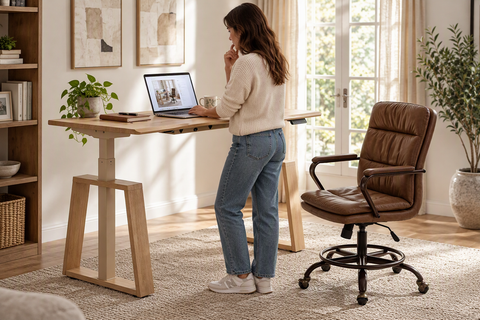
The Solution: Transition to a sit-stand workflow. The Ark Executive Standing Desk (63"x29") utilizes a dual-motor system to facilitate smooth, quiet transitions that encourage movement without disrupting deep-focus work. The goal is not to stand all day, but to interrupt sedentary patterns.
2. Miscalculating Desk Height: The "Hunch and Shrug"
A common error is accepting the "standard" desk height of 29 or 30 inches as a universal truth. For many users, this height is either too high, causing the shoulders to shrug, or too low, leading to a perpetual spinal hunch.
In our scenario modeling for a 185cm (approx. 6'1") male executive, we found that the standard 74cm (29-inch) desk height actually creates a 2.5cm deficit compared to the recommended ergonomic sitting height of 76.5cm. While two centimeters may seem negligible, it forces the user into a slight forward lean to reach the keyboard, placing excessive torque on the cervical spine.
Modeling Note: Ergo-Precision Anthropometric Calculation
Our analysis for a tall male professional (185cm) assumes the following parameters based on BIFMA G1-2013 Ergonomics Guidelines:
Parameter Value Rationale User Stature 185 cm 90th percentile male height Shoe Correction 2.5 cm Standard executive footwear Recommended Sit Height 76.5 cm Derived from popliteal and elbow height ratios Recommended Stand Height 113.5 cm Aligns elbows at 90-100 degrees Standard Desk Height 74.0 cm Industry default (creates a 2.5cm deficit) Boundary Condition: This model assumes a neutral typing posture and may vary based on torso-to-leg length ratios.
The Solution: Use an adjustable desk with memory presets. By programming your specific anthropometric heights into the controller of an Ark EL Executive Standing Desk (60"x26"), you ensure that your elbows remain at a 90-degree neutral position, significantly reducing the risk of carpal tunnel strain and trapezius fatigue.

3. The "Neck Crane" Effect: Poor Monitor Alignment
Even with a high-performance desk, users often fail at the final stage: screen placement. The OSHA eTools for Computer Workstations specify that the top of the monitor should be at or slightly below eye level. When the monitor is too low, it triggers "text neck," where the weight of the head (approx. 10-12 lbs) places up to 60 lbs of pressure on the neck as it tilts forward.
Furthermore, many executives use dual-monitor setups without considering the focal arc. If monitors are placed flat against each other, the user must constantly rotate their neck to see the edges, leading to cervical strain.
The Solution: Deploy a gas-spring monitor arm. The Dual Monitor Arm allows for 3-section adjustment, enabling you to set the height, tilt, and depth independently. This ensures your eyes remain in a "neutral gaze" zone, which is roughly 15 to 30 degrees below the horizontal line of sight.
4. Underestimating Load Capacity and Stability
A frequent oversight in WFH setups is the "wobble factor." A standard standing desk may feel stable at sitting height, but as it extends to 45 inches or higher, the center of gravity shifts. If the desk is loaded with heavy equipment—dual ultrawide monitors, a liquid-cooled PC tower, and professional audio gear—low-quality frames will exhibit significant screen shake during typing.
Based on our Battlestation Load Analysis, a fully equipped executive setup can easily reach 130 lbs (approx. 59kg). Desks with single motors or thin leg structures often operate at 95% of their capacity in these scenarios, leading to premature motor failure and structural instability.
The Solution: Look for dual-motor systems and robust leg architecture. The Ark X Executive Standing Desk (60"x26") features a specialized K-shaped wooden leg design and dual motors that provide a 120kg (264 lbs) capacity. This leaves a significant "safety margin," ensuring the desk remains rock-solid even at its maximum height extension.

5. Neglecting Cable Safety: The "Rat's Nest" Risk
Cable management is often treated as an aesthetic preference, but it is fundamentally a safety and equipment longevity issue. In a height-adjustable setup, cables must have enough slack to reach maximum height without tension, but enough organization to avoid tangling during descent.
Improperly managed cables are a leading cause of port damage on expensive GPUs and monitors. More critically, according to the NFPA 70 National Electrical Code, bundled power cables that are pinched or strained can create electrical fire hazards.
Methodology Note: Safe Cable Length Calculation
We calculated the minimum cable requirements for a standard 60-inch standing desk:
- Horizontal Travel: 24 inches (from monitor to leg drop).
- Vertical Travel: 48 inches (max height).
- Slack Buffer: 20% (to prevent connector strain).
- Result: A standard 6-foot cable is often insufficient; 10-foot cables are recommended for safe routing through integrated trays.
The Solution: Utilize integrated storage and deep cable trays. The Ark series desks include built-in drawers and dedicated cable management zones, allowing you to route power strips and data lines away from moving parts.
6. The "All-or-Nothing" Sit-Stand Rhythm
A common mistake among new standing desk users is trying to stand for several hours at a time. This often leads to "lower limb MSDs," including plantar fasciitis and varicose veins. The Canadian Centre for Occupational Health and Safety (CCOHS) emphasizes that standing too long is just as harmful as sitting too long.
The most effective approach is the "20-8-2" rule developed by Cornell University: 20 minutes of sitting, 8 minutes of standing, and 2 minutes of moving/stretching. This rhythm optimizes metabolic rate while preventing the fatigue associated with prolonged static standing.
The Solution: Use the memory preset buttons on your desk to toggle between these heights. Set a "standing" preset and a "sitting" preset, and use a simple timer to remind you to switch. This behavioral intervention, combined with the engineering of an ergonomic desk, provides the highest return on your health investment.
7. Ignoring the "Depth Deficit"
Workspace depth is the most underrated ergonomic variable. Most standard desks are 24 to 26 inches deep. When using modern 34-inch ultrawide monitors, this depth is insufficient to maintain a proper viewing distance.
Our geometric analysis shows that for a 34-inch 21:9 monitor, the recommended viewing distance for a 60-degree field of view is approximately 27 inches. On a 24-inch desk, the user is forced too close to the screen, increasing eye strain (digital eye strain syndrome) and forcing the neck into a retracted position to compensate for the proximity.
The Solution: Opt for a deeper desktop or use a monitor arm to "push back" the screens. The Ark Executive Standing Desk (63"x29") provides a 29-inch depth, which, when combined with a monitor arm, allows for the ideal focal distance for high-resolution displays.

Summary of Ergonomic Correctives
To help you audit your current setup, we have summarized the key metrics and standards discussed in this article:
| Component | Common Mistake | Ergonomic Standard / Target |
|---|---|---|
| Desk Height | Accepting "Standard" 29" | Neutral elbow height (varies by stature) |
| Monitor Height | Top of screen too low | Top of screen at eye level (OSHA) |
| Viewing Distance | Sitting too close (<20") | ~27" for 34" Ultrawide screens |
| Load Stability | Single motor / thin frame | Dual motor / Heavy-duty frame (e.g., Ark series) |
| Movement | Standing > 2 hours | 20-8-2 Rhythm (Cornell Ergo) |
| Cable Management | "Rat's Nest" / Taut cables | Integrated trays / 20% slack for travel |
Building a Professional Workspace
An executive home office should be a reflection of your professional standards—not just in appearance, but in performance. By moving away from "standard" configurations and adopting a setup grounded in anthropometric data and mechanical safety, you transform your workspace from a source of strain into a tool for longevity.
Whether it is the vintage charm and trapezoidal stability of the Ark EL or the sophisticated leather-and-wood fusion of the Ark X, the core objective remains the same: creating an environment that adapts to you, rather than forcing you to adapt to it.
Disclaimer: This article is for informational purposes only and does not constitute professional medical advice. Individuals with pre-existing musculoskeletal conditions or chronic pain should consult a qualified physiotherapist or occupational therapist before making significant changes to their workstation or work habits.
References
- BIFMA G1-2013 - Ergonomics Guideline for Furniture. Link
- OSHA eTools - Computer Workstations: Monitors and Desks. Link
- ISO 11226:2000 - Evaluation of static working postures. Link
- Cornell University Ergonomics Web - Workstation Setup Guides. Link
- CCOHS - Office Ergonomics: Sit/Stand Desks. Link
- The 2026 Workstation White Paper - Converging Ergonomic Science and Sustainable Engineering. Link
- NFPA 70 - National Electrical Code (NEC). Link




Leave a comment