

Why Executives Are Ditching the Stand for a Monitor Arm
For the modern executive, the home office is no longer a temporary arrangement; it is a high-stakes command center. Yet, many high-performance workspaces suffer from a subtle, pervasive flaw: the static monitor stand. While an executive desk may exude authority, a monitor positioned at the wrong height or angle acts as a silent drain on both physiological health and cognitive focus.
The transition from a factory-supplied stand to a professional-grade monitor arm is not merely an aesthetic choice. It is a strategic upgrade based on the principles of musculoskeletal health and workflow optimization. As we explore the convergence of ergonomic science and professional productivity, it becomes clear why the "fixed" workstation is being replaced by dynamic, adjustable systems.
The Physiological Cost of the Static Display
The human body is not designed for the prolonged static loading required by modern computer work. When a monitor is fixed to a standard base, it dictates the user's posture. In most executive setups, the factory stand is too low, forcing the user into a state of chronic neck flexion—often referred to as "tech neck."
According to the ISO 9241-5:2024 standard for workstation layout, the physical arrangement of equipment must support a "neutral" spinal position. When the head tilts forward by just 15 degrees to look at a low screen, the effective weight of the head on the cervical spine increases from roughly 12 pounds to 27 pounds. Over an eight-hour workday, this results in significant strain on the trapezius and levator scapulae muscles.
The Mechanism of Musculoskeletal Disorders (MSDs)
The European Agency for Safety and Health at Work (EU-OSHA) identifies prolonged static sitting as a primary risk factor for Work-related Musculoskeletal Disorders (WMSDs). Static loading restricts blood circulation to the muscle tissues, leading to the accumulation of metabolic waste products like lactic acid. This is why your back pain often worsens in the afternoon; it is the result of local muscle fatigue and tissue hypoxia caused by an inflexible workstation.
A monitor arm addresses this by allowing for "micro-adjustments." Unlike a fixed stand, a gas-spring arm enables the user to shift the screen height and angle as their posture naturally evolves throughout the day, maintaining the "ergonomic line" regardless of whether they are sitting upright, reclining, or standing.
Engineering the Solution: The Case for the Monitor Arm
In a premium home office, every square inch of the desktop is valuable. A traditional monitor base can occupy up to 15% of the usable primary work zone. By "floating" the display, a Single Monitor Arm reclaims this space, allowing for a cleaner, more organized environment that facilitates deep work.

The Advantage of Gas-Spring Technology
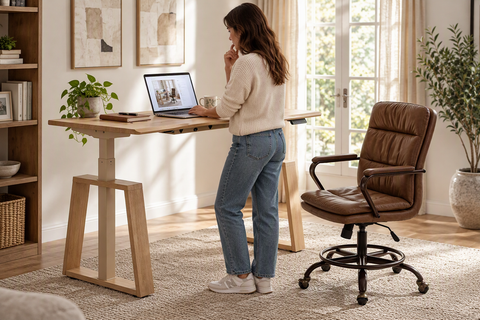
For executives who utilize sit-stand desks, the relationship between the desk height and the monitor height is dynamic. A common mistake is adjusting the desk but leaving the monitor in a fixed position relative to the desktop. This often results in the monitor being too low when standing, as the visual parallax changes.
Professional arms, such as the Single Monitor Arm, utilize gas-spring mechanisms. This allows for effortless, one-finger adjustments. As noted in the 2026 Workstation White Paper: Converging Ergonomic Science and Sustainable Engineering, the ability to align the screen height precisely with the eye level (the "top-third" rule) is critical for reducing ocular fatigue and cervical strain.
Logic Summary: Our recommendation for gas-spring arms is based on the need for frequent, low-friction adjustments during sit-stand transitions, which mechanical-bolt arms cannot provide without tools.
The Executive Foundation: Stability and Surface
A monitor arm is only as effective as the surface it is mounted to. For high-end setups involving dual 27-inch or 34-inch ultrawide displays, the torque applied to the desk edge is substantial. This requires a desk built with structural integrity and premium materials.
The Ark EL Executive Standing Desk (60"x26") is designed to handle these loads. Its trapezoidal leg design and heavy-duty frame provide the "zero-wobble" environment necessary for monitor arms. When a monitor arm is mounted to a flimsy desk, every keystroke can cause the screen to vibrate, leading to significant visual distraction and eye strain.

Material Integrity and Clamp Pressure
Executives should be cautious when mounting high-torque arms to desks made of thin veneers or honeycomb glass. The Ark EL Executive Standing Desk (60"x26") uses a robust oak texture veneer over a high-density core, which is capable of withstanding the concentrated pressure of a C-clamp mount. For added security, we recommend using a reinforcement plate to distribute the load across a larger surface area, preventing any long-term deformation of the desktop.
Deep Dive: The Tall Executive Scenario
Standard ergonomic advice often fails for users in the upper percentiles of height. For a tall executive (190cm+), the "standard" 29-inch desk height creates a compounding deficit in posture.
Modeling the 95th Percentile User
We modeled a scenario for an executive standing 193cm (6'4") tall to determine the specific requirements for a functional workspace.
| Parameter | Value | Rationale |
|---|---|---|
| User Height | 193cm | 95th percentile (US Male) |
| Recommended Seated Desk Height | ~79cm (31in) | ANSI/HFES 100-2007 Ratios |
| Monitor Height Deficit (on stand) | ~6cm (2.4in) | Standard stands lack sufficient lift |
| Viewing Distance (34" Ultrawide) | ~100cm (39in) | SMPTE EG-18-1994 FOV Guidance |
| Required Arm Extension | ~50cm+ | Necessary to bridge 30" desk depth |
Methodology Note: This model is a hypothetical scenario based on anthropometric averages and industry-standard FOV (Field of View) geometry. It is not a clinical study. Individual needs may vary based on torso-to-limb ratios.
For this persona, a monitor arm is not an accessory; it is a necessity. Without the additional 5-8 inches of vertical lift provided by a pole-mounted arm, a tall executive is forced into a permanent "hunch," leading to chronic upper-back tension.
Integrating the Holistic Workspace
While the monitor arm handles the visual interface, the rest of the body requires equal attention to maintain the "Neutral Position" defined by the BIFMA G1-2013 Ergonomics Guideline.
The Role of the Executive Chair
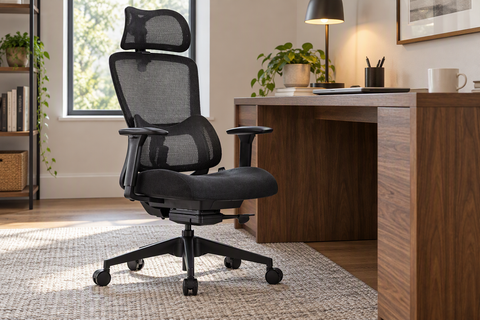
A high-performance display setup must be paired with a chair that supports the lumbar spine's natural curve. The Serene, Napa Leather Executive Office Chair provides the necessary structural support to complement a monitor arm. When the monitor is at the correct height, the user can fully utilize the chair's backrest, reducing the load on the spinal discs.

Lower Limb Circulation
Even with a standing desk, the World Health Organization (WHO) recommends interrupting long periods of static behavior. When seated, using an Adjustable Ergonomic Footrest helps maintain blood circulation in the lower limbs and reduces pressure on the underside of the thighs. This is particularly important for executives who spend long hours in virtual meetings, where movement is often restricted.
Practical Recommendations for Setup
To achieve a benchmark-level ergonomic setup, follow these actionable steps derived from OSHA's Computer Workstation guidelines:
- The Top-Third Rule: Adjust the monitor arm so that the top third of the screen is at or slightly below eye level. This ensures your gaze is naturally slightly downward, which is the most relaxed position for the eye muscles.
- The Arm's Length Rule: Position the monitor approximately 20 to 30 inches (50-75cm) from your eyes. If you are using a large 32-inch or ultrawide screen, you may need to increase this distance to avoid eye strain.
- Cable Management: Professional executives value a clean aesthetic. Ensure your monitor arm has integrated cable channels. Avoid plastic clips that may snap; look for arms with internal routing or woven sleeves.
- Sit-Stand Rhythm: Follow the Cornell University "20-8-2" rule: sit for 20 minutes, stand for 8 minutes, and move/stretch for 2 minutes. Your monitor arm should be adjusted slightly each time you change positions to account for the shift in your eye line.

The Business Case for Ergonomic Investment
From a management perspective, the ROI on ergonomic equipment is found in "presenteeism"—the ability of an executive to remain focused and productive throughout the day without being distracted by physical discomfort.
A systematic review published by Cochrane concluded that sit-stand interventions can significantly reduce sitting time by over 100 minutes per day. When paired with a monitor arm that maintains the ergonomic integrity of the workstation, this reduction in sedentary time translates to higher energy levels and improved long-term health outcomes.
The "hidden" cost of a cheap monitor stand is the cumulative fatigue it causes. For the executive tier, where decision-making quality is paramount, investing in a Single Monitor Arm and a stable foundation like the Ark EL Executive Standing Desk (60"x26") is a strategic move to safeguard their most valuable asset: their health.
Summary of Technical Specifications
When selecting your equipment, ensure it meets or exceeds these industry standards to guarantee safety and longevity:
| Component | Relevant Standard | Key Benefit |
|---|---|---|
| Desk Stability | ANSI/BIFMA X5.5 | Prevents monitor wobble during typing |
| Chair Safety | ANSI/BIFMA X5.1 | Ensures structural integrity for 8+ hours |
| Desk Safety | UL 962 | Verified electrical and mechanical safety |
| Monitor Layout | ISO 9241-5 | Optimizes visual and postural health |
| Indoor Air Quality | UL GREENGUARD Gold | Low chemical emissions for home offices |
By prioritizing these certifications and technical requirements, executives can create a home office that is not only sophisticated in design but also a benchmark for professional ergonomics.
Disclaimer: This article is for informational purposes only and does not constitute professional medical advice. Individuals with pre-existing musculoskeletal conditions or chronic pain should consult a qualified physiotherapist or ergonomic specialist before making significant changes to their workstation.
References
- BIFMA G1-2013 Ergonomics Guideline for Furniture
- Canadian Centre for Occupational Health and Safety (CCOHS): Office Ergonomics
- ISO 9241-5:2024 Workstation layout & postural requirements
- OSHA eTools: Computer Workstations - Monitors
- The 2026 Workstation White Paper: Converging Ergonomic Science and Sustainable Engineering
- WHO 2020 Guidelines on Physical Activity & Sedentary Behaviour
- Cochrane: Workplace interventions for reducing sitting at work




Leave a comment