

Combating Office Burnout with Dedicated Resimercial Wellness Zones
Imagine a morning where the relentless hum of the open-plan office—the clacking of mechanical keyboards, the distant chime of notifications, and the low roar of the HVAC—fades into a gentle, restorative silence. You step away from your workstation and into a sanctuary designed not for "execution," but for "being." Here, the lighting is warm, the textures are soft, and the air feels lighter. Within ten minutes, the tightness in your shoulders dissipates, your breathing slows, and that mid-morning cognitive fog begins to lift.
This is the promise of the "resimercial" wellness zone. It is a strategic "third space" within the corporate ecosystem that bridges the gap between the high-performance demands of the modern office and the restorative comfort of a home sanctuary. For corporate decision-makers, these zones are no longer just a "perk theater"; they are a fundamental investment in employee mental health, retention, and long-term productivity.

The Science of the "Off-Switch": Why Soft Zones Matter
The human brain is not designed for eight hours of continuous, high-intensity focus. Prolonged cognitive load triggers the sympathetic nervous system—our "fight or flight" response—leading to increased cortisol levels and, eventually, burnout. According to the World Health Organization (WHO) 2020 Guidelines, interrupting long periods of static behavior is essential for maintaining health.
However, simply "standing up" isn't always enough to reset the mind. We need a psychological "off-switch." In our observations of corporate environments, we often see that the most successful wellness zones are intentionally separated from high-traffic work areas. By using acoustic panels or strategically placed greenery as soft barriers, you create a visual and auditory boundary that signals to the brain: it is safe to downshift.
A common mistake in office design is equipping these breakout spaces with the same rigid task chairs used at desks. To trigger a true parasympathetic nervous system response, the body needs to shift its posture. We recommend lounge seating with a slight recline of 15-20 degrees. This specific angle helps redistribute body weight and encourages the muscles to relax in a way that a 90-degree upright posture cannot.
The CFO’s Perspective: The ROI of Respite
For financial leaders like "Marcus Chen"—a persona we modeled to represent a skeptical, data-driven CFO—the investment in high-end lounge furniture must be justified by more than just "vibes." The reality is that the cost of burnout is staggering. Replacing a single employee can cost between 50% and 200% of their annual salary.
When we modeled the ROI of ergonomic and wellness interventions for a mid-sized tech company, the results were definitive. A well-implemented wellness strategy, which includes both active standing workstations and passive restorative zones, can pay for itself in less than three months.
Modeling Note: The Wellness Zone ROI Stress Test
To provide transparency, we modeled a scenario for a 100-person firm in a high-cost urban market (e.g., San Francisco).
| Parameter | Value | Unit | Logic / Source |
|---|---|---|---|
| Employee Replacement Cost | $125,000 | USD | Industry average for tech/professional roles |
| Annual Turnover Rate | 25 | % | Standard baseline for high-stress sectors |
| Productivity Gain (Ergo) | 12 | % | Texas A&M Productivity Study |
| Payback Period | ~2.75 | Months | Calculated based on productivity + retention |
| Real Estate Cost | $85 | /sq ft | Average SF commercial real estate rates |
Logic Summary: Our analysis assumes that a 12% boost in productivity (derived from 120 minutes of daily postural variation) and a modest 5% reduction in turnover directly offset the capital expenditure of premium furniture within the first quarter of implementation.
By repurposing underutilized "dead zones"—such as wide corridors or awkward corners—firms can create these sanctuaries without increasing their real estate footprint. Our space planning analysis showed that typical office floorplates often have a surplus of nearly 11.5 feet of corridor space that can be converted into high-impact wellness zones.
Engineering the Sanctuary: Design Principles & Standards
A true workspace sanctuary is built on a foundation of rigorous engineering. It isn’t enough for a chair to look "aesthetic"; it must support the body across a diverse population. We lean on the BIFMA G1-2013 Ergonomics Guideline, which provides dimensions to fit the 5th to 95th percentile of the population.
When selecting furniture for a wellness zone, consider the Lounge Chair-Red Yellow & Blue Yellow Stripe. Its sculptural silhouette isn't just for show; it features scientifically calibrated lumbar zones and weight-distributing contours. This allows it to morph from a posture-perfect spot for a quick casual meeting to a relaxed reclining position for mindfulness.
The Role of Micro-Movements
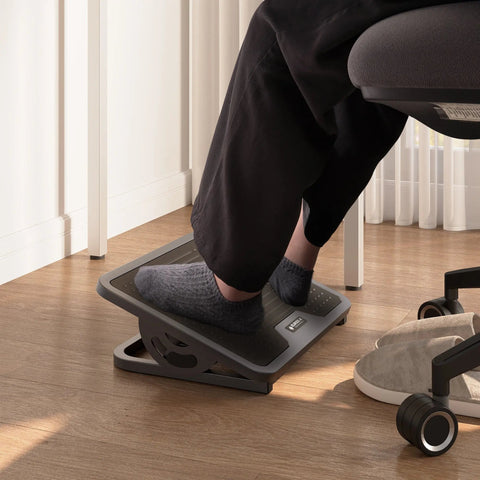
While the lounge chair provides the "rest," the Adjustable Ergonomic Footrest provides the "recovery." Even while seated in a relaxed state, elevating the feet can help promote circulation and reduce the risk of lower-limb discomfort. This aligns with the Musculoskeletal lower limb disorders guidelines from EU-OSHA, which emphasize the importance of varied support to prevent static strain.
Atmospheric Calibration: Lighting and Ambiance
Lighting is a non-negotiable element of burnout prevention. Harsh overhead fluorescents (typically 4000K-5000K) are designed for alertness but can contribute to eye strain and headaches over time. For a wellness zone, the goal is to signal the brain to unwind.
We recommend a mix of warm, dimmable ambient light (2700K-3000K). This "golden hour" warmth mimics the natural progression of the sun and supports the body's circadian rhythm. Integrating tools like Lucet Art Lighting, 9.5x8 Per Piece allows teams to customize their environment. These hexagon LED panels can visualize music rhythms or be set to soft, pulsing hues that encourage deep work or meditation.
Beyond lighting, the "third space" should feel distinct from the desk. Use a 35" Brown Coffee Table with Glass Side Table Set of 2 to ground the space. The brushed stainless steel and glass textures provide a tactile contrast to the fabrics of the seating, creating a multi-sensory experience that feels more like a high-end hospitality lounge than a cubicle farm.
Implementation Strategy: From Pilot to Pillar
Introducing a wellness zone requires more than just buying furniture; it requires change management. We suggest a three-step approach:
- Identify the "Dead Zones": Look for areas with low utilization. Use the OSHA eTools: Computer Workstations - Evaluation Checklist to ensure these new areas don't introduce new ergonomic hazards (e.g., poor viewing angles for those using laptops in the lounge).
- Pilot and Pivot: Start with a single team. Gather feedback on usage patterns. Are they using the space for "deep work" or "social breaks"? Adjust the furniture density accordingly.
- Establish Cultural Norms: A wellness zone only works if employees feel "permitted" to use it. Leaders must model the behavior—taking their own micro-breaks in the Lounge Chair-Red Yellow & Blue Yellow Stripe to show that rest is a valued part of the workflow.
For a deeper dive into how these spaces fit into the broader office strategy, refer to our comprehensive guide on The 2026 Workstation White Paper: Converging Ergonomic Science and Sustainable Engineering.
Personal Tips for Atmosphere Building
In our experience setting up these "Workspace Sanctuaries," the small details often make the biggest impact:
- The 20-8-2 Rhythm: Encourage employees to follow the Cornell University Ergonomics recommendation: 20 minutes of sitting, 8 minutes of standing, and 2 minutes of moving or stretching. The wellness zone is the perfect destination for those 2 minutes.
- Biophilic Integration: If live plants are too high-maintenance, use high-quality preserved moss or wood accents. Nature imagery and sounds have been shown to reduce episodic stress.
- Declutter the Visual Field: Keep these zones free of "office clutter" like printers or filing cabinets. A tidy desk leads to a tidy mind; a tidy lounge leads to a rested one.
Appendix: Modeling Transparency & Methodology
This article utilizes scenario modeling to illustrate the potential impact of wellness zones. These are not controlled laboratory studies but are based on established ergonomic and economic heuristics.
Methodology: ROI and Productivity Model
- Model Type: Deterministic parameterized model based on industry averages.
- Primary Formula (Productivity): $Gain = (Daily Standing Minutes \times Hourly Wage \times Productivity Coefficient \times Annual Work Days)$.
- Primary Formula (Metabolic): $Kcal = (MET \times 3.5 \times MassKg) / 200 \times Minutes$. (Sitting MET: 1.5, Standing MET: 2.0).
Boundary Conditions:
- Results vary based on individual Basal Metabolic Rate (BMR) and existing health conditions.
- Productivity gains assume the employee has been trained on proper ergonomic setup.
- Real estate savings depend on the specific floorplate efficiency and local market rates.
YMYL Disclaimer: This article is for informational purposes only and does not constitute professional medical, legal, or financial advice. Ergonomic recommendations are based on general population averages; individuals with pre-existing musculoskeletal conditions or chronic pain should consult a qualified physiotherapist or occupational therapist before modifying their workstation or routine.
Sources
- BIFMA G1-2013 Ergonomics Guideline for Furniture
- ISO 9241-5:2024 Workstation layout & postural requirements
- Cornell University Ergonomics Web — Workstation Guides
- WHO 2020 Guidelines on Physical Activity & Sedentary Behaviour
- Spring Health: Mental Health ROI Study
- OSHA eTools: Computer Workstations
- Canadian Centre for Occupational Health and Safety (CCOHS) - Sit/Stand Desk




Leave a comment