

Creating Your Workspace Sanctuary: The Corner Desk Evolution
Imagine a home office that sparks your limitless creativity—a corner of your apartment where the chaos of the outside world fades, replaced by a sense of calm, focused energy. For many remote workers and gamers, the dream of a "Workspace Sanctuary" often hits a literal wall: the limited square footage of urban living. Here, every inch must earn its keep. You’ve likely asked yourself: Is an L-shaped corner desk truly a spatial miracle, or is it just a clutter trap in disguise?
The journey from a cramped, uninspiring setup to a professional-grade workflow begins with understanding how geometry meets human biology. We aren't just placing furniture; we are transforming a static environment into a dynamic stage for deep work and mindfulness. In this guide, we will explore the practicalities of corner desks through the lens of ergonomic science and real-world apartment constraints, helping you decide if this transformation is right for your lifestyle.
The Space Transformation: Freestanding vs. Wall-Mounted Reality
When we envision a minimalist small-space solution, many of us first gravitate toward wall-mounted desks. They look elegant and occupy zero floor space. However, as experts often point out, the viability of wall-mounted furniture is non-negotiably contingent on load-bearing studs. In many modern apartments, you may find metal studs or even a lack of accessible structural support in older buildings. Attempting to mount a heavy workstation on drywall alone is a common pitfall that can lead to structural failure.
This is where a freestanding corner desk, like the L-Shaped Standing Desk with Accessories Set (60"x23"), offers a more reliable "After" state. It provides the stability of a traditional desk while utilizing the often-wasted real estate of a room's corner.
The "Sweep Zone" Heuristic
A common oversight when planning an L-shaped desk in an apartment is failing to account for the "sweep zone"—the arc needed for an office chair to rotate and slide out. Based on practitioner observations of room flow, we recommend leaving at least 30 to 36 inches of clear floor space in front of each desk wing. Without this buffer, the "space-saving" desk can actually make a room feel more cramped, blocking traffic paths or access to outlets.
Logic Summary: Our "Sweep Zone" analysis assumes a standard office chair with a 26-inch base diameter and a user requiring a 10-inch push-back distance for exit. This is a scenario model for high-traffic apartment layouts, not a controlled lab study.
| Parameter | Recommended Value | Rationale |
|---|---|---|
| Floor Clearance (Sweep Zone) | 30–36 inches | Allows for 360° chair rotation without hitting walls. |
| Desk Depth (Short Wing) | Monitor Depth + 10 inches | Prevents visual parallax and allows forearm support. |
| Wing Length | 48–60 inches | Aligns with BIFMA G1-2013 Ergonomics Guideline for reach zones. |
| Legroom Width | Min 20 inches | Based on OSHA eTools: Computer Workstations - Desks. |
Linking Functionality with Emotion: The Ergonomics of Deep Work
A desk is more than a surface; it is a tool for managing your physical and mental state. According to the World Health Organization (WHO) 2020 Guidelines on Physical Activity & Sedentary Behaviour, adults should aim to reduce long periods of static behavior. In the context of a home office, this means shifting between "thinking" and "execution" modes.
Standing isn't just about burning calories—it’s about a cognitive shift. When you transition from sitting to standing, you are signaling to your brain that it’s time for a different type of energy. A systematic review from Cochrane: Workplace interventions for reducing sitting at work indicates that sit-stand desks can significantly reduce sitting time by approximately 84 to 116 minutes per day.
Finding Your "Neutral"
To achieve a state of deep work, your body must be in a "neutral" posture. According to the Canadian Centre for Occupational Health and Safety (CCOHS), a proper sit/stand setup requires the desk height to align with your resting elbow height.
We can model the ideal desk height ($H_{desk}$) using this simple heuristic: $H_{desk} = H_{seat} + H_{elbow} + \Delta_{wrist}$
- $H_{seat}$: Your seat height from the floor (accounting for cushion compression).
- $H_{elbow}$: The vertical distance from the seat to your elbow.
- $\Delta_{wrist}$: A small offset (usually 0–20 mm) for neutral wrist alignment.
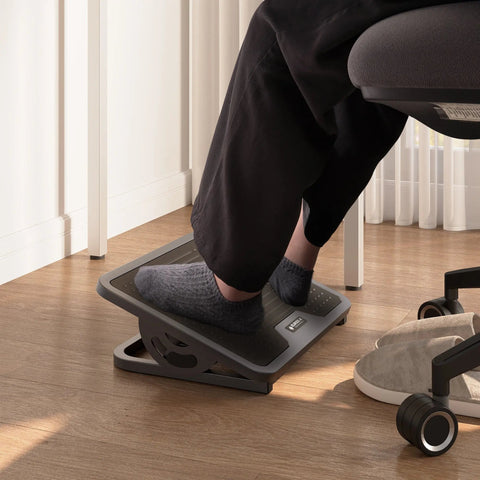
By using an adjustable desk, you can fine-tune these measurements to avoid the "shoulder shrug" or "wrist extension" that leads to chronic strain. For those who find their feet dangling or back arching, adding an Adjustable Ergonomic Footrest can help maintain the neutral spinal posture recommended by OSHA eTools: Neutral Working Postures.

The Clutter Trap: Why Organization is an "Aesthetic" Choice
A common critique of L-shaped desks is that they become "clutter magnets." Because you have more surface area, it’s easy to let papers, cables, and coffee mugs migrate into the corner "dead zone." Professional organizers suggest that an L-shape requires a deliberate system to maintain its ambiance.
Space-Saving Accessories
To truly declutter, you must move items off the desktop and into the vertical or under-desk space.
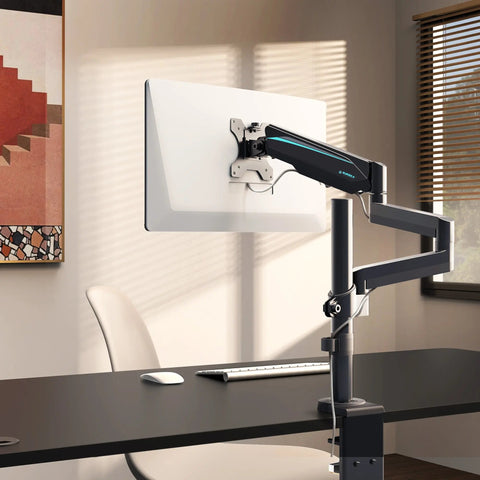
- Monitor Mounting: Using a Single Monitor Arm allows you to reclaim the space taken up by bulky monitor stands. This also aligns with ISO 9241-5:2024 requirements for adjustable viewing angles, reducing neck rotation and fatigue.
- CPU Suspension: In tight apartment corners, floor space is precious. A Knob-operated Adjustable CPU Holder keeps your PC tower off the ground, protecting it from dust and pet hair while ensuring that cables move seamlessly with your desk as it rises.
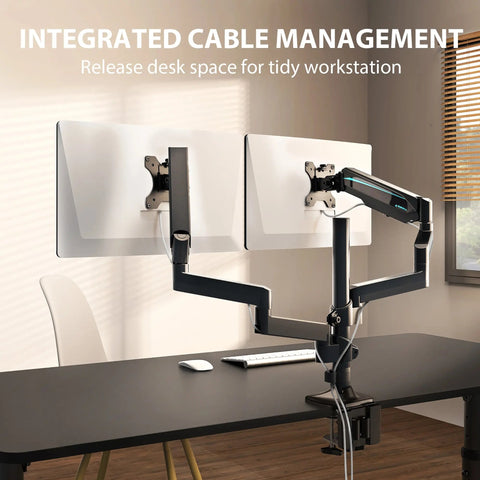
- Cable Management: Experience shows that for tight corners, using flat adhesive cable channels along the desk legs is often more effective than standard trays. This prevents the "cable waterfall" that ruins a clean aesthetic.

Sharing Personal Tips: Building Your Ambiance
Beyond the technical specs, your workspace sanctuary needs a soul. Here is how I personally recommend setting up a corner for maximum inspiration:
- The 20-8-2 Rhythm: Follow the Cornell University Ergonomics recommendation: 20 minutes sitting, 8 minutes standing, and 2 minutes of moving or stretching. This prevents the "prolonged static standing" risks highlighted by OSHwiki.
- Lighting and Greenery: Place your L-shaped desk near a window if possible, but be mindful of glare. According to HSE: Working safely with display screen equipment (DSE), controlling light levels is crucial for eye health. A small plant in the corner "dead zone" can soften the hard angles of the desk and improve air quality.
- The Roommate Factor: If you share your apartment, be aware that an L-shaped desk occupies "premium corner real estate." This can sometimes lead to perceived unfairness regarding floor space. I find that using a desk with a smaller footprint, such as a 60-inch model, balances personal productivity with shared living harmony. You can read more about this in our guide on L-Shaped Desk vs. Straight: Which Fits a Small Office?.

Is It Worth It? The Final Verdict
The "worth" of a corner desk depends on your commitment to the setup. If you simply buy the desk and let it collect clutter, it may make your apartment feel smaller. However, if you treat it as a cornerstone of your Ergonomic Workstation Blueprint, the benefits are clear.
An L-shaped desk provides:
- Defined Zones: One wing for computer work, one for creative "analog" tasks or gaming.
- Ergonomic Reach: Most of your tools remain within the "primary reach zone" without you having to slide your chair across the room.
- Aesthetic Presence: A well-organized corner desk creates a visual "office" within a multi-purpose room, helping you mentally clock out when the day is done.
By integrating smart accessories like the Single Monitor Arm and following the guidelines set by BIFMA and OSHA, you can create a high-performance environment that rivals any corporate office.
Summary Checklist for Apartment Dwellers:
- [ ] Measure the Sweep Zone: Do you have 30–36 inches for your chair?
- [ ] Check the Studs: If opting for wall-mounted, are they wood or metal? (Freestanding is safer for most).
- [ ] Plan for Cables: Do you have a centralized power strip and adhesive channels?
- [ ] Select for Sustainability: Look for FSC Certification and UL GREENGUARD to ensure your sanctuary is healthy.
In the end, a corner desk is worth it if it empowers your workflow and respects your space. It’s not just about the furniture; it’s about creating the sanctuary you deserve to do your best work.
Disclaimer: This article is for informational purposes only and does not constitute professional medical, legal, or financial advice. Ergonomic needs vary by individual; please consult with a qualified healthcare professional or ergonomist if you have pre-existing musculoskeletal conditions.
References
- BIFMA G1-2013 Ergonomics Guideline for Furniture
- CCOHS: Office Ergonomics - Sit/Stand Desk
- WHO 2020 Guidelines on Physical Activity & Sedentary Behaviour
- OSHA eTools: Computer Workstations
- Cochrane Library: Workplace interventions for reducing sitting at work
- ISO 9241-5:2024 Workstation layout & postural requirements
- HSE: Working safely with display screen equipment (DSE)




Leave a comment