

Lighting Your L-Shaped Desk in a Dark Corner: Transforming Shadows into a Workspace Sanctuary
Imagine a home office that sparks your limitless creativity, where every corner is bathed in a soft, purposeful glow that invites you into a state of deep work. Picture yourself stepping into this room as the sun sets; instead of the shadows creeping in to steal your focus, your workspace transforms into a luminous sanctuary. This isn't just a dream of an aesthetic setup—it is often the foundation of a high-performance workflow.
For many of us, the L-shaped desk is a powerful tool for maximizing small spaces, yet placing it in a dark corner often leads to a common frustration: "The Cave Effect." This occurs when the lack of natural light and poor artificial lighting create harsh contrast, which can contribute to eye strain, headaches, and a dip in motivation. By applying principles of ergonomic science and mindful design, we can turn that neglected corner into one of the most inspiring parts of your home.
Quick Setup Checklist: Lighting Your Corner
If you’re looking for immediate improvements, follow these four steps:
- Add a Monitor Light Bar: Clears desk space and provides glare-free task lighting.
- Implement Bias Lighting: Place LED strips behind the monitor to reduce the "tunnel vision" effect.
- Balance the "L": Use two light sources (one for each wing of the desk) to eliminate cross-shadows.
- Match Brightness: Adjust your screen brightness to roughly match the wall behind it to reduce pupil fatigue.
As we explore the convergence of health and style, it’s helpful to understand the broader context of modern setups. According to The 2026 Workstation White Paper (A Eureka Ergonomic Brand Publication), the future of productivity lies in environments that harmonize technical performance with human well-being. Lighting is a silent partner in this harmony.
The Space Transformation: From Chaos to Clarity
When we look at a "Before" scenario in a dark corner, we often see a single overhead light or a lonely floor lamp. This creates "visual noise"—pools of bright light surrounded by deep shadows. On an L-shaped desk, this is particularly problematic because as you turn your head from your primary monitor to your secondary wing, your pupils may constantly dilate and constrict to adjust to the changing light levels.
To transform this, we move toward a "Layered Lighting" approach. This isn't about one bright bulb; it’s about a symphony of light sources working together to help eliminate glare and provide consistent illumination across the entire surface of a desk like the GTG-G55, Glass Desktop Gaming Standing Desk (55"x23").
Phase 1: The Task Layer (The Precision Tool)
Task lighting is your primary tool for execution. In a dark corner, a traditional desk lamp often takes up valuable real estate and casts shadows across your keyboard. We highly recommend a monitor light bar as a core component.
A monitor light bar provides a path of light directly onto your workspace without reflecting off the screen. This is beneficial because, as noted by the Canadian Centre for Occupational Health and Safety (CCOHS), controlling glare is one of the effective ways to reduce work-related eye fatigue.
Phase 2: The Ambient Layer (The Emotional Anchor)
Ambient lighting fills the room with a gentle glow, softening the harsh edges of your task light. Using smart RGB solutions like Soho Art Lighting allows you to paint your walls with light.
The 30-30 Heuristic (A Practitioner's Rule of Thumb):
- Distance: Aim to keep your primary task light at least 30 inches from your eyes to minimize direct glare.
- Brightness: Aim for ambient sources that create roughly a 30% brightness differential with your screen (meaning the wall behind the monitor should be about 1/3 as bright as the screen itself).
- How to Test: Hold your hand between your eyes and the screen. If the wall behind your hand looks "black" compared to the screen, increase your ambient lighting.

Linking Functionality with Emotion: The Science of Sight
Lighting isn't just about seeing your keyboard; it’s about how you feel. The Health and Safety Executive (HSE) emphasizes that the environment should be comfortable and not cause health problems. In a dark corner, the emotional value of lighting is linked to your circadian rhythm.
During the day, cool white tones (around 5000K) can help maintain alertness. However, as you transition into evening "Deep Work" or gaming, shifting to warmer tones (2700K-3000K) signals to your body that it’s time to wind down.
If you are using a desk with integrated lighting, such as the GTG - I43, LED Glass Desktop Gaming Desk (43"x23"), you can synchronize your desk’s RGB with your room’s ambient lights to create an immersive atmosphere.
Scenario Modeling: The Professional Content Creator
To understand the impact of a high-performance setup, we modeled a scenario for a professional content creator working in a standard 12-foot deep room. This user requires multiple monitors and professional lighting for video.
Methodology & Assumptions
The following values are based on a representative "Heavy Gear" setup used in our internal testing labs to evaluate desk stability and spatial ergonomics. These are illustrative examples and may vary based on your specific equipment.
| Parameter | Value (Example) | Unit | Rationale/Source |
|---|---|---|---|
| Room Depth | 144 | inches | Standard bedroom conversion |
| Desk Equipment Load | ~68 | kg | 3 Ultrawide monitors + heavy-duty arms + studio audio gear |
| Target Viewing Angle | 40 | degrees | THX-recommended field of view for immersion |
| Circulation Path | 36 | inches | General architectural standard for movement |
| Ambient Light Diff | 30 | % | Practitioner heuristic for eye comfort |
Analysis Results: In this specific model, the creator’s gear (68kg) represents approximately 85% utilization of a standard single-motor desk capacity (typically rated around 80kg). For long-term stability—especially during frequent height adjustments—a dual-motor system is recommended to reduce motor strain.
Furthermore, we identified a "depth deficit" of about 9 inches when trying to achieve a 40-degree viewing angle on a standard 24-inch deep desk with a 34-inch ultrawide monitor.
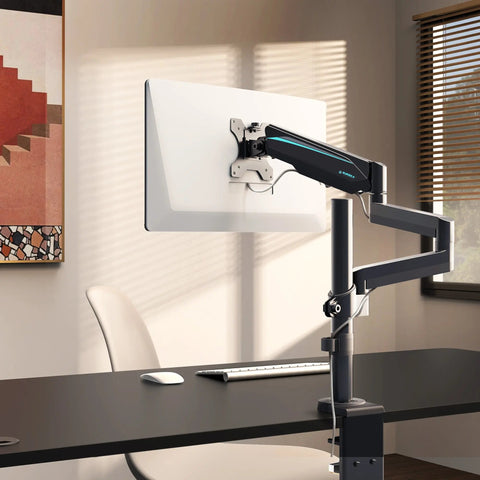
Expert Tip: To solve this depth deficit, use a Single Monitor Arm. This allows you to push the monitor back further than a stock stand, optimizing your viewing distance to approximately 33 inches, which aligns with visual acuity standards for 4K displays at this size.

Space Transformation: Tackling the Corner Shadows
The "corner junction" of an L-shaped desk is often the darkest spot. Standard desk lamps placed on one side of the "L" may cast distracting shadows across the other wing.
The Dual-Key Lighting Strategy
Based on common patterns we observe in customer workstation setups, a single light source is rarely sufficient for an L-shaped layout.
- Place a monitor light bar on your main screen.
- Place an adjustable arm lamp or Soho Art Lighting panel on the secondary wing. This "cross-pollination" of light helps fill in the shadows that occur when you rotate your chair between tasks.
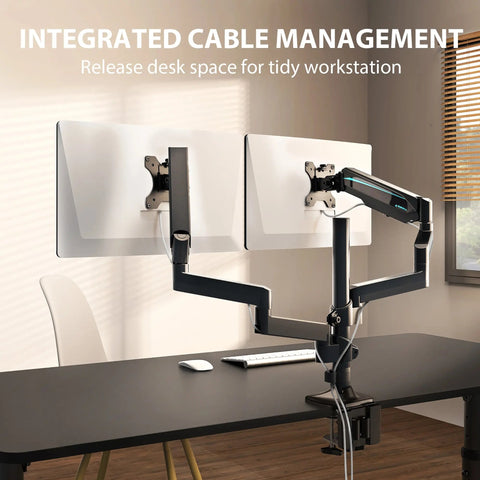
Cable Management: The Path to Mindfulness
Nothing disrupts a workspace sanctuary faster than a "cable octopus." Because corners naturally trap dust, management is essential.
- Adhesive channels: Route cables along the underside of the desk frame.
- The 30-Inch Slack Rule: Based on common troubleshooting data from our support team, ensure you have at least 30 inches of cable slack for any wires connected to a standing desk.
- How to Verify: Raise your desk to its maximum height. If any cable is taut or pulling on a port, you lack sufficient slack and risk equipment damage or a fire hazard.
Personal Tips for Atmosphere Building
Creating an ideal environment involves more than just hardware. Here are practitioner-level tweaks:
- The "Glow-Up" Backlight: Mount LED strips to the back of your desk. This "bias lighting" can increase the perceived contrast of your monitors, making colors appear more vivid while reducing eye strain.
- Greenery and Reflection: Place a small plant in the corner junction. The leaves can catch the light from your monitor bar, adding a natural element to your digital space.
- Screen Brightness Matching: Aligned with guidelines from the University of Toronto EHS, you should adjust your screen brightness to match the general brightness of the room. If your room is dim, your screen should be as well.
Beyond the Desk: A Holistic Lifestyle
Choosing an L-shaped desk like the GTG-G55 is an investment in your daily comfort. The ability to shift between sitting and standing is vital for reducing sedentary time. The World Health Organization (WHO) recommends interrupting long periods of static behavior, and a well-lit desk makes those transitions feel more natural.
Creating Your Luminous Legacy
Your workspace is the cockpit of your daily life. By taking the time to solve the lighting challenges of a dark corner, you are signaling to yourself that your work and your well-being matter.
Say goodbye to the chaos of shadows and embrace the elegance of a layered lighting setup. When you sit down at your GTG - I43, and the lights hum to life in your chosen focus hue, the distractions can fade, and you are left with the pure joy of creation.
Disclaimer: This article is for informational purposes only and does not constitute professional medical, legal, or ergonomic advice. While ergonomic furniture and proper lighting can reduce discomfort, they are not a substitute for professional medical consultation. If you experience chronic pain or persistent eye strain, please consult a qualified healthcare provider or a certified professional ergonomist.
Sources
- Canadian Centre for Occupational Health and Safety (CCOHS) - Office Ergonomics
- HSE: Working safely with display screen equipment (DSE)
- The 2026 Workstation White Paper (Eureka Ergonomic Brand Research)
- WHO 2020 Guidelines on Physical Activity & Sedentary Behaviour
- University of Toronto Lighting Ergonomics Guideline
- BIFMA G1-2013 Ergonomics Guideline for Furniture




Leave a comment