

Why does a professional graphic designer, equipped with a high-performance workstation and a precision mouse, still experience frustrating jitters during detailed vector work? Why does the forearm feel leaden and cold by 3:00 PM, even in a climate-controlled studio? Many creative professionals attribute these issues to "creative burnout" or general fatigue, yet the root cause often lies beneath their wrists. The surface texture and material composition of a desk are not merely aesthetic choices; they are critical ergonomic variables that dictate the precision of micro-movements and the long-term health of the musculoskeletal system.
A common misconception in the design community is that a "smooth" surface is universally superior for mouse tracking. In reality, an overly smooth surface, such as polished glass or high-gloss laminate, can introduce a phenomenon known as "skating," where the lack of static friction makes it difficult to stop a cursor on a specific pixel. Conversely, an improperly textured surface can increase the static load on the forearm muscles, leading to early-onset fatigue. Understanding the intersection of physics, physiology, and material science is essential for any professional seeking to optimize their creative workflow.
The Physics of Precision: Friction and Fluidity
At the heart of every brush stroke in Photoshop or every anchor point adjustment in Illustrator is the principle of friction. Specifically, designers must balance static friction (the force required to start a movement) and kinetic friction (the resistance during movement). According to the Science Behind Mousepad Surface Textures, a consistent, low static friction coefficient is the key variable for predictable micro-movements.
When a surface is too slick, such as tempered glass, the mouse lacks "stopping power." For designers working with high-DPI (dots per inch) settings, where a one-millimeter hand movement translates to dozens of pixels on screen, this lack of resistance requires the hand to exert constant counter-pressure to stabilize the cursor. This leads to a "death grip" on the mouse, increasing the risk of Repetitive Strain Injury (RSI).

The "Pixel Test" for Surface Friction
Professional ergonomists suggest a simple diagnostic to determine if a desk surface is appropriate for high-precision work:
- Open a high-resolution canvas in a design application.
- Attempt to move the cursor to a specific pixel and stop instantly.
- If the mouse requires more than a slight, subconscious adjustment to remain on that pixel, the surface friction is likely too low.
- If the cursor "stutters" or requires a jerky movement to start, the static friction is too high, often due to surface imperfections or accumulated oils.
Physiological Impact: Thermal Comfort and Static Load
The material of a desk also dictates the thermal environment of the user’s forearms. According to the Occupational Safety and Health Administration (OSHA) regarding identifying ergonomic problems, environmental factors significantly contribute to Musculoskeletal Disorders (MSDs).
Materials like glass and metal have high thermal conductivity, meaning they rapidly wick heat away from the skin. When the forearm rests on a cold surface for extended periods, the blood vessels constrict (vasoconstriction), and the muscles contract slightly to generate heat. This persistent, low-level contraction increases the static load on the muscles. Over an eight-hour workday, this thermal drain can lead to stiffness and a reduction in fine motor control. In contrast, materials with lower thermal conductivity, such as wood veneers or specialized carbon fiber laminates, feel "warmer" to the touch, promoting muscle relaxation and fluid movement.
The Double-Reflection Trap: Visual Ergonomics
Visual fatigue is a primary driver of productivity loss in tech and design sectors. A frequent error in studio setup is pairing a glossy desk surface with a high-brightness monitor. This creates a "double-reflection" issue. Light from the monitor reflects off the desk surface and back into the designer's eyes, often from an angle that the monitor's own anti-glare coating cannot mitigate.
As noted in the guidance on reducing glare on ultrawide monitors, managing ambient light is crucial for color accuracy. A matte or micro-textured surface, such as a carbon fiber finish, scatters incident light in multiple directions (diffuse reflection) rather than reflecting it directly at the user (specular reflection). This reduction in glare allows the eyes to focus on the screen content without competing with the "ghost images" on the desk surface.
Engineering the Solution: Material Selection and Edge Design
To address these physiological and physical challenges, the industry has moved toward specialized surfaces that prioritize functionality over mere appearance.
Carbon Fiber and Matte Finishes
Carbon fiber textures have become a benchmark for professional workstations not just for their durability, but for their tactile properties. The slightly abrasive, consistent texture provides the necessary "bite" for mouse sensors to track accurately while offering the stopping power required for precision vector work. Furthermore, these surfaces are typically scratch-resistant and waterproof, ensuring that the tracking environment remains consistent over years of use.
The Importance of the Beveled Edge
While surface texture handles the "X and Y" axes of movement, the desk edge handles the health of the wrist and forearm. A sharp, 90-degree desk edge creates a localized pressure point on the ulnar nerve and surrounding blood vessels. According to research on beveled desk edges and wrist health, a rounded or beveled edge distributes the weight of the forearm over a larger surface area. This prevents the "burning" sensation often felt in the trapezius and forearm, which is a common precursor to chronic MSDs.
| Feature | Glass/Glossy Surface | Carbon Fiber/Matte Surface | Wood/Laminate Surface |
|---|---|---|---|
| Tracking Precision | Low (High 'Skate') | High (Consistent Friction) | Medium to High |
| Glare Reduction | Poor (High Reflection) | Excellent (Diffuse Reflection) | Good |
| Thermal Comfort | Poor (Cold/Conductive) | High (Neutral) | Excellent (Warm) |
| Maintenance | High (Fingerprints/Smears) | Low (Scratch Resistant) | Medium |
Adhering to International Ergonomic Standards
When selecting a workstation, professional studios should look toward established benchmarks such as the ISO 9241-5:2024 standard for workstation layout and postural requirements. This standard emphasizes that the workstation must allow the user to maintain a "neutral position"—a posture where joints are naturally aligned, reducing stress on muscles, tendons, and the skeletal system.
Similarly, the BIFMA G1-2013 Ergonomics Guideline provides dimensions that accommodate the 5th to 95th percentile of the population. This "fits most" logic is essential for studios with multiple users, ensuring that the desk height and surface area are sufficient for varied body types and equipment setups.

Beyond the Surface: The Sit-Stand Rhythm
The most advanced surface texture in the world cannot compensate for the risks of prolonged static behavior. The World Health Organization (WHO) 2020 Guidelines recommend that adults reduce sedentary time and interrupt long periods of sitting with physical activity.
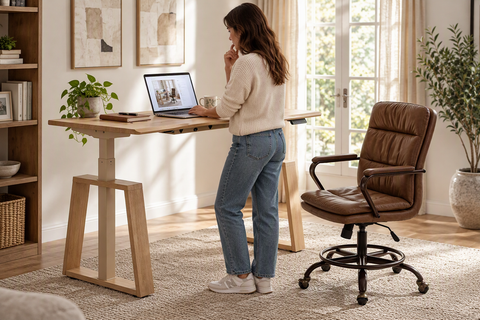
For the graphic designer, this means transitioning between sitting and standing throughout the day. A systematic review by Cochrane on workplace interventions found that sit-stand desks can significantly reduce sitting time by over 80 minutes per day. However, standing is not a substitute for exercise; it is a tool for postural variation.
The 20-8-2 Rule
The Cornell University Ergonomics Web suggests a specific rhythm for maximum productivity and health:
- 20 Minutes Sitting: Maintain a neutral posture with lumbar support.
- 8 Minutes Standing: Shift weight occasionally to promote circulation.
- 2 Minutes Moving: Stretch or walk to reset the musculoskeletal system.
This rhythm prevents the "static load" from accumulating in any single muscle group, keeping the designer's hands and mind sharp for precision tasks. For more on optimizing this setup, refer to the guide on finding your ideal ergonomic standing desk height.
Practical Recommendations for a Precision Workspace
To build a workspace that truly supports a high-DPI creative workflow, follow these expert-vetted steps:
- Prioritize Matte Finishes: If you work in a room with windows or overhead lighting, choose a matte or textured carbon fiber surface to eliminate secondary reflections.
- Verify Edge Comfort: Ensure your desk has a beveled edge or use a high-quality, large-format desk mat with a tapered edge to protect the ulnar nerve.
- Manage Monitor Height: Use a monitor riser or arm to ensure the top third of your screen is at eye level. This prevents the neck flexion that often accompanies "hunching" over a detailed design. According to the HSE guide on working with display screen equipment, improper screen height is a primary cause of neck strain.
- Control the Environment: If your desk surface feels cold to the touch, consider a desk mat made of felt or vegan leather to improve thermal comfort and reduce muscle tension.
- Audit Your Mouse Glide: Regularly clean your desk surface. Even microscopic dust particles can increase the static friction coefficient, leading to "stuttering" during fine adjustments.
The integration of these principles is further explored in The 2026 Workstation White Paper: Converging Ergonomic Science and Sustainable Engineering, which details how material science is evolving to meet the needs of the modern digital professional.
The Long-Term Perspective
Investing in a precision surface is an investment in your career longevity. Musculoskeletal disorders are often cumulative; the slight strain of a "skating" mouse or the minor chill of a glass desk may not seem significant today, but over a decade of professional practice, these factors contribute to chronic conditions. By aligning your workspace with the standards set by BIFMA, ISO, and the latest ergonomic research, you create an environment where creativity is limited only by your imagination, not by physical discomfort.
Disclaimer: This article is for informational purposes only and does not constitute professional medical advice. Individuals with pre-existing musculoskeletal conditions or chronic pain should consult a qualified physiotherapist or ergonomic specialist before making significant changes to their workstation setup.
References
- BIFMA G1-2013 Ergonomics Guideline for Furniture
- Canadian Centre for Occupational Health and Safety (CCOHS): Office Ergonomics
- Cochrane: Workplace interventions for reducing sitting at work (2018)
- Cornell University Ergonomics Web — Workstation Guides
- HSE: Working safely with display screen equipment (DSE)
- ISO 9241-5:2024 Workstation layout & postural requirements
- WHO 2020 Guidelines on Physical Activity & Sedentary Behaviour
- OSHA: Ergonomics - Identify Problems




Leave a comment