

Quick Answer: How Many People Can Fit?
If you are looking for a fast reference, here is our quick heuristic guide for standard dining table seating.
Note: These estimates act as a practical rule of thumb assuming you are using standard 20-inch wide armless chairs and allowing about 24 inches of linear space per person.
Rectangular Tables:
- 72 inches (6 feet): Seats 6 comfortably
- 96 inches (8 feet): Seats 8 to 10
- 120 inches (10 feet): Seats 12
Round Tables:
- 42 inches: Seats 4
- 48 inches: Seats 4 to 5
- 60 inches: Seats 6 (up to 8 if crowded)
- 72 inches: Seats 8 to 10
Crafting Your Workspace Sanctuary: The Art of the Dining Table Seating Guide
Imagine a home where your environment breathes with your rhythm. A morning of deep work at a sun-drenched table, followed by an evening of laughter and shared stories around that same elegant surface. This is the essence of a true workspace sanctuary—a place that balances practical ergonomics with the warmth of a lived-in home.
Choosing a dining table is more than a purchase; it is a transformation of space. Yet, a common pattern we see in customer support isn't about style—it's about the "fit." There is a specific discomfort when elbows clash during a meal or when a chair won't quite pull back far enough to let someone pass. To avoid these friction points, we must look beyond the tabletop and understand the spatial geometry of human connection.
The Science of Personal Space: Why Dimensions Matter
At the heart of every comfortable gathering is the concept of the "individual zone." According to general anthropometric datasets (such as those referenced in the BIFMA G1-2013 Ergonomics Guideline for Furniture), furniture is often designed to accommodate a wide range of body types—from the 5th to the 95th percentile.
When translated to the dining room as a practical rule of thumb, a person typically needs a minimum of 24 inches of linear table space to dine without feeling crowded. However, as noted in The 2026 Workstation White Paper: Converging Ergonomic Science and Sustainable Engineering, the modern home now demands multifunctional surfaces that serve as both dining hubs and professional workstations. This shift often requires moving from "compact" seating to "standard" or "formal" spacing to help ensure long-term comfort.
Methodology Note: The Seating Capacity Model Our recommendations are based on a practical spatial model that accounts for three levels of comfort. Assumption: This model uses standard 20-inch wide chairs without armrests and average place setting dimensions (12" x 18").
Comfort Level Table Space per Person Best For Compact 20–22 inches Small apartments, casual snacks, armless chairs Standard 24–26 inches Daily family meals, remote work sessions Formal 30+ inches Multi-course dinners, holiday gatherings, large setups
How to Measure Your "Chair Envelope" (A Practical Example)
When selecting a table, a frequent mistake is measuring only the table’s footprint. To find out if a table truly fits your room, you need to calculate the "chair envelope" and traffic flow. Here is a simple way to measure it:
- Measure the Chair Depth: Pull a dining chair out to a comfortable sitting position. Measure from the edge of the table to the back edge of the chair (this typically requires about 24 inches).
- Add Traffic Clearance: As a general interior design heuristic, add a minimum of 36 inches from the back of the pulled-out chair to the nearest wall or furniture piece to allow people to edge past. For a completely unobstructed walkway, 48 inches is ideal.
- Calculate the Total Footprint: If your table is 36 inches wide, and you have chairs on both sides (24" + 24" = 48"), plus minimum walking clearance on both sides (36" + 36" = 72"), your room needs to be at least 156 inches (13 feet) wide to accommodate the setup comfortably.
Rectangular Tables: The Anchor of the Modern Home
The rectangular table is the workhorse of the dining room. Its linear design aligns perfectly with walls and provides a structured layout for both meals and "thinking modes" of work.

For those who value both minimalist aesthetics and grand gatherings, the Evelyn, 70"- 102" Extendable Dining Table with Slate, White offers a masterclass in versatility. Its sintered stone surface provides a durable, heat-resistant workspace that transitions seamlessly into a formal dining area.
Capacity Heuristic for Rectangular Tables: (Assumes 24 inches of linear space per person and 20-inch armless chairs)
- 72 inches (6 feet): Seats 6 comfortably (2 on each side, 1 at each end).
- 96 inches (8 feet): Seats 8 to 10. (Note: Using armless chairs or benches can tighten the requirement to 21 inches per person, but 24 remains the ergonomic standard).
- 120 inches (10 feet): Seats 12.
Round Tables: Encouraging Mindfulness and Flow
Round tables are an excellent choice for fostering intimacy. Without sharp corners or a "head of the table," the energy of the room becomes more fluid. However, round tables can be deceptive regarding their actual capacity.
A common misconception is that a 60-inch round table can comfortably seat 8 people. In reality, this usually only works for very slim builds or minimal place settings. For practical dining and diverse body types, a 60-inch round table generally seats 6 people comfortably. If you intend to seat 8, you will likely need a diameter of 72 to 78 inches to avoid "tabletop clutter."
| Table Diameter | Seating Capacity (Comfortable) | Seating Capacity (Crowded) |
|---|---|---|
| 36–42 inches | 2–3 People | 4 People |
| 48 inches | 4 People | 5 People |
| 60 inches | 6 People | 8 People |
| 72 inches | 8 People | 10 People |
| (Table Note: Heuristic based on 20-inch armless chairs and a standard 12x18-inch place setting. Chairs with armrests will decrease capacity.) |
When setting up a round table for deep work, remember that the curved edge changes your arm support. While ISO 9241-5:2024 principles are primarily designed for office workstations, the core ergonomic idea applies here: aim for a chair height that allows your elbows to rest at roughly a 90-degree angle to the table surface, which can help prevent a "rounded shoulder" posture.
The Extendable Revolution: Adapting to Life’s Moments
In a dynamic lifestyle, your needs change by the hour. An extendable table is a holistic solution that respects the boundaries of your home while remaining ready for larger gatherings.
The Charlotte, 90"-129" Extendable Dining Table With Sintered Stone Desktop is designed for those who refuse to choose between daily efficiency and festive hospitality. Its rotating mechanism allows it to expand to nearly 11 feet, accommodating up to 12 guests.

Expert Insight: The Stability Factor When choosing an extendable table, we recommend testing the mechanism's "wobble factor." Drawing a parallel to safety testing concepts found in UL 962 Standards for adjustable desks, mechanical stability is crucial for safety—especially when a table is at its maximum extension. Look for robust frames, like the carbon steel legs found in the Charlotte and Evelyn series, which help ensure the table remains solid even when fully loaded with a holiday feast or multiple monitor setups.

Seating: The Bridge Between Functionality and Emotion
A table is only as good as the chairs that surround it. To create a true sanctuary, your seating should support your body while fitting your room's aesthetic.
For a touch of vintage style, the Rlesana, Velvet Dining Side Chair uses a petal-shaped backrest to provide comfortable support. The soft velvet texture isn't just an aesthetic choice; it’s a way to add sensory ambiance to your room, making long conversations more indulgent.
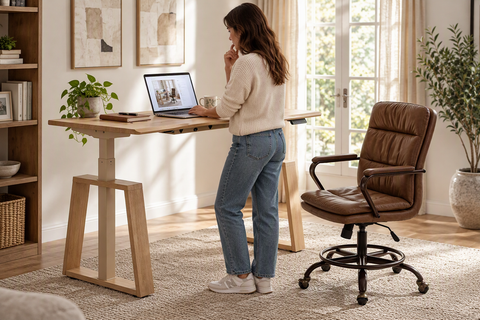
However, if your dining table often doubles as your executive suite, consider the Regal, PU Leather Home Office Chair. It bridges the gap between mid-century style and modern ergonomic needs. Its slimline cushioning and hammered metal finish allow it to sit beautifully at a dining table without looking like standard office equipment, yet it provides the structural support often needed for hours of focus.
Spatial Efficiency and Atmosphere Building
Beyond the numbers, the "feeling" of a room is determined by how you manage its flow. Here are a few practical tips for a more harmonious setup:
- The Rug Rule: If you use a rug under your table, try to ensure it extends at least 24 to 30 inches beyond the table edge. This helps keep chair legs on the rug when pulled out, preventing an uneven seat.
- Lighting and Mindfulness: A pendant light should generally hang approximately 30 to 34 inches above the table. This creates a "pool of light" that defines the space and can help reduce eye strain for those working from the table (a concept echoing general HSE guidance for display screen equipment users).
- The Power of Greenery: A small plant or a vase of flowers in the center of the table acts as a visual anchor. It encourages you to pause, breathe, and appreciate the space you’ve created.
Summary Checklist for Your Purchase
Before you commit to a new centerpiece for your home, run through this final checklist to help ensure a perfect fit:
- Measure the Room: Do you have at least 36 inches of clearance between the table edge and the wall/furniture?
- Count the Guests: Does the table length provide roughly 24 inches per person for daily use?
- Check the Base: Does the table have a pedestal base (which saves knee room) or four legs (which might restrict where chairs can be tucked)?
- Verify Stability: For extendable models, is the frame made of high-quality materials like carbon steel or solid wood to prevent sagging?
- Consider the Surface: Is the material (like sintered stone) resistant to the heat of a laptop and the spills of a dinner party?
Creating a home that sparks your creativity begins with planning your space effectively. By understanding the practical heuristics of seating and the value of a well-chosen table, you can transform your dining area into a sanctuary of both productivity and peace.
Disclaimer: This article is for informational purposes only and does not constitute professional medical, ergonomic, or architectural advice. Readers should consult with a qualified professional before making significant changes to their home environment, especially if they have pre-existing musculoskeletal conditions.
Sources
- BIFMA G1-2013 Ergonomics Guideline for Furniture
- The 2026 Workstation White Paper: Converging Ergonomic Science and Sustainable Engineering
- ISO 9241-5:2024 Workstation layout & postural requirements
- CCOHS: Office Ergonomics - Sit/Stand Desk
- HSE: Working safely with display screen equipment (DSE)
- UL 962 — Safety of Height-Adjustable Desks (Overview)




Leave a comment