

Professional illustrators and digital artists often describe a familiar, nagging sensation: a sharp, burning tightness between the shoulder blades that begins around 2:00 PM and intensifies by the end of the workday. While this is frequently dismissed as a byproduct of "the grind," it is actually a physiological response to static muscle loading and repetitive strain. For those whose livelihood depends on the precision of a stylus, understanding the biomechanics of drawing is not just about comfort; it is about career longevity.
The transition from traditional media to digital tablets has introduced a unique set of ergonomic challenges. Unlike a canvas on an easel, a digital tablet is often placed flat on a desk or at an angle that does not align with the body's natural neutral position. This article explores the scientific principles behind "Illustrator’s Shoulder" and provides a framework for optimizing the digital workspace using industry standards and evidence-based practices.
The Physiology of the Creative Stroke: Understanding MSDs
Musculoskeletal Disorders (MSDs) are not the result of a single event but the cumulative effect of three primary risk factors: excessive force, repetitive tasks, and awkward postures. According to the U.S. Occupational Safety and Health Administration (OSHA), these factors combine to create a high-risk environment for chronic injury.
For illustrators, the primary culprit is "static loading." This occurs when muscles are held in a fixed position for extended periods to support the weight of the limbs or to maintain a specific posture. While the drawing hand is moving, the shoulder and neck muscles—specifically the upper trapezius and the supraspinatus—are often locked in a state of isometric contraction to stabilize the arm.
The Mechanics of Shoulder Abduction
When a drawing tablet is placed too far from the body or at an incorrect height, the artist must lift their elbow away from their side. This movement, known as shoulder abduction, places immense pressure on the rotator cuff. Prolonged abduction reduces blood circulation to the tendons, leading to fatigue and, eventually, micro-tears.
The ISO 11226:2000 standard for the evaluation of static working postures specifies that the risk of musculoskeletal strain increases significantly when joints are held outside their neutral range for more than a few minutes. For an illustrator, whose sessions can last eight to twelve hours, the "neutral range" is the only sustainable position.
The Tablet Tilt Debate: Display vs. Non-Display Biomechanics
A common misconception in the design community is that a single "optimal" angle exists for all drawing tasks. However, recent research suggests that the ideal setup depends heavily on whether the artist is using a display tablet (like a Cintiq) or a non-display tablet (like an Intuos).
The Non-Display Tablet (Looking Forward)
When using a non-display tablet, the hand and eye are decoupled. The artist looks forward at a monitor while drawing on a surface below. This setup is generally superior for neck health because it allows the head to remain balanced over the shoulders. According to the Mayo Clinic, maintaining a forward-facing gaze prevents "tech neck," a condition caused by excessive neck flexion.
The Display Tablet (Looking Down)
Display tablets offer a more intuitive "pen-on-paper" feel but introduce a significant ergonomic "gotcha." Because the visual target is the drawing surface itself, artists tend to hunch over the device. This increases neck flexion and shoulder protraction.
Expert observations suggest that for large-format display tablets, a slightly negative tilt (where the top of the tablet is closer to the body than the bottom) can sometimes help maintain a neutral wrist position during long vertical strokes. However, for most precision work, a tilt of 10 to 20 degrees is the "sweet spot" to reduce pronation strain in the forearm without forcing the shoulder into an awkward elevation.
The Task-Dependency Factor
Interestingly, a 2023 study published in PLOS ONE found that while a 30-degree tilt is often recommended, it can actually increase upper trapezius muscle activity during precision tasks. For inking and fine detail work, a flatter surface (closer to 0 degrees) may actually reduce strain by allowing the weight of the arm to be supported more naturally by the desk surface.
Engineering the Solution: The "Hierarchy of Controls"
To address these issues, we must look at the OSHA "Hierarchy of Controls". This model suggests that "Engineering Controls"—such as changing the physical workspace—are far more effective than "Administrative Controls," like simply telling yourself to sit up straight.
1. The Elbow Rule and Forearm Support
The most critical heuristic for any illustrator is the Elbow Rule. When seated with shoulders relaxed, the drawing hand's elbow should remain at an angle between 90 and 120 degrees. The tablet surface should be within a forearm's length, allowing the artist to reach all corners of the active area without fully extending the arm or leaning the torso forward.
2. The Role of the Ergonomic Chair
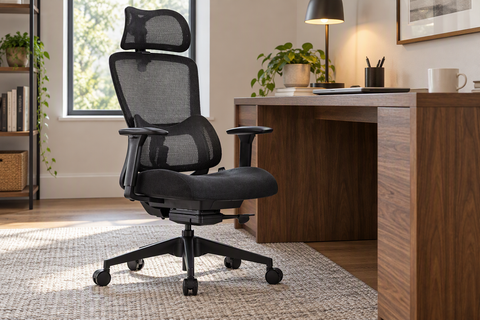
A chair is not merely a seat; it is a support system for the spine. The BIFMA G1-2013 Ergonomics Guideline emphasizes that furniture must accommodate a wide range of body types (from the 5th to the 95th percentile). For illustrators, the chair must provide:
- Adjustable Lumbar Support: To maintain the natural S-curve of the spine and prevent the "slump" that often occurs during deep focus.
- 3D or 4D Armrests: These are essential for digital artists. Armrests that adjust in height, depth, and angle allow the artist to support the weight of their non-drawing arm, reducing the load on the neck and shoulders.

3. Monitor and Tablet Alignment
In a dual-monitor setup, the primary reference screen should be positioned directly at eye level. According to the Canadian Centre for Occupational Health and Safety (CCOHS), the top of the screen should be roughly at eye level to minimize neck tilt. The drawing tablet should be positioned centrally, often on a lowered tray or an adjustable arm, to eliminate the need for constant torso rotation. Constant twisting to look at a side monitor is a leading cause of asymmetrical back pain.

Practical Recommendations: The Illustrator’s Workflow
Beyond furniture, the way you interact with your tools determines your long-term health. Implementing a structured rhythm of movement is the most effective way to combat the effects of sedentary work.
The 20-8-2 Rhythm
Developed by ergonomic experts at Cornell University, the 20-8-2 rule provides a sustainable template for the workday:
- 20 Minutes Sitting: Maintain a neutral, supported posture.
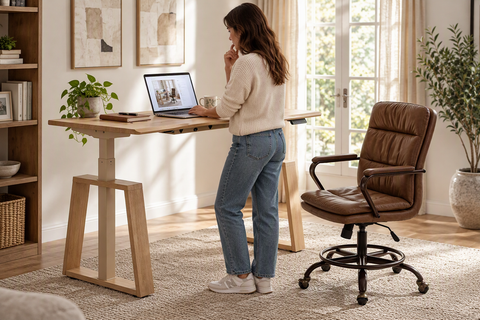
- 8 Minutes Standing: Use a height-adjustable desk to change the load on your muscles.
- 2 Minutes Moving: Stretch the wrists, roll the shoulders, and look away from the screen to rest the eyes.
This rhythm is supported by a Cochrane systematic review, which concluded that sit-stand workstations can significantly reduce total sitting time, thereby mitigating the risks associated with a sedentary lifestyle.
The Sit-Stand Ratio Table
| Work Mode | Duration | Primary Benefit | Key Ergonomic Check |
|---|---|---|---|
| Seated Focus | 20 min | Precision & Stability | Feet flat on the floor, lumbar support engaged. |
| Standing Review | 8 min | Circulation & Posture Change | Desk height at elbow level, shoulders relaxed. |
| Micro-Break | 2 min | Muscle Recovery | Full range of motion for neck and wrists. |
Visual Distance and Eye Strain
The HSE guidelines for Display Screen Equipment (DSE) suggest that the screen should be approximately an arm's length away. For illustrators working on high-resolution tablets, there is a temptation to get closer to see fine pixels. Instead of leaning in, use the software's zoom functions. Leaning forward even a few inches doubles the effective weight of your head on your neck muscles.
Addressing Common Pitfalls: The "Gotchas" of Digital Art
Even with the best equipment, certain habits can undermine your ergonomic health.
- The "Claw" Grip: Many artists grip the stylus too tightly. This creates tension that travels up the arm into the shoulder. Practice a "light touch" and consider using a tablet glove to reduce friction, allowing the hand to glide rather than stick.
- Keyboard Placement: If you use keyboard shortcuts, do not place the keyboard to the side of the tablet. This forces a "twisted" shoulder position. Instead, use a small macro pad or a compact keyboard placed above the tablet or in the non-drawing hand's natural resting spot.
- Ignoring the Legs: While the focus is often on the shoulders, the World Health Organization (WHO) reminds us that reducing sedentary time is a whole-body requirement. Ensure there is enough legroom under your desk to allow for frequent position changes, as restricted leg movement can impede blood circulation.
Building a Professional Foundation
Investing in an ergonomic setup is an investment in your creative output. As detailed in The 2026 Workstation White Paper: Converging Ergonomic Science and Sustainable Engineering, the future of professional workspaces lies in the integration of adjustable technology and human-centric design.
For the professional illustrator, this means moving away from "one-size-fits-all" solutions. A height-adjustable desk, a chair that meets ANSI/BIFMA X5.1 standards, and a monitor arm that allows for dynamic repositioning are the "tools of the trade" just as much as a high-end stylus or software.

Summary Checklist for Illustrators
- Check your elbow angle: Is it between 90-120 degrees?
- Adjust your tablet tilt: Try 10-20 degrees for general work, but don't be afraid to go flat for inking.
- Align your monitors: Is your reference screen directly in front of you at eye level?
- Support your arms: Are your armrests positioned to take the weight off your shoulders?
- Move every 30 minutes: Are you following the 20-8-2 rule?
By aligning your workspace with the physiological needs of your body, you can eliminate the "afternoon burn" and focus on what truly matters: your art.
Disclaimer: This article is for informational purposes only and does not constitute professional medical advice, diagnosis, or treatment. Always seek the advice of your physician or other qualified health provider with any questions you may have regarding a medical condition. The ergonomic recommendations provided are based on general industry standards and may need to be adjusted for individuals with pre-existing musculoskeletal conditions.
References
- BIFMA G1-2013 Ergonomics Guideline for Furniture
- CCOHS: Office Ergonomics - Sit/Stand Desk
- Cochrane: Workplace interventions for reducing sitting at work (2018)
- Cornell University Ergonomics Web — Workstation Guides
- HSE: Working safely with display screen equipment (DSE)
- ISO 9241-5:2024 Workstation layout & postural requirements
- WHO 2020 Guidelines on Physical Activity & Sedentary Behaviour
- ANSI/BIFMA X5.1 General-Purpose Office Chairs
- PLOS ONE: The effect of tablet tilt angles and time on posture (2023)
- Mayo Clinic: Effect of technology on your neck
- OSHA eTools: Computer Workstations - Neutral Working Postures




Leave a comment