

As the new year begins, many gamers and remote professionals look toward their workstations as the foundation for a productive and healthy year. However, a common misconception persists: that an aesthetic "battlestation" and a sustainable, health-conscious environment are mutually exclusive. Many users prioritize high-performance hardware and RGB aesthetics while overlooking the invisible impact of the materials supporting that gear. Why does a headache often set in after hours in a brand-new setup? Why does "new furniture smell" persist for weeks? These are not just inconveniences; they are signals of the chemical and physical environment of your workspace.
Choosing sustainable materials for a gaming setup is no longer just about environmental ethics; it is a critical component of human-centric engineering. A high-performance setup must support the body through complex musculoskeletal demands while ensuring that the air you breathe during a 10-hour session is free from harmful pollutants. Understanding the intersection of material science, ergonomic standards, and environmental certifications is essential for any modern professional or gamer.
The Invisible Environment: VOCs and Respiratory Health
The primary health concern in many modern furniture pieces is the emission of Volatile Organic Compounds (VOCs), particularly formaldehyde. According to the U.S. Environmental Protection Agency (EPA), formaldehyde is a colorless, flammable gas that can cause respiratory irritation and is classified as a known human carcinogen. In a gaming context, where equipment often generates heat, the off-gassing of these chemicals can accelerate.
When purchasing a desk, the core material is often a composite wood product, such as Medium Density Fiberboard (MDF) or particleboard. These materials traditionally use resins containing formaldehyde. To address this, the EPA's Formaldehyde Emission Standards for Composite Wood Products Act established strict limits. Products meeting these standards are labeled as TSCA Title VI compliant. For the health-conscious consumer, ensuring a desk carries this certification or the even more stringent UL GREENGUARD Gold Certification is the first step toward a healthy indoor environment. GREENGUARD Gold specifically accounts for sensitive individuals and ensures lower total VOC emissions, which is vital for small home offices or gaming rooms with limited ventilation.
Beyond the desktop, the choice of upholstery in ergonomic chairs also impacts air quality. Traditional synthetic leathers can involve heavy use of phthalates and solvent-based adhesives. Modern sustainable alternatives, such as water-born silicone "leathers" or high-recycled-content textiles, eliminate these solvents, providing a high-durability surface that does not contribute to indoor air pollution.
Structural Integrity and the Performance Equation
Sustainability in furniture is often equated with "recycled materials," but from an engineering perspective, it also encompasses longevity and efficiency. A product that fails after two years is inherently unsustainable. In a high-performance gaming setup, the structural load is significant.
Based on technical simulations of a professional streaming setup—incorporating a liquid-cooled full-tower PC, three 34-inch ultrawide monitors, and professional audio gear—the total static load can reach approximately 94 kg (207 lbs). This poses a challenge for standard entry-level standing desks.
| Component | Estimated Weight (kg) | Impact on Framework |
|---|---|---|
| Full-Tower Liquid-Cooled PC | 25 kg | High localized stress |
| 3x 34" Ultrawide Monitors | 30 kg | High cantilever load on arms |
| Peripherals & Audio Gear | 8 kg | Distributed load |
| Sustainable Desktop (Thick MDF/Wood) | 25 kg | Base dead load |
| Total Battlestation Load | 88-94 kg | Requires Dual-Motor System |
As noted in the 2026 Workstation White Paper: Converging Ergonomic Science and Sustainable Engineering, a single-motor lift system typically has a capacity of 80 kg. Attempting to support a 94 kg load with a single motor results in 117.5% utilization, leading to premature motor failure and increased noise. Conversely, a dual-motor system utilizing high-recycled-content steel frames provides the necessary torque and stability, operating at a safer 78% utilization rate.

Furthermore, energy efficiency is a frequently overlooked aspect of "eco" furniture. While a desk's active movement consumes power, the standby power consumption is the long-term environmental driver. Research into desk controllers shows that a high-efficiency "green" controller with a 0.5W standby mode, compared to a generic 5W standby model, can save approximately 15.7 kg of CO₂ emissions annually. This is roughly equivalent to the carbon sequestration of a mature tree over a year, proving that small engineering choices in electronics have measurable ecological impacts.
Physiological Principles: Beyond the Surface
The materials you touch and the way they are configured directly influence your musculoskeletal health. The Occupational Safety and Health Administration (OSHA) identifies poor posture and repetitive tasks as core risk factors for Musculoskeletal Disorders (MSDs). In a gaming environment, these risks are compounded by the duration of static load.
A sustainable setup must facilitate a "Neutral Position." This is a posture where joints are naturally aligned, reducing stress on muscles, tendons, and the skeletal system. According to the BIFMA G1-2013 Ergonomics Guideline for Furniture, furniture should accommodate the 5th to 95th percentile of the population through adjustability.
One common friction point in modern setups is the "Visual Parallax" error. Users often set their standing desk height based on where their hands feel comfortable, but fail to adjust their monitor height accordingly. This leads to neck flexion or extension. To combat this, practitioners recommend the "20-8-2" rhythm developed by Cornell University Ergonomics Web: sit for 20 minutes, stand for 8 minutes, and move or stretch for 2 minutes.

The Sustainability Checklist: Material Selection
When building a sustainable battlestation, a "layered approach" is most effective. This involves prioritizing the largest surfaces first, as they have the greatest impact on both stability and air quality.
- The Desktop: Look for FSC-certified wood or composite panels that meet EPA TSCA Title VI standards. Avoid "honeycomb" cardboard-filled desktops; while light, they lack the screw-holding strength for heavy monitor arms, leading to instability and potential equipment damage. Wood vs. Metal stability is a key consideration here, as the density of the material affects the resonant frequency and "wobble" of the desk at standing heights.
- The Frame: High-recycled-content steel is the gold standard for durability. It is infinitely recyclable and provides the mass necessary to dampen vibrations from typing or intense gaming movements.
- The Seat: Beyond ergonomics, the sustainability of a chair lies in its "circularity." Can the parts be replaced, or must the whole chair be discarded if the cylinder fails? Look for chairs that meet ANSI/BIFMA X5.1 standards for safety and durability.
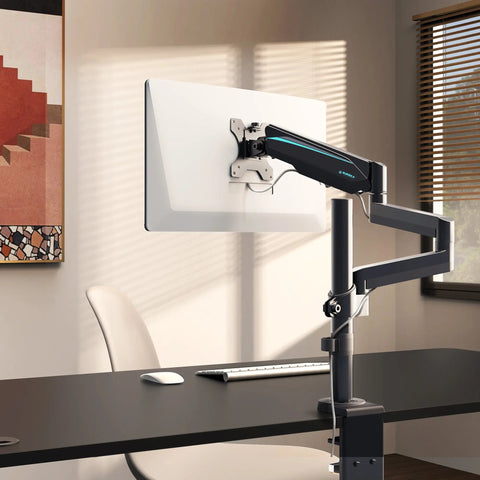
- Accessories: Utilize monitor arms made from post-consumer recycled aluminum. This not only clears desk space but allows for the precise positioning required to maintain a neutral cervical spine.
Practical Recommendations for Setup
A sustainable setup is only effective if it is configured correctly. Misalignment can lead to "static load," where muscles remain contracted for long periods, restricting blood circulation.
- Monitor Depth: For those using 34-inch ultrawide monitors, a desk depth of at least 30 inches is recommended. A typical 24-inch desk often places the screen too close to the user, causing eye strain and forcing the head backward. If you have a shallower desk, a monitor arm is essential to push the screen further back.
- The Elbow Rule: Whether sitting or standing, your keyboard and mouse should be at a height where your elbows are bent at approximately 90 degrees, and your wrists remain in a neutral, flat position. According to OSHA's guide on keyboards, avoiding wrist extension is critical for preventing Repetitive Strain Injury (RSI).
- The Sit-Stand Ratio: While standing desks are excellent for reducing sedentary time, the World Health Organization (WHO) reminds us that "standing is not exercise." The benefit comes from the transition between postures. Aim to switch positions every 30 to 60 minutes to stimulate blood flow and reduce spinal compression.

Balancing Aesthetics and Ethics
A major hurdle for gamers is the perception that "eco-friendly" means a sacrifice in the "gamer aesthetic." However, modern sustainable engineering allows for the integration of RGB lighting and sleek designs without compromising environmental standards. For example, using recycled plastics for cable management systems or energy-efficient LED strips that consume minimal power.
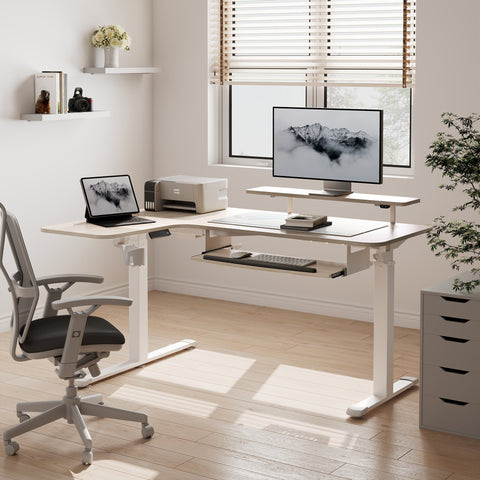
The transition to a sustainable setup is an investment in your long-term well-being. By choosing materials that are durable and high-quality, you reduce the frequency of replacement, saving money and reducing landfill waste. This aligns with the broader trend of designers choosing gaming desks for their superior functionality and adaptability.
Summary of Performance & Sustainability Benchmarks
For the power user, these benchmarks serve as a guide for a high-performance, eco-conscious upgrade:
- Load Capacity: Dual-motor system for setups exceeding 80 kg.
- Air Quality: EPA TSCA Title VI or GREENGUARD Gold certified materials.
- Efficiency: Standby power consumption < 1.0W.
- Ergonomics: Adjustable height range covering at least 25" to 45" to accommodate both seated and standing neutral postures for most users.
- Material Origin: FSC-certified wood sources and high-recycled-content metals.
Health Disclaimer: This article is for informational purposes only and does not constitute professional medical advice. The ergonomic recommendations provided are general guidelines. Individuals with pre-existing musculoskeletal conditions, chronic back pain, or other health concerns should consult a qualified physician or physical therapist before making significant changes to their workstation or activity levels.
Sources
- U.S. EPA - Formaldehyde Emission Standards for Composite Wood Products
- BIFMA - Ergonomics Guideline for Furniture (G1-2013)
- OSHA - Computer Workstations eTool
- Cornell University - Ergonomic Workstation Guidelines
- World Health Organization - Guidelines on Physical Activity and Sedentary Behaviour
- Canadian Centre for Occupational Health and Safety (CCOHS) - Sit/Stand Desks





Leave a comment