

Many high-level professionals and executives view a home office desk as a once-in-a-decade investment. They seek a piece that anchors the room with a classic aesthetic, suggesting stability and permanence. However, a common frustration emerges within six to twelve months of regular use: a subtle but persistent wobble. This instability often manifests when typing or leaning during a video call, undermining the "premium" experience the user paid for.
The failure of a classic desk is rarely about the desktop surface itself. Instead, it is a structural failure of the leg-to-frame attachment points. Many traditional-style desks rely on simple bolt-on legs without cross-bracing or gussets. Over time, the lateral forces applied during daily use—even the simple act of resting one's forearms—loosen these connections, leading to a degraded work environment that impacts both focus and professional presentation.
The Physiological Cost of Static Workstations
The impact of a desk extends beyond its physical stability; it directly influences the human musculoskeletal system. Prolonged static sitting is a primary risk factor for Work-related Musculoskeletal Disorders (MSDs). According to the OSHA eTools on Computer Workstations, maintaining a "neutral body posture" is essential for reducing stress on the muscles, tendons, and skeletal system.
When a desk is at a fixed, incorrect height, the body compensates. A desk that is even an inch too high forces the shoulders to shrug, leading to tension in the trapezius muscles. Conversely, a desk that is too low causes the user to hunch, increasing the load on the lumbar spine. This "static load" restricts blood circulation and can lead to chronic pain. The EU-OSHA research on prolonged static sitting highlights that these risks are not merely about discomfort; they involve pathophysiological mechanisms where muscle fatigue and spinal disc compression accumulate over time.
For the tall professional, the risks are amplified. A standard 29-inch fixed desk is often inadequate for users in the upper height percentiles, forcing them into a permanent state of flexion. This mismatch is a primary driver for the transition toward height-adjustable executive desks that maintain a classic look while offering the precision of modern ergonomics.
Engineering Durability: Beyond Surface Aesthetics
To identify a desk that will remain stable for a decade, one must look at the "under-carriage" engineering. A reliable heuristic for durability is the presence of a triangulated structure or a substantial horizontal beam to which the legs are welded. This design resists the "parallelogram effect"—the tendency of a four-legged structure to lean and sway under lateral pressure.

The Ark SWS Pro Executive Standing Desk (63"x29") exemplifies this approach with its innovative X-shaped leg design. This geometry provides inherent lateral stability that traditional vertical legs lack. Furthermore, for electric models, the durability of the lifting mechanism is paramount. A dual-motor system is generally superior to single-motor designs because it distributes the load symmetrically, preventing the "cogging" or hesitation that often precedes motor failure.
Material Science and Cosmetic Longevity
Durability is not only structural but also cosmetic. While solid wood is often prized, it is susceptible to environmental changes, such as humidity-induced warping. Modern executive desks often utilize high-performance materials like sintered stone or advanced laminates to ensure "ageless beauty."
As noted in research on durable desk materials, high-pressure laminates offer superior resistance to scratches, heat, and water compared to traditional veneers. For the highest tier of durability, the Zen Pro Executive Standing Desk (86"x39") utilizes a sintered stone desktop. Sintered stone is virtually non-porous and highly resistant to the "ring marks" and fine scratches that typically degrade the appearance of a premium desk over years of use.
Quantitative Analysis: Load and Stability Scenarios
To demonstrate the importance of engineering specifications, we can compare two distinct user scenarios based on load and height requirements.
| Metric | Scenario A: The Standard User | Scenario B: The Tall Power User |
|---|---|---|
| User Height | 175 cm (5'9") | 195 cm (6'5") |
| Ideal Desk Height (Sitting) | 68.5 cm (27") | 76.5 cm (30.1") |
| Total Equipment Load | 25 kg (Laptop + Monitor) | 95.5 kg (Triple Ultrawide + Tower PC) |
| Motor Utilization (80kg Cap) | 31% (Safe) | 119% (Failure Risk) |
| Motor Utilization (120kg Cap) | 21% (Optimal) | 80% (Safe/Longevity Zone) |
| Stability Requirement | Standard | High (due to leverage at height) |
Values estimated based on standard ergonomic industry rates and equipment weights.
In Scenario B, a standard desk or a single-motor adjustable desk would operate at a significant deficit. The 195 cm user requires a desk height of 30.1 inches just for sitting—higher than many fixed desks. When standing, the desk must extend even further. At these heights, any weakness in the leg-to-frame attachment is magnified by the increased leverage. This is why the Opal Executive Standing Desk (66"x29"), with its dual-motor system and robust frame, is a more appropriate choice for heavy workstation setups.

The Hidden Role of Cable Management in Longevity
A frequently overlooked aspect of desk durability is integrated cable management. In a high-end setup, the cost of peripherals (monitors, high-fidelity audio, specialized input devices) can exceed the cost of the desk itself.
Traditional desks often leave cables dangling, which leads to "cable abrasion" and strain at the connector points, especially in height-adjustable models. Integrated channels, such as those found in the Ark EL Executive Standing Desk (60"x26"), protect these connections. By preventing repeated bending and snagging during height transitions, these systems prolong the life of expensive electronics and maintain the tidy, professional aesthetic required by executives and remote professionals.
Standards and Compliance: The Mark of Quality
When evaluating a desk's durability, professional buyers should look for adherence to industry standards. These certifications provide a baseline for safety and structural integrity that goes beyond marketing claims.
- BIFMA X5.5: This is the North American standard for desk and table products. It involves a series of rigorous tests, including top load, leg strength, and stability tests. According to the Business and Institutional Furniture Manufacturers Association (BIFMA), compliance ensures the product can withstand the rigors of a professional environment.
- ISO 9241-5:2024: This international standard specifies the requirements for workstation layouts and postures. It emphasizes the need for adjustability to accommodate the 5th to 95th percentile of the population.
- UL 962: For electric desks, this safety standard covers the electrical and motorized components, ensuring they meet strict fire and mechanical safety requirements.
Choosing a desk that meets these standards, such as those listed in the BIFMA Compliant® Registry, is a primary way to ensure your investment is built to last.
Practical Recommendations for a Durable Setup
Achieving a durable and healthy workspace requires more than just buying the right desk; it requires proper implementation. Based on the Cornell University Ergonomics Web workstation guides, users should follow the "20-8-2" rule: 20 minutes of sitting, 8 minutes of standing, and 2 minutes of moving/stretching.
How to Set Your Desk for Maximum Stability and Health:
- Determine Your Neutral Height: When seated, your elbows should be at a 90-degree angle, and your wrists should be flat on the surface. If your desk is fixed and too high, use a footrest to bring your body into alignment.
- Monitor Placement: According to the Canadian Centre for Occupational Health and Safety (CCOHS), the top line of text on your monitor should be at or slightly below eye level. This prevents neck strain (cervical spine flexion).
- Manage the Load: Distribute heavy equipment (like PC towers or monitor arms) toward the rear of the desk, ideally directly over the support beams or legs, to minimize the "cantilever effect" that can cause the desktop to bow over time.
- Check the Fasteners: For any desk with bolted connections, perform a "stability audit" every six months. Using a hex key to tighten the leg-to-frame bolts can prevent a minor looseness from becoming a permanent wobble.

Balancing Aesthetics and Function
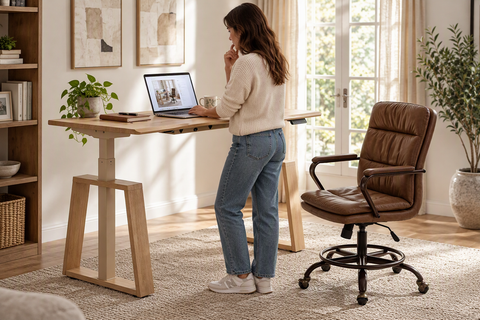
The modern executive desk has evolved. It no longer requires a choice between the "old world" charm of a heavy wooden pedestal and the "new world" utility of a standing desk. The Ark EL Executive Standing Desk bridges this gap by using original oak texture veneers and trapezoidal legs that provide a vintage charm while housing a quiet, high-performance lifting system.
For those who require even more presence, the Ark SWS Pro Executive Standing Desk provides a larger footprint and a dark brown finish that fits seamlessly into traditional studies or high-level corporate offices. These desks are designed to be "lifestyle pieces" that support the user's health without looking like industrial equipment.

Final Considerations for the Long-Term Investor
When you invest in a classic desk, you are investing in your productivity and long-term musculoskeletal health. A desk that wobbles is not just a nuisance; it is a sign of structural inadequacy that will eventually lead to failure. By prioritizing engineering features like dual motors, triangulated frames, and durable surfaces like sintered stone or high-grade laminates, you ensure that your workspace remains as sharp and stable as your professional performance.
The transition to a height-adjustable executive desk is a proactive step in preventing the chronic MSDs associated with sedentary work. As noted in the WHO 2020 Guidelines on Physical Activity and Sedentary Behaviour, reducing sedentary time is a critical component of overall well-being. A durable, beautifully crafted standing desk is the tool that makes this transition possible.
YMYL Disclaimer: This article is for informational purposes only and does not constitute professional medical advice. The ergonomic recommendations provided are based on general industry standards. Individuals with pre-existing musculoskeletal conditions, back pain, or other health concerns should consult a qualified physiotherapist or medical professional before making significant changes to their workstation or work habits.
References
- BIFMA - Standards Overview
- CCOHS - Office Ergonomics - Sit/Stand Desk
- Cornell University Ergonomics Web — Workstation Guides
- EU-OSHA - Musculoskeletal disorders and prolonged static sitting
- OSHA eTools - Computer Workstations: Neutral Working Postures
- WHO 2020 Guidelines on Physical Activity and Sedentary Behaviour




Leave a comment