

The subtle vibration of a monitor during a critical video call or the slight rhythmic sway of a desktop while typing can be more than a minor annoyance; it is a fundamental failure of workspace engineering. For high-level professionals and home office workers, desk stability is the silent foundation of productivity. When a desk wobbles, the user’s focus is fractured, and the body’s musculoskeletal system is forced to compensate for a shifting surface, leading to premature fatigue and potential long-term discomfort.
While many consumers focus on the aesthetic appeal of a "classic" or "executive" desk, the mechanical integrity of the piece—specifically how it handles lateral forces and uneven flooring—is what determines its long-term value. Understanding the physics of stability and the specific design features that mitigate "desk shake" is essential for anyone looking to make a serious investment in their well-being and professional performance.
The Physics of Instability: Why Desks Wobble
At its core, desk instability is a problem of physics involving moments of force and structural rigidity. A desk is essentially a cantilevered system or a series of jointed planes. When you type or lean on the edge of a desk, you are applying a "dynamic load." If the desk’s frame lacks sufficient stiffness, this energy is not dissipated into the floor; instead, it manifests as a visible oscillation or "wobble."
According to the Occupational Safety and Health Administration (OSHA), maintaining a "neutral working posture" is the primary defense against work-related musculoskeletal disorders (MSDs). A neutral posture requires the joints to be naturally aligned, reducing stress and strain on the muscles, tendons, and skeletal system. An unstable desk disrupts this alignment. As the surface moves, the user’s wrists, forearms, and shoulders must constantly perform micro-adjustments to stay in position. This creates what ergonomists call a "static load" on the muscles, where the tissue remains in a state of tension without movement, restricting blood circulation and accelerating the onset of Repetitive Strain Injuries (RSI).
The risk is compounded by the trend toward larger, heavier equipment. A professional "battlestation" or executive setup often includes multiple ultrawide monitors, heavy-duty monitor arms, and high-performance PC towers. These components elevate the center of gravity of the entire workstation. In a scenario involving a 49-inch super ultrawide monitor and a liquid-cooled PC, the total equipment load can easily reach 70–90 kg. When this mass is concentrated at the back or sides of the desk, it creates a significant "moment arm," amplifying any inherent weakness in the desk's frame.
Engineering the Solution: Frame Rigidity and Material Science
To counter these forces, a desk must be engineered with a focus on structural adequacy rather than just appearance. The most stable traditional desks utilize high-gauge steel frames, specifically SPCC (Steel Plate Cold Commercial) carbon steel. Cold-rolled steel is denser and more rigid than hot-rolled alternatives, providing a higher strength-to-weight ratio that eliminates the flex common in budget furniture.
The Role of Leg Geometry and Bracing
The geometry of the desk's legs plays a critical role in lateral stability. While traditional four-post legs are common, modern executive designs often utilize X-shaped or trapezoidal frames to create a wider base of support.
- X-Shaped Legs: As seen in the Ark SWS Pro Executive Standing Desk (63"x29"), X-shaped legs provide inherent cross-bracing. This design distributes lateral forces diagonally across the frame, significantly reducing the side-to-side sway that often plagues standard vertical legs.
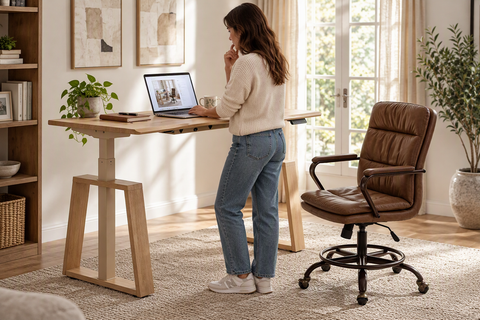
- Trapezoidal Legs: The Ark EL Executive Standing Desk (60"x26") utilizes a trapezoidal leg design. By widening the footprint at the floor level relative to the desktop connection, the desk achieves a lower center of gravity and increased resistance to tipping or shaking.

Beyond the legs, the "gusseting"—the reinforcement at the junction where the leg meets the frame—is the most common point of failure. A wobbly desk often has thin-gauge steel or insufficient welding at these joints. High-quality executive desks, such as the Ark Executive Standing Desk (63"x29"), prioritize reinforced connections and heavy-duty hardware to ensure the frame acts as a single, rigid unit.
Desktop Thickness and Mass
The desktop itself contributes to stability through mass and stiffness. For large-scale executive setups, a desktop thickness of at least 25–30 mm is recommended to prevent bowing under the weight of heavy monitors. The Zen Classic Executive Standing Desk (86"x39") exemplifies this, using a substantial surface that provides the necessary inertia to dampen vibrations from typing or peripheral movement.
The Floor Interface: Mastering Adjustable Foot Levelers
One of the most overlooked causes of desk wobble is not the desk itself, but the floor beneath it. No floor is perfectly level, whether it is hardwood, laminate, or tile. Even a 1 mm discrepancy can cause a desk to rock, which is then amplified by the height of the desk into a multi-centimeter sway at the surface.
This is where adjustable foot levelers become indispensable. Unlike cheap plastic glides, professional-grade levelers feature a wide, non-marring base and a robust metal thread. These levelers allow the user to fine-tune the height of each leg independently, ensuring that all four points of contact are under equal tension.
| Feature | Low-End Glide | Professional Leveler |
|---|---|---|
| Material | Hard Plastic | Rubberized/Non-marring base |
| Thread Gauge | Thin/Short | Robust/Extended (≥1.5 inch) |
| Adjustment Range | < 0.5 inches | 1.0 - 1.5 inches |
| Stability Impact | Minimal | High (Compensates for floor slope) |
Estimated performance based on standard furniture hardware specifications.
The Challenge of Thick Carpet
For users in home offices with high-pile or plush carpeting, stability becomes even more difficult to achieve. Carpet compresses unevenly under load. When you place a 94 kg setup (including the desk and equipment) on carpet, the feet will sink. If the foot levelers have a narrow base, they will "pierce" the carpet padding, leading to an unstable foundation.
To achieve a "rock-solid" feel on carpet, you must use levelers with a broader foot to distribute the weight and a longer thread extension to reach the subfloor if necessary. A useful heuristic for testing stability in a showroom or after assembly is to apply moderate lateral pressure to the desk's edge. If you can induce a noticeable wobble with one hand, that movement will be amplified during daily use.
Practical Setup: A Step-by-Step Guide to a Wobble-Free Desk
Achieving maximum stability requires more than just buying the right product; it requires a precise installation process.
- The Bubble Level Technique: A common mistake is assuming the desk is level by sight. After assembly, place a 24-inch bubble level across the desktop, both side-to-side and front-to-back. Adjust the foot levelers until the bubble is perfectly centered in both directions.
- Hardware Torque: Over time, the vibrations from typing and the movement of adjustable components can loosen fasteners. According to HSE guidelines on Display Screen Equipment (DSE), regular equipment checks are part of maintaining a safe workstation. Re-tighten all leg-to-frame bolts every six months to maintain structural integrity.
- Load Distribution: Avoid "cantilevering" heavy equipment. If using a monitor arm, try to mount it as close to a leg or a reinforced frame section as possible. As noted in our internal load testing, placing a 70 kg setup on a 30-inch deep desk creates a significant forward-leaning moment. Centering the mass over the frame's strongest points will reduce the "spring" effect of the desktop.
- Cable Tension Check: In height-adjustable executive models, ensure that cables have enough slack at the highest setting. Taut cables can act like a guitar string, transmitting vibrations from the floor or the desk's motor back into the monitor array.

The Human Element: Why Stability Matters for Health
The Canadian Centre for Occupational Health and Safety (CCOHS) emphasizes that the goal of office ergonomics is to "fit the job to the person." A stable desk is a prerequisite for this fit. When a desk is steady, the user can maintain the ideal monitor height and keyboard angle recommended by the BIFMA G1-2013 Ergonomics Guideline.
If the desk is wobbly, users often subconsciously change their posture to "stabilize" the environment—for example, by leaning their elbows heavily on the desk or gripping the mouse more tightly. These behaviors are primary drivers of tension in the trapezius muscles and carpal tunnel strain. By investing in a desk with a rigid frame and high-quality levelers, you are not just buying a piece of furniture; you are implementing an "engineering control"—the most effective level of hazard prevention according to OSHA's hierarchy of controls.
Scenario Analysis: Choosing the Right Foundation
Depending on your specific environment and equipment, the "ideal" stable desk may vary.
Scenario A: The Standard Home Office (Hardwood/Laminate)
In this environment, the floor is relatively predictable but often slightly sloped toward a floor drain or exterior wall. A desk like the Ark EL Executive Standing Desk (60"x26") is ideal here. Its trapezoidal legs provide a wide stance, and the standard adjustable levelers are more than sufficient to compensate for the minor floor variances of a modern home.
Scenario B: The Executive Power User (Thick Carpet & Heavy Load)
For a user with a 94 kg setup (liquid-cooled PC + triple monitors) on thick carpet, maximum mass and structural bracing are required. The Zen Classic Executive Standing Desk (86"x39") provides the necessary footprint and 4-column support to handle extreme loads without flexing. On thick carpet, it is recommended to use the levelers at their minimum extension to keep the center of gravity as low as possible, only extending them as needed to achieve a level surface.

Beyond the Wobble: A Long-Term Investment
A desk that doesn't wobble is a desk that disappears. It allows the professional to enter a state of "flow," where the tools of the trade are so reliable they are no longer noticed. By prioritizing high-gauge steel, intelligent leg geometry, and robust leveling systems, you ensure that your workspace remains a sanctuary of focus rather than a source of distraction.
When selecting your next classic desk, look past the veneer and the drawers. Reach out and shake the frame. Check the thickness of the steel. Inspect the feet. These are the details that separate a temporary piece of furniture from a lifetime investment in your professional success and physical health.
YMYL Disclaimer: This article is for informational purposes only and does not constitute professional medical advice. Ergonomic requirements vary significantly based on individual physical health, pre-existing conditions, and specific work tasks. Always consult with a qualified healthcare professional or an ergonomics specialist before making significant changes to your workstation setup, especially if you are experiencing chronic pain or discomfort.




Leave a comment