

Why does your back pain intensify specifically in the late afternoon, despite working from a high-end, classic executive suite? For decades, the "executive desk" was defined by its weight, its mahogany veneer, and its permanence. However, many professionals discover too late that a desk designed solely for status often ignores the physiological requirements of the human body. Traditional office furniture has historically prioritized aesthetic authority over musculoskeletal health, leading to a hidden epidemic of chronic discomfort among high-level professionals.
The common misconception is that "ergonomic" and "traditional" are mutually exclusive categories. One is associated with plastic, mesh, and a laboratory-like aesthetic, while the other is associated with heritage, wood, and static heavy-duty construction. This binary is a fallacy. A truly ergonomic workspace is not defined by its visual style but by its ability to support a "neutral position" and facilitate movement. By reimagining the classic silhouette through the lens of modern biomechanics, we can define a new category: the Ergonomic Traditional Desk.
The Physiology of the "Executive Hunch"
To understand why traditional desks often fail the user, we must look at the pathophysiological mechanisms of musculoskeletal disorders (MSDs). According to the OSHA guidelines on identifying ergonomic problems, the core risk factors include repetitive tasks, excessive force, and, most critically for office workers, poor posture.
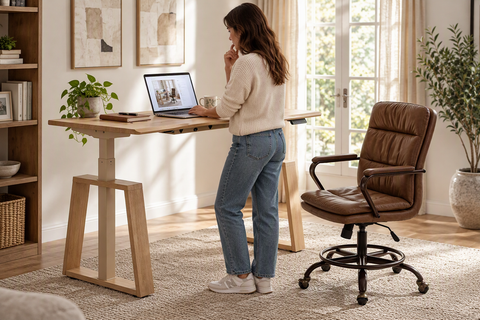
When you sit at a fixed-height traditional desk for eight hours, your body is subjected to a "static load." Unlike dynamic movement, which encourages blood circulation, static loading compresses the spinal discs and restricts blood flow to the muscles. The ISO 11226:2000 standard for evaluating static working postures specifies that maintaining a fixed position for extended periods—even if that position feels "comfortable" initially—leads to tissue fatigue and eventually chronic pain.
For many executives, the desk height is fixed at a standard 29 inches. However, anthropometric data suggests that this "one size fits all" approach fails a significant portion of the population. A 95th-percentile tall male (approximately 6'2") requires a seated desk height of roughly 30.7 inches to maintain 90-degree elbow angles. Conversely, a 5th-percentile petite user may need a height as low as 22 inches. When the desk is at the wrong height, the user compensates by hunching the shoulders or craning the neck, leading to tension in the trapezius and levator scapulae muscles.
Defining the Ergonomic Traditional Desk
An Ergonomic Traditional Desk is a workstation that preserves the timeless aesthetic of classic furniture—utilizing materials like real wood veneers, leather accents, and substantial silhouettes—while integrating the engineering required to support human health. The primary intervention is height adjustability, but the "ergonomic" label requires more than just a motor.
1. Anthropometric Range Coverage
Industry standards like the BIFMA G1-2013 Ergonomics Guideline recommend that furniture should accommodate the 5th to 95th percentile of the population. In the context of a traditional desk, this means the lift mechanism must be powerful enough to move heavy solid-wood or sintered stone tops while providing a travel range that supports both seated and standing work for users of varying heights.
2. Structural Integrity and Load Capacity
Traditional aesthetics often involve heavier materials. A standard executive setup including a solid wood top, dual large-format monitors, and a high-performance PC can easily exceed 80 kg (approx. 176 lbs). While a single-motor desk might struggle, a dual-motor system is essential for maintaining a safe 80% utilization margin, ensuring smooth, quiet transitions without risking mechanical failure or "monitor wobble."
3. The "Invisible" Tech Integration
Modern ergonomics requires cable management. A cluttered desk is not just an aesthetic issue; it creates cognitive load and physical obstructions. The new classic desk integrates power outlet holders and cable trays within the frame, ensuring that the clean lines of a mahogany or walnut finish are not marred by a "spaghetti" of wires.
Technical Comparison: Materials and Performance
When selecting an ergonomic traditional desk, the choice of surface material impacts both durability and sensory comfort. We have analyzed the two most common premium finishes used in modern executive designs.
| Feature | Real Wood Veneer (e.g., Walnut/Mahogany) | Sintered Stone (Black/Gold Marble Aesthetic) |
|---|---|---|
| Sensory Feel | Warm to the touch; organic texture. | Cool to the touch; ultra-smooth. |
| Maintenance | Requires gentle, pH-neutral cleaners. | Virtually maintenance-free; scratch-resistant. |
| Weight Profile | Medium-High (Requires dual motors). | High (Requires high-torque dual motors). |
| Durability | Susceptible to water rings/scratches. | Heat, stain, and scratch-proof. |
| Best For | Traditional home libraries and classic offices. | Modern executive suites with a luxury edge. |
Note: Values and traits are based on standard material performance in the high-end furniture industry.
For those who prefer the warmth of tradition, the Ark Executive Standing Desk (63"x29") utilizes a walnut finish and trapezoidal legs to provide a grounded, settled feel while offering the health benefits of a dual-motor lift system.
Scenario Analysis: The Tall Executive vs. The Traditional Setup
To demonstrate the "Information Gain" of an adjustable traditional desk, consider a simulation for a 95th-percentile male executive (189cm / 6'2.5").
The Problem: At a standard 29-inch fixed desk, this user experiences a 1.75-inch ergonomic gap. To reach the keyboard, he must hunch his shoulders forward. Over a 40-hour work week, this sustained "forward head posture" increases the effective weight of the head on the cervical spine from 12 lbs to nearly 42 lbs.
The Solution: By utilizing a desk like the Opal Executive Standing Desk (66"x29"), the user can set a seated height of 30.7 inches and a standing height of 45.6 inches. This alignment allows the elbows to remain at a 90-degree angle, significantly reducing strain on the ulnar nerve and preventing Repetitive Strain Injury (RSI).

Furthermore, the Ark ES Executive Standing Desk (60"x26") addresses the need for storage without sacrificing legroom. A common mistake in traditional desk design is underestimating knee clearance. According to practitioners, a minimum of 24 inches of knee clearance is required when the desk is paired with deep drawers or a keyboard tray. The Ark ES solves this by utilizing a side-cabinet configuration, maintaining the traditional "heavy" look while providing the necessary "humanized" space for the user’s legs.
Practical Recommendations for a Healthy Workspace
Transitioning to an ergonomic traditional desk is only the first step. To maximize the health benefits, you must implement a structured work rhythm.
1. The 20-8-2 Rule
Developed by ergonomics experts at Cornell University, this rhythm suggests that for every 30 minutes of work, you should spend:
- 20 minutes sitting in a neutral posture.
- 8 minutes standing to encourage circulation.
- 2 minutes moving or stretching.
This cycle prevents the negative effects of "prolonged static standing," which, as noted by EU-OSHA, can lead to lower limb disorders and varicose veins if not balanced with movement.
2. Monitor Placement and Visual Parallax
A recurring issue with deep traditional desks is improper monitor height. Even with an adjustable desk, the "top of the screen should be at or slightly below eye level," according to the CCOHS guide on office ergonomics. Because traditional desks often have fixed aesthetic backboards or thick tops, we recommend using a monitor arm. For an L-shaped setup, the Ark Pro L-Shaped Standing Desk (Sintered Stone, 63"x23") provides the necessary surface area to position dual monitors at the correct focal length (at least an arm's length away) while maintaining the luxurious look of black and gold sintered stone.

3. Cable Management "Gotchas"
Experienced installers emphasize that cable management should be the first step of assembly, not the last. Routing power strips and excess cable length into the integrated management tray before the desk reaches its final position prevents "cable tension" issues. When the desk rises to its full standing height, cables that are too short can pull on ports or even tip over equipment. Always ensure you have "service loops"—extra slack in the cables—to accommodate the full range of motion.
The Investment in Longevity
Choosing an ergonomic traditional desk is an investment in both your professional image and your long-term physical capacity. By selecting a piece that meets ANSI/BIFMA X5.1 standards for safety and durability, you ensure that your workspace is built to withstand the rigors of daily use while protecting your spinal health.
The "New Classic" is not just a piece of furniture; it is a tool for productivity. It acknowledges that while we value the heritage of wood and the weight of a traditional office, we cannot afford the health costs of a static life. By integrating dual-motor lift systems, intelligent cable management, and anthropometrically correct dimensions, the modern executive desk finally achieves the perfect balance of form and function.

References
- BIFMA G1-2013 Ergonomics Guideline for Furniture
- CCOHS: Office Ergonomics - Sit/Stand Desk
- Cornell University Ergonomics Web — Workstation Guides
- OSHA eTools: Computer Workstations - Neutral Working Postures
- ISO 11226:2000 Evaluation of static working postures
Disclaimer: This article is for informational purposes only and does not constitute professional medical advice. If you have pre-existing musculoskeletal conditions or chronic back pain, please consult a qualified physiotherapist or medical professional before significantly altering your workstation setup or adopting a new sit-stand routine. Individuals with circulatory issues should be particularly cautious regarding prolonged standing.




Leave a comment