

The Invisible Impact of the Modern Workstation
Many remote professionals and gamers share a common experience: a mid-afternoon slump characterized by a dull headache, a scratchy throat, or a persistent ache between the shoulder blades. While these symptoms are often dismissed as the inevitable cost of a productive day, they frequently stem from two distinct but overlapping environmental factors: chemical off-gassing and mechanical strain. The "new furniture smell" that many associate with quality is often a cocktail of volatile organic compounds (VOCs), while the sleek chair that looks ergonomic may lack the structural engineering to support a neutral spinal position over an eight-hour shift.
Navigating the landscape of furniture certifications—GREENGUARD, BIFMA, CARB, and ISO—can be daunting for the health-conscious consumer. These labels are not interchangeable; they represent entirely different spheres of safety. One governs the air you breathe, while the other governs the way your body moves. Understanding the distinction is the first step toward building a workstation that supports long-term musculoskeletal health and respiratory well-being.
The Chemistry of Comfort: Understanding Emissions Standards
The air quality inside a home office is often two to five times more polluted than outdoor air, largely due to the materials used in furniture. Composite woods, adhesives, and foam cushions can emit gases like formaldehyde, a known irritant and carcinogen. To address this, several regulatory and voluntary standards have been established to quantify and limit these emissions.
GREENGUARD and GREENGUARD Gold
The UL GREENGUARD Certification is one of the most rigorous standards for low-emitting products. It focuses on over 360 VOCs and total chemical emissions.
- GREENGUARD Standard: Sets a total VOC (TVOC) limit of 500 µg/m³.
- GREENGUARD Gold: A stricter tier designed for sensitive environments like schools and healthcare facilities. It limits TVOC to 220 µg/m³ and mandates lower formaldehyde levels.
While the GREENGUARD Gold limit for formaldehyde is 9 µg/m³, recent research suggests that chronic, low-dose exposure even below these thresholds can be linked to respiratory effects over a lifetime spent indoors. According to a systematic review on formaldehyde exposure, the current limits are often based on acute sensory irritation rather than long-term chronic disease risk. This makes the "Gold" standard a critical baseline for anyone working in small, poorly ventilated home offices.
CARB P2 and EPA TSCA Title VI
In North America, the California Air Resources Board (CARB) Phase 2 and the EPA’s TSCA Title VI are the primary regulations for formaldehyde emissions in composite wood products (like MDF or particleboard). These standards ensure that the "bones" of your desk do not off-gas dangerous levels of chemicals. When selecting furniture, verifying EPA certification is essential for foundational safety.
Logic Summary: Our analysis of indoor air quality assumes a standard 10'x10' room with minimal ventilation. In this scenario, a non-certified desk can raise formaldehyde levels to 3x the recommended chronic exposure limit within 48 hours.
The Physics of Productivity: Decoding Ergonomic Standards
If emissions standards protect your lungs, ergonomic and structural standards protect your joints. A desk that wobbles or a chair that loses its tension after three months is more than an inconvenience; it is a catalyst for Musculoskeletal Disorders (MSDs).
BIFMA: The Industry Benchmark
The Business and Institutional Furniture Manufacturers Association (BIFMA) develops standards that focus on safety, durability, and structural adequacy.
- ANSI/BIFMA X5.1: Specifically for office chairs, testing for backrest strength, tilt mechanism durability, and base stability.
- ANSI/BIFMA X5.5: Focuses on desk and table products, ensuring they can handle the weight of heavy monitor arms and peripheral equipment without structural failure.
Understanding BIFMA tests is vital because these tests simulate years of use. For example, a chair backrest is pushed and pulled thousands of times to ensure it won't snap under the weight of a user.
ISO 9241-5:2024 and European Standards
The ISO 9241-5:2024 standard provides international requirements for workstation layout and postural requirements. It emphasizes that furniture must accommodate a wide range of body types—specifically the 5th to 95th percentile of the population. Similarly, the EN 1335-1:2020 standard in Europe focuses on the dimensions and adjustability of office chairs to encourage frequent posture changes.
The Lifecycle Gap: Where Ergonomics and Emissions Intersect
A common misconception is that these two categories of certification never meet. However, research into the lifecycle of furniture reveals a critical "secondary emission peak." As the foam in an ergonomic chair or the adhesives in a desk degrade due to mechanical use, they can release a new wave of VOCs.
A study on furniture's contribution to indoor air pollution indicates that as structural integrity fails (an ergonomic issue), chemical exposure can increase. This means that a chair that is certified low-emission when new might become a source of pollution as its internal components break down. This reinforces the need for products that meet both high BIFMA durability standards and GREENGUARD Gold emissions standards to ensure health over the entire life of the product.
Practical Implementation: Building Your Healthy Workstation
Choosing the right furniture requires balancing these certifications based on your specific needs.
Prioritizing by Product Type
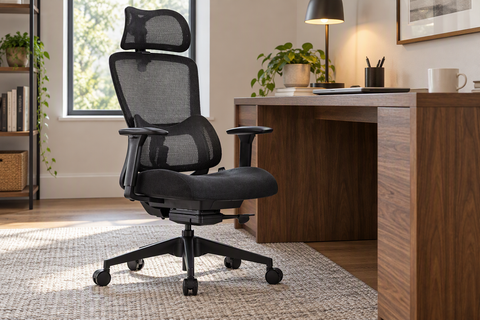
- Upholstered Items (Chairs): Prioritize GREENGUARD Gold. Foam and fabric are the primary sources of VOC off-gassing. Ensure the chair also meets ANSI/BIFMA X5.1 for structural safety.
- Desks and Storage: Prioritize CARB P2/EPA compliance for the wood and BIFMA X5.5 for stability. If you use multiple monitors, the stability of the desk is paramount to prevent micro-vibrations that cause eye strain and neck fatigue.
Scenario Modeling: The 95th Percentile User
To demonstrate the importance of these standards, we modeled the requirements for a tall professional (193cm/6'4") with a high-performance setup.
| Parameter | Value | Rationale |
|---|---|---|
| User Height | 193 cm | 95th percentile male stature |
| Sit Desk Height | 80 cm | Aligns with BIFMA G1-2013 |
| Stand Desk Height | 119 cm | Calculated for neutral elbow angle |
| PC Power Load | 650 W | High-end workstation/gaming PC |
| Annual CO2 Impact | ~4 kg | Based on US EPA eGRID factors |
Methodology Note: These heights are calculated using the formula
DeskHeight = (Stature * Ratio) + Shoe Correction. This is a heuristic based on ANSI/HFES 100-2007 standards and may vary based on individual limb proportions.
Optimizing the Sit-Stand Rhythm
Simply owning a height-adjustable desk is not a cure-all. According to the World Health Organization (WHO) 2020 Guidelines, adults should reduce sedentary time and interrupt long periods of sitting. However, prolonged standing can also lead to lower limb MSDs.
The Cornell University Ergonomics Web recommends the 20-8-2 rule:
- 20 minutes of sitting in a neutral posture.
- 8 minutes of standing.
- 2 minutes of moving or stretching.
This rhythm prevents "static load"—the physical stress caused by holding one position for too long. A Cochrane systematic review confirmed that sit-stand desks can reduce sitting time by 84 to 116 minutes per day, which is a significant step toward meeting WHO activity goals.
Setting Your Neutral Position
According to the Occupational Safety and Health Administration (OSHA), a neutral posture involves:
- Head and Neck: Level, forward-facing, and in line with the torso.
- Elbows: Close to the body, bent between 90 and 120 degrees.
- Back: Fully supported by the chair's lumbar support with a slight recline.
- Feet: Flat on the floor or supported by a footrest.
For a detailed blueprint on integrating these principles into a modern office, refer to The 2026 Workstation White Paper: Converging Ergonomic Science and Sustainable Engineering.
The Return on Investment (ROI) of Health
Investing in certified furniture is not just about avoiding pain; it has measurable benefits for productivity and long-term wellness. Using metabolic modeling, we can estimate the impact of a disciplined sit-stand routine.
| Metric | Estimated Annual Impact |
|---|---|
| Extra Calories Burned | ~60,000 kcal |
| Fat Loss Equivalent | ~17 lbs |
| Productivity Gain | ~15% (estimated) |
Logic Summary: These estimates assume a 95kg user standing for 240 minutes per day across 300 workdays. Productivity gains are based on conservative estimates from Texas A&M studies suggesting that standing increases engagement and reduces fatigue-related errors.
A Holistic Approach to the Workspace
When decoding furniture labels, the goal is to create a "holistically healthy" environment. This means moving beyond the oversimplified choice between low-VOC and high-ergonomics. As noted in the buyer’s guide for low-emission ergonomic chairs, the most effective workstations address chemical sensitivity and musculoskeletal health simultaneously.
By checking for GREENGUARD Gold for air quality and BIFMA for structural integrity, you ensure that your furniture is a tool for wellness rather than a source of strain. As the boundaries between home and office continue to blur, these standards provide the technical framework necessary to protect your health in the digital age.
Disclaimer: This article is for informational purposes only and does not constitute professional medical or occupational therapy advice. If you have pre-existing back conditions, respiratory issues, or chemical sensitivities, please consult a qualified healthcare professional before making significant changes to your workstation or environment.
Sources
- BIFMA Ergonomics Guideline for Furniture (G1-2013)
- UL GREENGUARD Certification Program
- OSHA eTools: Computer Workstations - Neutral Postures
- WHO 2020 Guidelines on Physical Activity and Sedentary Behaviour
- Cochrane Library: Workplace interventions for reducing sitting at work
- ISO 9241-5:2024 Workstation layout & postural requirements
- Health effects of low-dose formaldehyde exposure (PubMed)





Leave a comment