

The Ergonomic Paradox: Why a High-End Chair Is Not a Cure-All
It is a common scenario in the modern home office: a professional experiences persistent lower back stiffness or a dull ache between the shoulder blades and decides to invest in a premium ergonomic chair. The expectation is that the chair will act as a corrective device, resolving years of postural habits. However, weeks later, the discomfort persists or even intensifies. This phenomenon leads many to believe the chair is faulty or the concept of ergonomics is marketing hyperbole.
In reality, the issue rarely lies with the chair's engineering but rather with a fundamental misunderstanding of how ergonomic furniture interacts with human physiology. An ergonomic chair is not a passive medical treatment; it is a tool designed to reduce specific risk factors, such as muscle load and spinal compression. According to the Cochrane Back and Neck Group, while ergonomic interventions can reduce sitting time and discomfort, chairs alone rarely produce large-scale long-term effects without proper configuration and behavioral changes.
The gap between purchasing an ergonomic solution and achieving physical relief usually stems from three areas: incorrect adjustment of the lumbar mechanism, a failure to establish a neutral pelvic foundation, and the "set-and-forget" mentality that ignores the necessity of postural variation. To unlock the potential of a professional-grade chair, one must move beyond basic setup and apply the principles of musculoskeletal health.
The Science of Static Load and Spinal Neutrality
To understand why discomfort persists, one must examine the physiological principles of the "static load." When a person sits, the muscles of the back and core are often required to maintain a single position for hours. This creates a sustained contraction that restricts blood circulation, leading to a buildup of lactic acid and metabolic waste in the muscle tissue. Over time, this results in what clinicians refer to as Musculoskeletal Disorders (MSDs).
The primary goal of any ergonomic setup is to achieve a "Spinal Neutral Position." This is the posture where the spine maintains its natural "S" curve—cervical lordosis (neck), thoracic kyphosis (upper back), and lumbar lordosis (lower back). When the spine is neutral, the vertebrae are stacked in a way that minimizes the pressure on the intervertebral discs and the strain on the surrounding ligaments.
The Pathophysiology of Poor Sitting
When a user slumps or "shrimps" forward, the lumbar curve flattens. This posterior pelvic tilt increases the pressure on the anterior (front) portion of the spinal discs, pushing the nucleus pulposus (the jelly-like center) backward toward the spinal nerves. Conversely, excessive lumbar support can force the back into an exaggerated arch, known as anterior pelvic tilt. Both extremes lead to localized "hot spots" of pressure.
Logic Summary: Our understanding of spinal loading is based on the principle that neutral alignment minimizes disc pressure. Research from ISO 11226:2000 specifies that static working postures should be evaluated based on duration and joint angles, confirming that even a "perfect" posture becomes harmful if held too long without movement.
The Lumbar Trap: Why "More" Support Isn't Always Better
The most frequent oversight in ergonomic chair use is treating lumbar support as a "set-and-forget" feature or, worse, setting it to the maximum depth. Many users believe that if a little support is good, a lot of support must be better. Practitioners frequently observe users setting their lumbar mechanism at its maximum protrusion. This creates excessive lordosis, which can be just as damaging as slouching.
The effective technique for lumbar calibration is a gradual, sensory-based approach. The support should not feel like a point of pressure pushing into the spine; instead, it should feel like a gentle, widespread contact that fills the gap between the chair back and the natural curve of the lower back.
The Two-Finger Rule for Depth and Height
An expert-level heuristic for setting lumbar depth is the "Two-Finger Rule." After adjusting the chair, the user should be able to slide two fingers comfortably between their back and the support at its fullest point. If the fingers cannot pass, the support is too aggressive and is likely forcing the pelvis into an unhealthy tilt. If there is a large gap, the support is insufficient to prevent the spine from collapsing into a flat-back position.
Furthermore, the vertical placement of the support is often misaligned. Many users place the support at the "waist" (the narrowest part of the torso). However, the center of the lumbar mechanism should align with the top of the pelvis—the iliac crest. This provides a foundation for the lower vertebrae (L4 and L5), which bear the highest load during seated tasks.

The Forgotten Foundation: Pelvis and Feet
A common mistake in troubleshooting back pain is focusing exclusively on the backrest while ignoring the seat pan and the floor. Biomechanically, the pelvis is the foundation of the spine. If the pelvis is not stable, the lumbar support cannot function correctly.
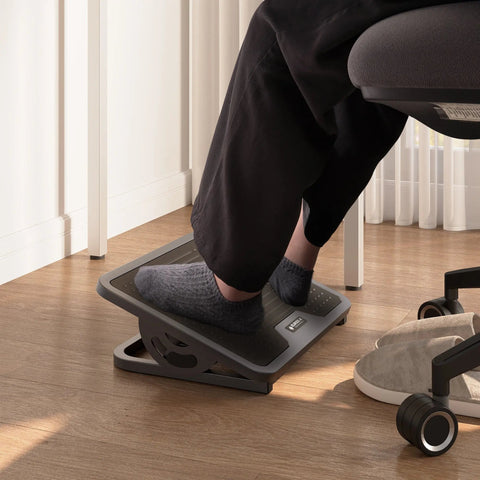
A 2022 study published in Applied Ergonomics found that using a footrest significantly increases backrest use and facilitates a neutral posture. When the feet are not firmly supported, the user tends to slide forward in the seat (perching). This causes the pelvis to tuck under (posterior tilt), which flattens the lumbar curve and makes even the most advanced backrest irrelevant.
Seat Pan Depth and Circulation
The seat pan depth is equally critical. If the seat is too deep, it will press against the back of the knees, restricting blood circulation and forcing the user to sit forward, away from the lumbar support. If the seat is too shallow, there is insufficient support for the thighs, increasing the pressure on the sit-bones (ischial tuberosities).
The Seat Pan Self-Check:
- Sit as far back as possible in the chair.
- Check the gap between the edge of the seat and the back of your knees.
- The ideal gap is approximately two to three fingers' width.
- If the gap is wider, you are likely losing pelvic stability. If the gap is narrower, you risk popliteal pressure and reduced circulation.
Case Study: The Tall Professional's Ergonomic Gap
To demonstrate how standard setups fail specific users, we modeled a scenario involving a 190cm (approx. 6'3") tall male professional. This "95th percentile" user often experiences persistent pain despite owning an ergonomic chair because standard furniture dimensions are often optimized for the 5th to 95th percentile range of a general population, which can leave outliers at a disadvantage.
Modeling Note: The 190cm Professional Scenario
Our analysis indicates that for a tall professional, back pain is often the result of a "compounded mismatch" where the chair is correctly adjusted, but the desk and monitor are not.
| Parameter | Value | Unit | Rationale |
|---|---|---|---|
| User Stature | 190 | cm | 95th Percentile Male |
| Recommended Seat Height | 50 | cm | Popliteal height + shoe correction |
| Recommended Sit-Desk Height | 78.5 | cm | Based on ANSI/HFES 100-2007 |
| Standard Fixed Desk Height | 73.7 | cm | Typical industry standard (29 inches) |
| Ergonomic Height Gap | 4.8 | cm | The discrepancy causing the "slump" |
Analysis: In this model, the standard desk is nearly 5cm too low. This forces the tall user to either slump their shoulders to reach the keyboard or lower their chair. If they lower their chair, their knees rise above their hips, causing the pelvis to tilt backward and flattening the lumbar curve. This demonstrates that for certain users, a chair cannot solve back pain if the desk height is fixed at a standard level.

The Hierarchy of Solutions: Engineering vs. Behavior
The U.S. Occupational Safety and Health Administration (OSHA) describes a "hierarchy of controls" for addressing workplace risks. The most effective is an Engineering Control—such as a sit-stand desk or a dual-backrest chair—which physically changes the environment to reduce strain. The second is an Administrative Control, such as taking breaks.
Many users fail because they rely solely on administrative controls (trying to remember to sit straight) without the engineering support to make that posture sustainable. Conversely, others buy the equipment (engineering) but fail the administrative side by remaining static for eight hours.
The 20-8-2 Rhythm
To maximize the utility of ergonomic furniture, practitioners recommend the 20-8-2 rule developed by researchers at Cornell University. In every 30-minute block:
- 20 Minutes Sitting: In a neutral, supported position.
- 8 Minutes Standing: Using a height-adjustable surface to transition the load to different muscle groups.
- 2 Minutes Moving: Gentle stretching or walking to stimulate blood circulation and "reset" the spinal discs.
This rhythm prevents the "creep" effect in spinal ligaments—a condition where tissues become permanently stretched or deformed due to sustained static loading.
Advanced Setup: The Workstation Ecosystem
The chair is only one component of the "Workstation Blueprint." To truly eliminate back pain, the entire environment must align with the user's biomechanics. As detailed in the industry white paper The 2026 Workstation White Paper: Converging Ergonomic Science and Sustainable Engineering, a holistic approach is required to bridge the gap between furniture design and human health.
Monitor Placement and the "Lean" Dilemma
If a monitor is placed too low or too far away, the user will unconsciously lean forward. This "head-forward" posture increases the effective weight of the head on the cervical spine. For every inch the head moves forward, it gains roughly 10 pounds of effective weight. This forward lean also pulls the lower back away from the lumbar support, creating a chain reaction of musculoskeletal strain.
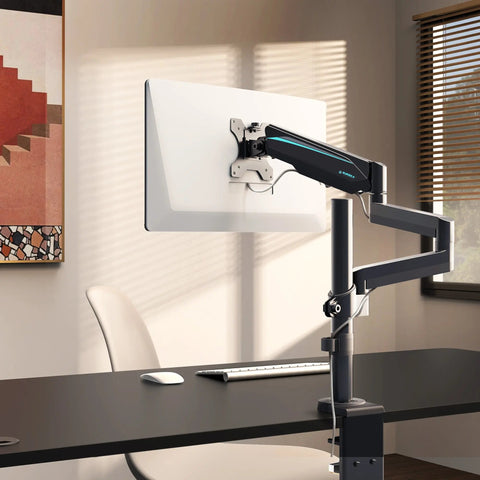
Expert Setup Tip: The top third of the monitor screen should be at eye level. This encourages a slight downward gaze (15–20 degrees), which is the most natural position for the eyes and neck, reducing the urge to crane the neck forward.
The Role of Armrest Calibration
Armrests are often neglected, yet they play a vital role in reducing tension in the trapezius muscles. If armrests are too high, the shoulders remain shrugged; if too low, the user leans to one side to find support. The BIFMA G1-2013 Ergonomics Guideline suggests that armrests should be adjusted so that the elbows are bent at approximately 90 to 110 degrees with the shoulders relaxed.

Actionable Checklist for Troubleshooting Discomfort
If you have invested in an ergonomic chair but still experience pain, follow this diagnostic sequence to identify the mismatch:
- Feet First: Are your feet flat on the floor or a footrest? If your heels are lifting or you feel pressure under your thighs, your chair is too high.
- Pelvic Anchor: Slide your hips all the way back until they touch the backrest. Is there a 2-3 finger gap behind your knees? If not, adjust the seat pan depth.
- Lumbar Calibration: Retract the lumbar support fully. Sit in your neutral posture. Slowly increase the depth until you feel contact, then stop. Apply the "Two-Finger Rule" to ensure it isn't too aggressive.
- Height Alignment: Ensure the center of the lumbar support is at your iliac crest (belt line), not your waist.
- Elbow Level: Adjust your chair or desk height so that your elbows are level with the keyboard. If your desk is too high and your chair cannot go higher, you need a footrest to bridge the gap.
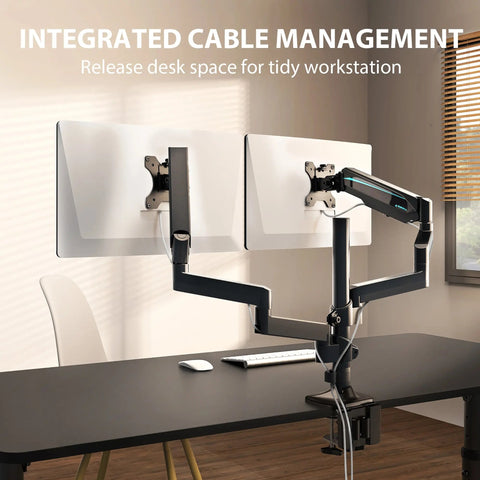
- Eye Level: Is the top of your monitor at eye level? If you are looking up or leaning forward, adjust the monitor arm or stand.
Summary of Ergonomic Principles
The transition from chronic discomfort to all-day productivity requires a shift in perspective. An ergonomic chair is a sophisticated tool that requires precise calibration based on individual anthropometrics. By understanding the physiological mechanisms of static load and applying standardized guidelines from organizations like BIFMA and OSHA, users can move beyond the "set-and-forget" trap.
Remember that the best posture is always the next posture. Even a perfectly adjusted chair cannot replace the biological need for movement. Integrating a sit-stand rhythm and ensuring the entire workstation ecosystem—from monitor height to foot support—is synchronized will provide the relief that a chair alone cannot deliver.
Disclaimer: This article is for informational purposes only and does not constitute professional medical advice, diagnosis, or treatment. Always seek the advice of a qualified health provider with any questions you may have regarding a medical condition. The ergonomic recommendations provided are based on general industry standards and may not be suitable for individuals with pre-existing spinal injuries or specific medical requirements.
Sources
- BIFMA G1-2013 Ergonomics Guideline for Furniture
- OSHA eTools: Computer Workstations - Neutral Working Postures
- Canadian Centre for Occupational Health and Safety (CCOHS): Sit/Stand Desk Setup
- ISO 11226:2000 Evaluation of Static Working Postures
- World Health Organization (WHO) 2020 Guidelines on Physical Activity and Sedentary Behaviour
- The 2026 Workstation White Paper: Converging Ergonomic Science and Sustainable Engineering




Leave a comment