

Is Your Chair Causing Discomfort? A Quick Fix Guide
You invested in a premium executive chair, expecting all-day comfort and support. Yet, by midafternoon, you find yourself shifting restlessly, battling a familiar ache in your lower back or tightness in your shoulders. If your chair feels more like a source of frustration than relief, the problem is likely not the chair itself, but how it's adjusted to fit you.
An ergonomic chair is a sophisticated tool. Like any tool, it requires proper calibration to perform its job effectively. A few small misalignments in seat height, lumbar position, or armrest level can negate the chair's benefits and create new pressure points. This guide provides a straightforward, step-by-step process to troubleshoot your setup. We will identify common mistakes and provide practical fixes to unlock the ergonomic support and comfort your body needs.
The Foundation: Why Your Setup Matters
Before we touch a single lever or knob, it's crucial to understand the goal: achieving a "neutral body position." This is the posture where your muscles, tendons, and skeletal system are under the least amount of stress. According to the U.S. Occupational Safety and Health Administration (OSHA), a neutral posture involves keeping the body aligned and balanced while sitting or standing. When your chair is poorly adjusted, it forces your body into static, awkward positions that contribute to musculoskeletal disorders (MSDs) over time.
Prolonged static postures, whether sitting or standing, increase the load on the spine and impede blood circulation. Research from EU-OSHA highlights that prolonged static sitting is a significant risk factor for MSDs, including low back pain and neck discomfort. The right adjustments transform your chair from a simple seat into an active tool that promotes a healthy posture.
Debunking a Common Myth: The 90-Degree Rule
A pervasive myth in office ergonomics is that you must sit rigidly upright at a perfect 90-degree angle all day. In reality, this is an unnatural and fatiguing posture. The goal is not to remain frozen in one position but to support a healthy spinal curve while allowing for dynamic movement. A slight recline of 100 to 110 degrees often reduces pressure on the lumbar discs more effectively than sitting bolt upright.
The 5-Step Ergonomic Chair Tune-Up: A Practical Checklist
Think of adjusting your chair as a sequence that starts from the ground up. Each step builds on the last, creating a stable and supportive foundation for your entire body. Let's walk through the process.
Step 1: Set Your Seat Height and Foundation
Your feet are your anchor. They should rest flat on the floor, providing a stable base.
- How to Adjust: Raise or lower your chair until your feet are flat on the floor and your thighs are roughly parallel to it, or sloping slightly downward. Your knees should be at approximately a 90 to 100-degree angle.
- Common Mistake: Setting the seat too high lifts your feet off the floor, putting pressure on the back of your thighs and restricting blood flow. Setting it too low causes your knees to rise above your hips, which can flatten your lower back's natural curve and lead to slouching.
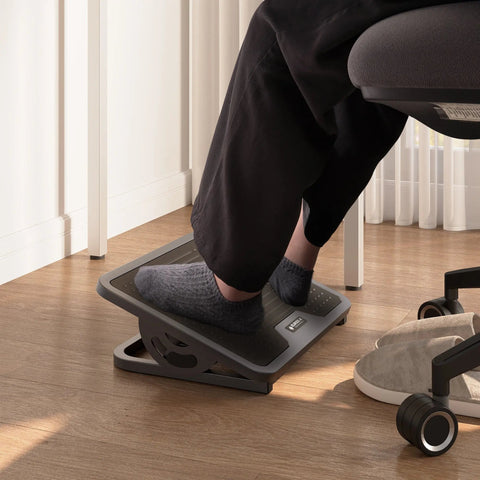
- Pro Tip: What if your desk is too high to maintain this posture with relaxed shoulders? Don't compromise your posture. Raise your chair to the correct height relative to the desk and place an Adjustable Ergonomic Footrest under your feet. This provides the necessary support to keep your legs in the ideal position.

Step 2: Adjust the Seat Pan Depth
The seat pan should support your thighs without pressing into the back of your knees.
- How to Adjust: Slide the seat pan forward or backward until you have a gap of about two to three finger-widths between the front edge of the seat and the back of your knees.
- Common Mistake: A seat that is too deep will press against your calves, potentially cutting off circulation and forcing you to slouch to get your back against the backrest. A seat that is too shallow fails to provide adequate thigh support, creating instability and pressure points.
Step 3: Position the Lumbar Support
This is arguably the most critical adjustment for preventing lower back pain. The lumbar support should fit perfectly into the natural inward curve (lordosis) of your lower spine.
- How to Adjust: Adjust the lumbar support's height so it sits just above your belt line, in the small of your back. Then, adjust its depth so you feel gentle, firm pressure.
- Common Mistake: Placing the support too high pushes your upper back forward, while placing it too low offers no support at all. Too much protrusion can feel like a constant push, forcing your chest forward into an unnatural position.
- Experiential Tip: I often tell clients to perform a quick hand test. While sitting upright, slide your hand behind your lower back. The support should fill that space comfortably, maintaining your natural spinal curve without actively pushing you forward.
Step 4: Align Your Armrests
Armrests are there to reduce the strain on your shoulders and neck, but only when positioned correctly.
- How to Adjust: Set the armrest height so that your forearms are parallel to the floor when your shoulders are relaxed and your elbows are bent at roughly a 90-degree angle. On advanced chairs like the Royal II, Silicone & Leather Executive Ergonomic Office Chair, you can also adjust the width and angle to support your arms during different tasks.
- Common Mistake: Armrests set too high force your shoulders to shrug upwards, creating tension in the neck and upper back. If they are too low, you may find yourself leaning to one side to rest an arm, throwing your spine out of alignment.
Step 5: Use the Recline Function Dynamically
Your chair's recline feature is for more than just relaxing. It allows you to shift your posture throughout the day, which is vital for spinal health.
- How to Adjust: For focused work like typing, a slight recline of 100-110 degrees is ideal. For reading, phone calls, or short breaks, a deeper recline of 110-135 degrees can help decompress the spine. Use the tilt lock to secure a stable position when needed, but allow for free movement when you can.
- Common Mistake: Either locking the chair in a single upright position all day or reclining so far back that it strains your neck to see your monitor.

Quick Adjustment Checklist
| Adjustment Point | Correct Position | Common Mistake |
|---|---|---|
| Seat Height | Feet flat on the floor, thighs sloped slightly down. | Too high (pressure on thighs) or too low (slouching). |
| Seat Depth | 2-3 finger gap between seat edge and back of knees. | Too deep (poor circulation) or too shallow (no support). |
| Lumbar Support | Fits the natural curve of your lower back. | Too high/low, or too much/little pressure. |
| Armrests | Shoulders relaxed, elbows at a ~90-degree angle. | Too high (shrugged shoulders) or too low (leaning). |
| Recline Angle | 100-110° for focused work; deeper for breaks. | Staying locked upright or reclining too far for tasks. |
Fine-Tuning for All-Day Comfort
Once you've made the primary adjustments, a few final touches can elevate your comfort from good to great.
The Headrest's Role
A headrest is not meant for constant contact while you work. Its primary purpose is to provide support for your head and neck during breaks, phone calls, or moments of recline. Position it to cradle the base of your head and neck, allowing your neck muscles to relax completely when you lean back.
Expert Warning: Ergonomics is Not One-Size-Fits-All
It's important to approach these guidelines as a starting point, not as rigid rules. The field of ergonomics provides evidence-based recommendations, but individual bodies have unique needs. The best setup is one that is tested and refined based on your personal comfort. Listen to your body. If an adjustment doesn't feel right, experiment with small changes until you find what works for you. True ergonomic success comes from creating a dynamic environment that adapts to your movements and tasks throughout the day.
Wrapping Up: Your Chair is a Tool—Learn to Use It
An uncomfortable executive chair is almost always a sign of a setup that needs correction. By methodically working through these five key adjustments—seat height, depth, lumbar support, armrests, and recline—you can transform your chair into a personalized tool for comfort and productivity.
A high-quality chair, like the plush Royal, Microfiber Leather Executive Office Chair, has the built-in engineering to support you. Your role is to calibrate it to your unique body shape and workflow. Take ten minutes today to go through this checklist. Your back, neck, and shoulders will thank you for it.
Frequently Asked Questions (FAQ)
How often should I readjust my chair? You should perform a full ergonomic check whenever you feel discomfort or if your primary tasks change. A quick check of your posture and key adjustment points once a week is a good habit to maintain.
Should my feet touch the floor when sitting in an office chair? Yes, absolutely. Your feet should rest flat on the floor or be fully supported by a footrest. This creates a stable base and promotes a healthy posture.
What is the best angle to recline my office chair? For active computer work, a slight recline of 100-110 degrees is generally recommended to reduce pressure on your spine. For breaks or less intensive tasks, you can recline further. The key is to change your position throughout the day.
Is an expensive executive chair worth it? A well-designed executive chair is worth the investment if it offers the adjustability needed to fit your body properly. Features like adjustable lumbar support, 4D armrests, and seat depth control, as detailed in this ergonomic office chair guide, are what provide long-term value and comfort.
Disclaimer: This article is for informational purposes only and does not constitute professional medical advice. If you have a pre-existing health condition or experience persistent pain, please consult with a qualified physician or a certified ergonomist to address your specific needs.




Leave a comment