
![[Coming Soon]Lark, Adjustable Lumbar Ergonomic Office Chair - Lark Ergonomic Office Chair With Black Mesh Back and Adjustable Lumbar Support, Ideal for Office Use.](http://eurekaergonomic.com/cdn/shop/articles/OC15_4_b51cba5f-5044-4268-b9c5-4362502d1428.jpg?v=1781005180&width=1100)

Tall professionals usually do better with an ergonomic chair for tall users that fits their proportions first and looks second. The quickest way to avoid regret is to check seat depth, lumbar height, and headrest reach before you care about padding or style. If the chair does not line up in those three places, it is usually a poor match no matter how premium it looks.

Why Standard Chairs Miss Taller Bodies
Most office chairs are built around average proportions, so taller users often feel the mismatch immediately. The seat may end too soon under the thighs, the lumbar support may land below the lower-back curve, and the headrest may stop short of the neck. OSHA notes that a well-adjusted chair is part of a safe workstation because the backrest should support the spine's natural shape, not force you into a fixed position.OSHA chair guidance
For tall professionals, that means the first question is not "Is this chair ergonomic?" It is "Does this chair fit my legs, torso, and upper back?" If the answer is no, more cushioning rarely fixes it. In real use, a chair can feel fine for ten minutes and still become annoying after an hour because you keep sliding forward or reaching for support that is not where your body needs it.
If your legs go numb or your seating position keeps shifting, it is worth reviewing a practical seat height and depth check before assuming the chair itself is the problem. That kind of mismatch is common when a chair is close on paper but wrong in the room.
Seat Depth and Thigh Support
Seat depth is the first fit variable most tall buyers should test. Cornell's ergonomic chair guidance says the seat pan should not be too long for your legs, because it can catch behind the knees or keep you from leaning fully back against the lumbar support; ideally, there should be a small gap behind the knees and the seat edge.Cornell ergonomic chair guidance
For taller users, the practical goal is simple: enough seat pan to support most of the thigh, but not so much that the front edge presses into the backs of the knees. If the seat is too short, thigh support feels incomplete and you may drift forward without noticing. If it is too long, you may avoid the backrest altogether, which defeats the point of the chair.
A bounded reference point can help, but it should stay secondary. Tall Chair Advisor suggests that very tall users, especially around 6'3" and above, may need roughly 18.5 inches or more of seat depth as a benchmark. Use that as a screening clue, not a universal rule. Body proportions vary, and seat contour matters as much as the number on the spec sheet.
When you compare a chair online, look for an adjustable seat depth range rather than a single fixed measurement. A thigh-support adjustment guide is useful if you want to understand how to test the fit after delivery. Adjustable depth matters most when your leg length is long but not extreme, or when more than one person will use the chair.

A chair usually starts to fail on thigh support when you cannot sit back fully without feeling the front edge, or when you keep pushing yourself backward during the day to stay aligned. That is the moment to treat the chair as a poor fit, not as a chair that just needs a little more time to break in.
Finding Lumbar Support Height
Lumbar support is where long-torso users often notice the biggest mismatch. The issue is not whether the chair has lumbar support. The issue is whether the support sits at the right height. CCOHS explains that standard chair proportions can place lumbar support below the natural curve for long torsos, which makes the support feel misplaced or ineffective.CCOHS adjustment guidance
For a tall professional, good lumbar fit usually means light contact at the lower-back curve, not pressure too high or too low. If the support sits too low, you may feel as if the chair is pushing at the wrong spot. If it sits too high, it can feel like it is crowding the middle of the back. Neither version is ideal, even if the chair is marketed as "supportive."
That is why adjustable lumbar height is valuable for taller users. It gives you room to line up the support with your actual torso length instead of hoping a fixed backrest lands in the right place. In the Lark lumbar chair, for example, the lumbar section moves up and down and also adjusts forward, backward, and side to side, which gives taller users more room to tune the fit after setup.
The key is to judge lumbar as an alignment feature, not a comfort promise. If you sit down for a few minutes and the lower back feels supported without being forced, that is a good sign. If you keep noticing the support in the wrong place, the chair is probably not built around your proportions.
Headrests, Backrests, and Armrests
Upper-body fit matters more for tall users than many product pages admit. A headrest that looks generous can still sit too low for a taller frame, and a backrest that seems sculpted may still push the shoulders forward. CCOHS recommends armrests that align with elbow height while the shoulders stay relaxed, which is a useful rule for tall buyers because armrests often run out of adjustment before the rest of the chair does.CCOHS adjustment guidance
- Headrest: The best headrest is the one your head can actually reach without craning. If it tops out below the back of your head, it is decorative more than supportive.
- Backrest shape: A tall user usually wants a backrest that follows the spine without forcing the shoulders to roll forward. One-piece backs can work well if the curve is placed correctly.
- Armrest height: Tall users often need more height range, not just padding. If your elbows float above the arm pads, your shoulders may stay raised.
- Armrest width and motion: Side-to-side and fore-aft movement matters when your frame is broader or when you sit closer to the desk.
- Upper-back contact: If the upper back never feels settled, the chair may be fine for short sessions but tiring over the course of a workday.
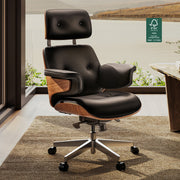
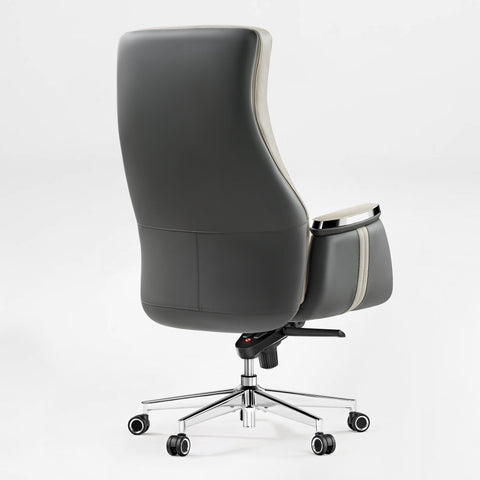
The Forma executive chair is a useful comparison point here because it pairs an adaptive headrest with 4D armrests and adjustable seat depth. That does not make it automatically right for every tall buyer, but it does show the kind of range that helps when upper-body fit is part of the buying decision.
How to Match Chair Features to Your Build
The most useful way to shop is to match your body proportion to the feature cluster that matters most. Tall does not mean one fixed chair type. A long-legged person and a long-torso person can need very different settings.
| Body Proportion | Prioritize First | What Good Fit Looks Like | Red Flags |
|---|---|---|---|
| Long legs, average torso | Seat depth and seat height | Thighs feel supported, knees stay clear of the front edge, and you can still sit back fully | The front seat edge presses behind the knees, or you keep sliding forward |
| Long torso, average legs | Lumbar height and headrest range | Lower-back support lands near the natural curve and the headrest reaches the back of the head or neck | Lumbar sits too low, or the headrest feels decorative |
| Tall overall with mixed proportions | Seat depth, lumbar range, and armrest range | You can fine-tune the chair in more than one direction and keep relaxed shoulders | Only one feature adjusts well while the rest stay off-target |
This is also where style becomes secondary to adjustment range. A mesh chair, an executive chair, or a hybrid chair can all work if the ranges line up with your build. The mesh Nico chair is a good example of why: it offers adjustable seat depth, dynamic lumbar support, and 3D arms, so it gives tall users more room to solve fit problems without assuming one body shape.
If your torso is long and your lumbar support cannot move, move on. If your legs are long and the seat depth cannot change, move on. If both are close but not quite right, the chair may still work with careful setup, but you should treat it as a borderline fit rather than a sure thing.
Final Fit Checks Before You Buy
Before checkout or during first setup, check the chair in the same desk setup you will use every day. Measure the seat height against your desk clearance, confirm that the seat depth leaves a small gap behind your knees, and test whether the lumbar support lands in the right spot while you sit all the way back. If the chair has a headrest or armrests, confirm that both still work once you raise the seat to your actual working height. The GSA seating guide is useful here because it frames chair fit as a workstation problem, not just a chair problem.
- Check the seat height range against your desk and leg length.
- Confirm the seat depth still lets you sit back without knee pressure.
- Test lumbar placement after you have adjusted the seat height.
- Raise the headrest and armrests to the position you actually use.
- If the fit is close but your feet do not rest flat, a footrest can help, but it will not fix a chair that is too shallow or otherwise mismatched.
That last point matters. A footrest can improve grounding when the height is close, but it is not a rescue tool for a chair that misses the core fit variables. If you are comparing models, keep the neutral fit test first and the product choice second.
FAQs
How Do I Know If a Chair Fits a Tall Torso?
A tall torso usually needs lumbar support that lands near the lower-back curve without pushing the shoulders forward. Sit all the way back and see whether the support feels placed, not forced. If the chair only feels good when you lean forward, it is probably not aligned well for your build.
What Seat Depth Works Best for Tall Users?
The best seat depth is the one that supports most of your thigh while leaving a small gap behind the knees. For some very tall users, a deeper range becomes important, but the exact number depends on leg length, seat contour, and whether the depth is adjustable.
Why Does Lumbar Support Feel Too Low on Some Chairs?
Many chairs are proportioned for average torsos, so the lumbar section can sit below the natural curve on a taller frame. When that happens, the support feels misplaced instead of helpful. Adjustable lumbar height is the easiest way to correct that mismatch.
Can a Footrest Help If My Chair Is Almost Right?
Yes, if the chair height is close and your feet just need better grounding. A footrest can make a borderline setup more usable. It will not solve a seat that is too shallow, a lumbar zone that is far off, or a headrest that never reaches the right spot.
What Should I Check First After a New Chair Arrives?
Check seat height, seat depth, lumbar placement, and armrest height before you decide the chair is a keeper. Test it in the exact desk setup you will use. A chair can look right in a product photo and still miss the fit in your real workspace.
Final Takeaway
For tall buyers, the safest approach is to treat chair shopping as a fit test, not a style choice. Start with seat depth, then verify lumbar placement, headrest reach, and armrest range. If two or more of those are off, keep looking. If the fit is close, use the first week to test it in your real desk setup and return it quickly if the mismatch stays obvious.


Leave a comment