

The "his and hers" office aesthetic is a popular design trend, often characterized by identical twin chairs flanking a shared desk or occupying a mirrored home office. However, from a biomechanical standpoint, this symmetry is frequently the root cause of chronic discomfort. When a 5'4" user and a 6'1" user sit in the same model of chair, at least one of them—and often both—is making a significant postural compromise.
The misconception that "one size fits all" in ergonomic seating ignores the fundamental variability of human anthropometry. According to the BIFMA G1-2013 Ergonomics Guideline, furniture should ideally accommodate the 5th percentile female to the 95th percentile male. In a couple’s shared workspace, the physiological differences in popliteal height, buttock-popliteal length, and pelvic tilt mean that "matching" chairs often lead to mismatched health outcomes.
The Biomechanics of Difference: Why Identical Chairs Fail
To understand why custom selection is necessary, we must look at the physiological principles of the "neutral position." A neutral posture minimizes the static load on the musculoskeletal system, allowing for optimal blood circulation and reducing the risk of Repetitive Strain Injuries (RSI).
When a chair is too large for a user, the seat pan depth typically exceeds their buttock-popliteal length. This forces the user to choose between two ergonomic failures: sitting forward without back support (increasing lumbar load) or sitting back and allowing the seat edge to press into the back of the knees. This pressure compresses the popliteal artery, significantly impairing blood circulation to the lower limbs. Conversely, a chair that is too small for a taller user fails to provide adequate thigh support, leading to increased pressure on the ischial tuberosities (sit bones) and a tendency to slouch to find stability.
Furthermore, spinal curvature differs between genders. Research into musculoskeletal disorders and prolonged static sitting suggests that women, on average, exhibit a different pelvic tilt and a more pronounced lumbar lordosis (inward curve) than men. This means a lumbar support system that feels perfect for one partner may be positioned too low or provide insufficient protrusion for the other.
Calculated Cheat Sheet: Standard-Based Modeling for Couples
Applying anthropometric ratios derived from ISO 9241-5:2024 and ANSI/HFES 100-2007, we can project the specific measurement gaps between an average male and female user. These "Derived Projections" provide a scientific baseline for selecting different chairs that meet individual needs.
| Measurement Category | Male (50th Percentile) | Female (50th Percentile) | The Ergonomic Gap |
|---|---|---|---|
| Ideal Seat Height | 17.0 inches (43.2 cm) | 16.0 inches (40.6 cm) | 1.0 inch difference |
| Seat Depth Requirement | 19.8 inches (50.3 cm) | 19.2 inches (48.8 cm) | 0.6 inch difference |
| Armrest Height | 9.8 inches (24.9 cm) | 9.0 inches (22.9 cm) | 0.8 inch difference |
| Ideal Desk Height | 27.8 inches (70.6 cm) | 26.0 inches (66.0 cm) | 1.8 inch difference |
Note: Calculations assume a 2.5cm shoe correction factor derived from ISO 9241-5 standards. Ideal desk height refers to the height required to maintain a 90-100 degree elbow angle while seated.
This data illustrates that even "average" users require a 1-inch variance in seat height and nearly an inch of difference in armrest positioning. If a couple buys two identical chairs with limited adjustability, the partner who doesn't "fit" the chair's default geometry will likely experience shoulder hiking or lower back fatigue within two hours of use.

The Symptom Decoder: Mapping Pain to Mechanical Root Causes
If you or your partner are already experiencing discomfort in your shared office, the cause is often a mechanical mismatch between your body and your chair. Use this decoder to identify which chair features need adjustment or replacement.
| Symptom | Mechanical Root Cause | Solution Requirement |
|---|---|---|
| Numbness in feet/calves | Seat pan is too deep; edge is pressing on the popliteal area. | Seat depth adjustment or a shorter seat pan. |
| Burning in shoulder blades | Armrests are too high (causing "hiking") or too low (causing leaning). | 3D or 4D adjustable armrests. |
| Sharp lower back pain | Lumbar support does not align with the lumbar lordosis curve. | Height-adjustable lumbar support. |
| Neck stiffness by 3 PM | Monitor height mismatch combined with lack of headrest support. | Adjustable headrest and monitor arms. |
| Wrist fatigue/tingling | Desk is too high relative to the chair's maximum lift. | Footrest or a height-adjustable desk. |
5-Minute Mechanical Audit for Couples
Before purchasing new seating, perform this audit on your current setup. This "Glass Box" methodology allows you to quantify exactly where your current chairs are failing you.
- The Finger Gap Test: Sit fully back in your chair. There should be a 2-3 finger width gap between the front edge of the seat and the back of your knee. If the gap is larger, you lack thigh support. If there is no gap, your circulation is at risk.
- The Belt Line Check: Feel for the natural inward curve of your lower back. The most prominent part of the chair's lumbar support should sit just above your belt line.
- The Elbow Angle: Relax your shoulders and place your hands on your keyboard. Your elbows should form a 90 to 110-degree angle. If your shoulders are raised toward your ears, your armrests (or desk) are too high.
- The Feet Flat Rule: Both feet must be flat on the floor. If a shorter partner has to dangle their feet to reach the desk, they require a chair with a lower minimum gas lift or a dedicated footrest.
Choosing the Right Models: Aesthetic Harmony Without Compromise
Selecting different chairs doesn't mean your office has to look cluttered. The key is to find chairs that share a "design language"—similar frame colors, material textures, or silhouettes—while offering the specific mechanical features each partner needs.
For the Partner Needing Robust Support
If one partner has a larger frame or prefers a "commanding" feel, an executive-style chair with a high backrest is often the best fit. The Royal II, Silicone & Leather Executive Ergonomic Office Chair is designed for those who prioritize a full-body "sink-in" feel. Its high back provides the necessary surface area for taller users to distribute pressure across the entire thoracic and lumbar regions.
For the Partner Needing Precision Adjustability
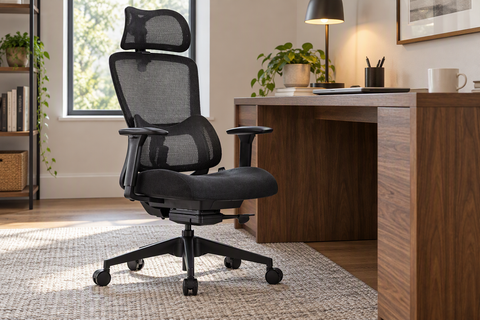
For the partner who spends long hours in deep-focus work or gaming, a chair with high "postural variability" is essential. According to OSHA's eTools for Computer Workstations, a chair must have a backrest that provides support for the lower back and a seat height that allows feet to rest flat. The Exis, Ergonomic Office Chair is an excellent choice for a partner who needs to fine-tune their environment. With 4-level adjustable lumbar support and 3D armrests, it can be calibrated to the 0.8-inch armrest height difference identified in our anthropometric modeling.

For the Minimalist Aesthetic
If the shared office is in a living area, the Vera, Ergonomic Office Chair offers a sleek profile that blends well with modern decor. Its PU leather upholstery provides a sophisticated look that can easily match a partner's executive chair while offering the "saddle-shaped" foam cushion that helps maintain a neutral pelvic tilt.
Practical Recommendations for Shared Workspaces
Once you have selected the appropriate chairs, the final step is integrating them into a cohesive, ergonomic environment. Even with the best chairs, a poorly configured desk will undermine your health goals.
The Ideal Sit-Stand Rhythm
If you are using height-adjustable desks alongside your new chairs, follow the "20-8-2" rule recommended by Cornell University Ergonomics Web. For every 30 minutes of work:
- 20 minutes of sitting in your correctly adjusted ergonomic chair.
- 8 minutes of standing.
- 2 minutes of moving or stretching.
Managing the Height Disparity
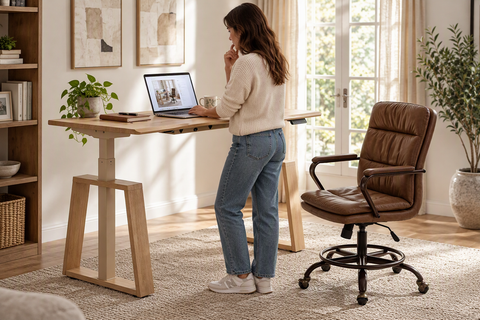
When partners of different heights share a desk, a height-adjustable desk is almost mandatory. However, if you use a fixed-height desk, the shorter partner should adjust their chair height to the desk (to protect the wrists) and then use a footrest to ensure their feet are supported. This prevents the "dangling leg" syndrome which leads to lower back strain.
Visual Harmony: The Armrest Plane
A designer's trick for making two different chairs look intentional in a shared space is to align the height of the armrests when the chairs are tucked in. Even if the seats are at different levels, having the armrests form a consistent horizontal plane creates a sense of visual order.

Strengthening Your Workspace Investment
Choosing different ergonomic chairs is an investment in your long-term well-being and productivity. By moving away from the "matching set" mentality and toward a "matching needs" strategy, you address the physiological realities of your unique body types.
As noted in a meta-analysis on ergonomic interventions, providing individualized ergonomic equipment significantly reduces musculoskeletal pain compared to standard office setups. Whether you are gaming together or building a business from home, your chair should be a tool that supports your body, not a constraint that forces it to adapt.
For more detailed guidance on fine-tuning your individual setup, explore our Guide to Adjusting Your Ergonomic Chair Correctly.
Key Takeaways for Couples
- Prioritize Fit Over Symmetry: A 1-inch difference in seat height can be the difference between comfort and chronic leg numbness.
- Use the 2-3 Finger Rule: Ensure the seat depth allows for proper circulation behind the knees.
- Independent Armrests are Critical: Height differences between partners often require specific armrest adjustments to prevent neck strain.
- Coordinate via Design Language: Use similar materials or colors (like black mesh or white frames) to keep different chair models looking cohesive.
YMYL Disclaimer: This article is for informational purposes only and does not constitute professional medical advice, diagnosis, or treatment. Ergonomic requirements can vary significantly based on individual health conditions. If you have pre-existing musculoskeletal disorders, chronic back pain, or other medical concerns, please consult a qualified physiotherapist or occupational health professional before making significant changes to your workstation setup.
Sources
- BIFMA G1-2013: Ergonomics Guideline for Furniture
- ISO 9241-5:2024: Workstation layout & postural requirements
- CCOHS: Office Ergonomics - Sit/Stand Desk
- OSHA: Computer Workstations - Chairs
- Cornell University Ergonomics Web: Workstation Guides
- Santos et al., 2025: Ergonomic Interventions & Work-Related Musculoskeletal Pain




Leave a comment