

Imagine a home office that sparks your limitless creativity—a shared sanctuary where the air is light, the surfaces are clear, and the energy of your partner’s focus actually fuels your own. We’ve all been there: the kitchen table cluttered with two laptops, tangled charging cables acting like a tripwire, and the constant "Can you mute for a second?" dance. But what if your shared workspace was designed to be a catalyst for both connection and deep work?
Transforming a spare room into a high-performance workspace sanctuary isn't just about buying two of everything. It’s a delicate balance of spatial geometry, ergonomic precision, and emotional resonance. Whether you choose to work side-by-side, sharing a view and a rhythm, or back-to-back, creating individual fortresses of concentration, the layout you choose defines the "vibe" of your professional life together.
In this guide, we will move beyond simple furniture placement. We’ll apply biomechanical modeling and spatial engineering to help you decide which layout truly serves your unique workflow. From the 17-foot depth requirement of a back-to-back setup to the 3-inch height discrepancy often found between partners, we’re diving deep into the science of shared success.
The Geometry of Togetherness: Side-by-Side vs. Back-to-Back
Choosing a layout is the first step in your space transformation. It’s not just about where the desks go; it’s about how you and your partner navigate the invisible boundaries of privacy and collaboration.
The Side-by-Side Setup: The Collaborator’s Choice
The side-by-side arrangement is the ultimate expression of a shared mission. It’s space-efficient, visually cohesive, and perfect for couples who enjoy occasional "look at this" moments. However, proximity can be a double-edged sword. Research into office spatial design suggests that while distances below 15 meters enhance communication, they can also lead to a decrease in face-to-face interaction in favor of electronic messaging if the environment feels too "open" and lacks privacy.
To make this work, we recommend the 4-inch gap rule. Staggering your desks or leaving a small physical buffer prevents chair arms from clashing and allows for individual cable management runs. This small tweak reduces the "perceived distraction" that comes from feeling every movement your partner makes.

The Back-to-Back Setup: The Focus Fortress
For those who prioritize deep work and visual privacy, the back-to-back layout is the gold standard. By facing away from each other, you eliminate the temptation of "screen peeking" and create a mental boundary that says, "I’m in my zone."
The challenge here is spatial. Based on our spatial modeling, a comfortable back-to-back setup requires significantly more room than most people realize. You aren't just fitting two desks; you are fitting two "dynamic zones" (the space needed for your chair to move) and a "circulation zone" (the walkway between you).
Spatial Requirements Comparison Table
| Feature | Side-by-Side Layout | Back-to-Back Layout |
|---|---|---|
| Minimum Room Depth | ~8.5 Feet (102 inches) | ~14 - 17 Feet (168 - 204 inches) |
| Privacy Level | Moderate (Visual crossover) | High (Visual isolation) |
| Collaboration | High (Easy screen sharing) | Low (Requires turning around) |
| Best For | Small rooms, similar workflows | Large rooms, high-focus roles |
| Key Constraint | Chair arm interference | Egress and circulation space |
As shown in the table, a back-to-back layout can easily exceed 17 feet of depth when you account for the 36 inches of egress needed for each person to leave their desk without coordinating movements. If your room is under 14 feet deep, the side-by-side or an L-shaped corner configuration is almost always the more functional choice.
The Invisible Foundation: Why Ergonomics is Personal
A common mistake we see in shared offices is the "matching set" trap—buying two identical, fixed-height desks. While it looks beautiful in photos, it’s an ergonomic disaster.
According to the ISO 9241-5:2024 standard, workstation layouts must accommodate postural requirements that vary significantly between individuals. Our derived modeling based on average heights reveals a "Gender Height Gap" that can lead to chronic discomfort if ignored.
The 3-Inch Discrepancy
Consider a typical couple where one partner is 5'7" and the other is 5'10".
- The 5'7" user needs a sitting desk height of approximately 26 inches.
- The 5'10" user needs a sitting desk height of approximately 27.8 inches.
Most standard fixed desks are 29 inches high. This means the desk is nearly 3 inches too high for the shorter partner, forcing them to shrug their shoulders or reach upward, which leads to tension in the trapezius and neck. This is why height-adjustable desks are not a luxury in a shared office—they are a necessity for biomechanical health.
For an executive feel that doesn't compromise on these metrics, the Ark Pro L-Shaped Standing Desk (Sintered Stone, 63"x23") provides the precision adjustment needed. Its sintered stone top offers a premium, tactile experience while the electric lift ensures both partners can find their "ideal" 100-110 degree elbow angle.

The "Symptom Decoder" for Couples
If you’re already feeling the strain, use this mechanical audit to identify the root cause:
| Symptom | Mechanical Root Cause | The Fix |
|---|---|---|
| Neck/Shoulder Tension | Desk is too high (shrugging) | Lower desk or use a footrest to raise your seat. |
| Lower Back Ache | Static sitting > 1 hour | Adopt the Cornell 20-8-2 sitting-standing rhythm. |
| Wrist/Forearm Pain | Keyboard angle too steep | Ensure elbows are at 100-110° to open the ulnar tunnel. |
| Eye Strain | Monitor too close or high | Top of screen at eye level, 20-28 inches away. |
Space Transformation: From Chaos to Sanctuary
Once you’ve chosen your layout, it’s time to curate the ambiance. A workspace sanctuary is built on the philosophy of "Mindfulness through Design."
1. The Visual Buffer
In back-to-back setups, we often recommend using a tall, shallow storage unit (about 14 inches deep) between the desks. This acts as a visual and partial acoustic buffer. It’s more flexible than a permanent wall and provides a home for shared resources like printers or reference books, decluttering your primary work surfaces.
2. The Comfort Layer
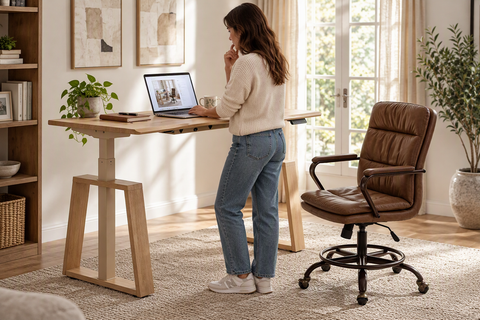
Ergonomics doesn't stop at the desk. The chair is your primary interface with your work. For those seeking an aesthetic that screams "I've arrived" while supporting the spine's natural curve, a chair like the Serene, Napa Leather Executive Office Chair is a game-changer. The genuine full-grain leather isn't just about luxury; it’s about durability and breathability during those deep work sessions.

3. The Footrest Secret
If your desk cannot go low enough to keep your feet flat on the floor—a common issue for users under 5'8"—you must use a footrest. This prevents the "hanging leg" syndrome which restricts circulation. Using a Footstool with Wheels allows you to maintain a neutral posture while giving you the freedom to shift positions throughout the day, which aligns with WHO guidelines on interrupting sedentary behavior.
Linking Functionality with Emotion: The ROI of Wellness
Investing in a high-end shared office isn't just an expense; it’s a strategic investment in your collective productivity. Let’s look at the "Investment Analysis" of a standing desk setup.
Based on metabolic research, a 70kg user standing for just 3 hours a day burns an extra 22,500 calories per year compared to sitting. That’s roughly equivalent to 6.4 pounds of fat loss potential annually, simply by changing your posture.
But the real "Aha!" moment comes from the productivity uplift. Conservative models suggest a 10% increase in focus and output when using ergonomic interventions. For a professional earning a $35/hour wage, that’s an annual value gain of over $1,300. In a shared office, that ROI is doubled. A premium setup essentially pays for itself in just over a year through enhanced efficiency and reduced sick days related to musculoskeletal disorders.
As noted in the Cochrane systematic review on workplace interventions, sit-stand desks can reduce sitting time by up to 116 minutes per day. When you combine this "engineering control" with behavioral habits—like a shared "standing meeting" at 10 AM—you create a culture of health within your home.
Personal Tips for Shared Success
After years of auditing home workspaces, we’ve found that the most successful "workspace sanctuaries" share three non-negotiable habits:
- The Headphone Rule: Regardless of your layout, if the headphones are on, the "Do Not Disturb" sign is active. This protects the sanctity of deep work.
- The "20-8-2" Rhythm: Follow the Cornell University Ergonomics recommendation: Sit for 20 minutes, stand for 8 minutes, and move/stretch for 2 minutes. Doing this together can turn a health habit into a shared ritual.
- Lighting Layers: Don't rely on a single overhead light. Use individual task lamps to define your "territory." This allows one partner to work in a "moody" focus light while the other enjoys a bright, energized environment.

Essential Takeaways for Your Shared Office
Creating the perfect couple’s desk layout is a journey of space transformation and mindfulness. By understanding the mechanical requirements of your bodies and the spatial limits of your room, you can build an environment that fosters both professional excellence and personal connection.
- Side-by-Side is best for rooms under 14 feet deep. Use the 4-inch gap rule to maintain individual focus.
- Back-to-Back requires significant depth (17 feet is ideal). Use a storage buffer to enhance privacy.
- Prioritize height adjustability. The 3-inch ergonomic gap between partners makes fixed desks a long-term health risk.
- Calculate your ROI. Ergonomic furniture isn't just an aesthetic choice; it’s a productivity and health investment that pays back within 12-18 months.
- Embrace the "Workspace Sanctuary" mindset. Declutter your surfaces and your mind by integrating smart storage and high-quality materials like Napa leather and sintered stone.
Frequently Asked Questions
How much space do we really need between desks in a back-to-back setup? To allow both partners to move their chairs freely and have a walkway in between, you should aim for at least 36 to 42 inches between the backs of your chairs when you are both seated. This ensures you aren't bumping into each other when standing up.
Is it better to have two separate desks or one long "double" desk? Two separate desks are almost always better. They offer superior cable management, allow for individual height adjustments, and prevent the "vibration transfer" that happens when one person types or moves on a shared surface.
We have a very small room. Can we still do a side-by-side setup? Yes! A side-by-side setup is the most space-efficient. To maximize the feel of the room, consider using stylish standing desk designs for small offices that have a smaller footprint but still offer full height adjustability.
Should we use a rug under our desks? While rugs add to the "aesthetic" and "ambiance," they can make rolling office chairs difficult to move. If you use a rug, ensure it is low-pile or use a transparent chair mat to protect the rug and your ergonomics.
YMYL Disclaimer: This article is for informational purposes only and does not constitute professional medical or ergonomic advice. While the guidelines provided are based on industry standards like BIFMA and ISO, individuals with pre-existing musculoskeletal conditions or chronic back pain should consult a qualified physiotherapist or ergonomic specialist before implementing major changes to their workstation.
References
- Canadian Centre for Occupational Health and Safety (CCOHS) - Sit/Stand Desk Guide
- Cornell University Ergonomics Web — Workstation Setup Guides
- ISO 9241-5:2024 - Workstation Layout & Postural Requirements
- World Health Organization (WHO) - 2020 Guidelines on Physical Activity and Sedentary Behaviour
- Cochrane Library - Workplace interventions for reducing sitting at work




Leave a comment