

Planning to surprise a loved one with a high-performance workspace for Christmas 2025 is a gesture of profound care. It is more than just a piece of furniture; it is an investment in their long-term musculoskeletal health and daily productivity. However, the "surprise" element introduces a significant technical challenge: how do you determine the correct desk dimensions without a formal fitting?
Selecting a desk that is too high can lead to chronic shoulder elevation and trapezius strain, while a desk that is too shallow can cause visual fatigue and wrist extension issues. To ensure your gift is a perfect fit, we must move beyond guesswork and apply the principles of biomechanical engineering and anthropometric modeling. This guide provides a rigorous framework for secretly sizing an ergonomic desk, utilizing industry standards to transform a thoughtful surprise into a precision-engineered wellness tool.
The Biomechanics of the "Perfect Fit"
To understand why sizing is critical, we must first examine the physiological impact of a poorly configured workstation. According to the U.S. Occupational Safety and Health Administration (OSHA), "repetitive tasks, awkward postures, and static loading" are primary risk factors for Musculoskeletal Disorders (MSDs). When a desk does not align with a user’s unique proportions, the body compensates by adopting "non-neutral" positions.
For example, if a desk is even two inches too high, the user must shrug their shoulders to reach the keyboard. This creates a "static load" on the upper trapezius and levator scapulae muscles. Over an eight-hour workday, this tension restricts blood circulation and can lead to tension-type headaches or chronic neck pain. Conversely, a desk that is too low forces the user into a "kyphotic" or hunched posture, compressing the intervertebral discs and increasing the risk of lumbar strain.
The goal of ergonomic sizing is to achieve a "Neutral Working Posture." As defined by OSHA eTools on Neutral Working Postures, this involves maintaining joints in a natural alignment where muscle tension is minimized. For the upper body, this means elbows should be at a 90-to-120-degree angle, wrists should be straight (not bent up or down), and the head should be balanced over the shoulders.
The Secret Measurement Strategy: Anthropometric Modeling
How do you calculate these requirements without a tape measure and a willing subject? The answer lies in anthropometry—the study of human body measurements. By using the recipient’s height and gender, we can apply "Derived Projections" based on the BIFMA G1-2013 Ergonomics Guideline to estimate their ideal desk height.
The "Fast Numbers" Framework: Calculated Projections
The following table provides ergonomic benchmarks derived from standard anthropometric ratios (including a 2.5cm shoe correction factor for typical indoor footwear).
| User Height | Gender | Calculated Seated Desk Height | Calculated Standing Desk Height | Ergonomic Risk Zone (Fixed 29" Desk) |
|---|---|---|---|---|
| 5'4" (162 cm) | Female | 24.5" (62.2 cm) | 38.0" (96.5 cm) | High Risk: Desk is 4.5" too high |
| 5'7" (170 cm) | Female | 26.0" (66.0 cm) | 40.0" (101.6 cm) | Moderate Risk: Desk is 3.0" too high |
| 5'10" (178 cm) | Male | 27.8" (70.6 cm) | 44.0" (111.8 cm) | Low Risk: Desk is 1.2" too high |
| 6'2" (188 cm) | Male | 29.5" (74.9 cm) | 47.5" (120.6 cm) | Neutral: Desk is at optimal height |
The "Ergonomic Gap" Insight
A critical finding from this modeling is the "Ergonomic Gap." While the furniture industry has historically used 29 inches as a "standard" fixed desk height, this dimension is actually optimized for the 95th percentile male. For the average female (5'4" to 5'7"), a standard desk is between 3 and 4.5 inches too high. This discrepancy is the root cause of the "burning sensation" in the shoulders many women feel by 3 PM.
When gifting, if you cannot confirm the exact seated elbow height, the safest strategy is to select an adjustable-height desk with a broad range (ideally 25" to 50"). This ensures that whether the recipient is in the 5th or 95th percentile, the desk can be tuned to their specific biomechanical needs.
Depth and Surface Area: The Visual Ergonomics Dilemma
While height gets most of the attention, desk depth is the "hidden" variable that often ruins a surprise gift. A desk that is too shallow forces the monitor too close to the eyes, leading to "Computer Vision Syndrome" (eye strain, blurred vision, and dry eyes).
According to the ISO 9241-5 standard for workstation layout, users require sufficient depth to allow for a viewing distance of at least 20 inches (50 cm), though 30 inches (76 cm) is preferred for modern large-format monitors.
The 30-Inch Rule
A common mistake in home office setups is selecting a 24-inch deep desk to save space. However, once you place a monitor stand and a keyboard, there is no room left for "forward arm support." Without space to rest the forearms on the desk surface, the weight of the arms must be supported by the neck and shoulder muscles, leading to rapid fatigue.
The Secret Observation: To check if your recipient needs more depth, look at their current setup. Are their monitors pushed right against the wall? Do their forearms hang off the edge of the desk? If so, they are suffering from "depth compression." A desk with a 29-to-30-inch depth, such as the Ark Executive Standing Desk (63"x29"), provides the necessary clearance for visual comfort and physical support.
Selecting the Right Mechanism: Standing Desks as Engineering Controls
In the hierarchy of ergonomic interventions, an adjustable standing desk is considered an "Engineering Control"—the most effective way to eliminate a hazard. As noted in a systematic review by the Cochrane Library, sit-stand desks can reduce sitting time by 84 to 116 minutes per day, which is vital for interrupting the negative effects of "prolonged static sitting."
When choosing a desk for a gift, look for dual-motor systems. Single-motor desks often struggle with heavy loads and can be noisy or jerky. A dual-motor system, like the one found in the Opal Executive Standing Desk (66"x29"), offers a smoother 1-inch-per-second lift speed and a higher weight capacity (often up to 220 lbs). This is crucial for users with multiple monitors or heavy desktop equipment.
The "Aha!" Moment: The Trapezoidal Advantage
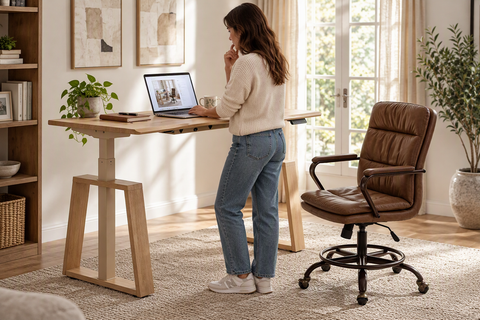
For a gift that combines aesthetics with stability, consider the leg design. Traditional T-frame legs can sometimes exhibit "lateral sway" when extended to standing heights. A trapezoidal leg design, featured on the Ark EL Executive Standing Desk (60"x26"), provides a wider base of support, significantly reducing wobble during typing or video calls.
The Symptom Decoder: Identifying Hidden Needs
If you want to be truly surgical in your gift selection, observe the recipient's physical complaints. You can map their symptoms to specific mechanical deficiencies in their current furniture.
| Symptom | Mechanical Root Cause | Gift Solution |
|---|---|---|
| Numbness in the pinky/ring finger | Desk too high; edge is compressing the ulnar nerve at the wrist. | Adjustable desk or a desk with a Special Slide-out Keyboard Tray. |
| Leaning forward to see the screen | Desk is too deep or monitor is too small. | Monitor arm for depth adjustability. |
| Constant shifting/fidgeting in the chair | Prolonged static load on the lower back. | Standing desk to allow for posture variation. |
| Shoulder blades "pinched" together | Desk is too low, causing a hunched posture. | Height-adjustable desk to raise the work surface. |
Practical Setup: The "5-Minute Mechanical Audit"
Once the gift is unwrapped, the final step is the setup. Even the best desk can fail if not configured correctly. Use this checklist to help your recipient dial in their new workspace:
- Start with the Chair: Adjust the chair height until feet are flat on the floor and thighs are parallel to the ground.
- Bring the Desk to You: Lower or raise the desk until the keyboard surface is level with the undersides of the elbows.
- Monitor Parallax: According to the Canadian Centre for Occupational Health and Safety (CCOHS), the monitor should be at a height where the "top line of text is at or slightly below eye level." This prevents the user from tilting their head back (extension) or chin down (flexion).
- The 20-8-2 Rule: Encourage the recipient to adopt the Cornell University "20-8-2" rhythm: 20 minutes of sitting, 8 minutes of standing, and 2 minutes of moving/stretching.
The Friction Points: Real-World Implementation Details
In my experience auditing hundreds of home offices, the most common "gotcha" isn't the desk itself—it's what happens when the desk moves.
- Cable Tension: When a desk rises to 45 inches, standard 3-foot cables for monitors or chargers will often snag or pull out. Always include a 6-to-10-foot power strip or longer cables as part of the gift package.
- Anti-Fatigue Mat Offset: If the recipient plans to stand for more than 20 minutes, an anti-fatigue mat is essential. However, remember that a thick mat adds about 0.5 to 1 inch to their "standing height." The desk must be able to adjust high enough to compensate for this.
- Monitor Wobble: On a standing desk, every keystroke can cause a slight vibration. High-quality desks with reinforced frames and dual motors mitigate this, but using a sturdy monitor arm can further isolate the screen from desk vibrations.
If you are working with a limited area, you might want to explore Stylish Standing Desk Designs for Small Home Offices to find a model that maximizes ergonomics without overwhelming the room.
Summary of Key Takeaways
- Height is Personal: Standard 29-inch desks are often too high for the average female user, creating an "Ergonomic Gap" that leads to shoulder pain.
- Depth is Safety: Ensure the desk is at least 29-30 inches deep to protect visual health and provide forearm support.
- Adjustability is the "Safety Net": When gifting, a desk with a wide height range (25"-50") removes the risk of a poor fit.
- Observe the Symptoms: Use physical complaints like wrist numbness or shoulder tension to identify the specific ergonomic needs of your loved one.
- Complete the System: A desk is only as good as its setup. Include long cables and an anti-fatigue mat to ensure a seamless transition to a sit-stand lifestyle.
For more detailed guidance on the final configuration, refer to our comprehensive Standing Desk Setup for Peak Productivity.
Frequently Asked Questions (FAQ)
Can I just use a desk converter as a gift instead? While converters are a budget-friendly option, they often fail the "Depth Rule." They take up significant surface area and can raise the minimum seated height of the keyboard, which may worsen ergonomics for shorter users. A full standing desk is a more robust "Engineering Control."
What if the recipient has a pre-existing back condition? Individuals with chronic back issues should be especially careful. While sit-stand desks are generally beneficial, the transition should be gradual. It is recommended to consult a physiotherapist to determine the ideal Sit-Stand Ratio for their specific condition.
Is standing all day better than sitting? No. According to the WHO 2020 Guidelines on Physical Activity, the goal is to reduce "sedentary behavior" through movement. Prolonged standing can lead to lower limb MSDs. The key is frequent posture variation—alternating between sitting, standing, and walking.
YMYL Disclaimer: This article is for informational purposes only and does not constitute professional medical advice. Ergonomic requirements can vary significantly based on individual health conditions. Always consult with a qualified healthcare professional or a certified professional ergonomist before making significant changes to your workstation, especially if you have pre-existing musculoskeletal issues.
References
- BIFMA G1-2013: Ergonomics Guideline for Furniture
- OSHA eTools: Computer Workstations - Neutral Working Postures
- CCOHS: Office Ergonomics - Sit/Stand Desk Guide
- ISO 9241-5:2024: Workstation Layout & Postural Requirements
- Cochrane Library: Workplace Interventions for Reducing Sitting at Work
- WHO: 2020 Guidelines on Physical Activity and Sedentary Behaviour




Leave a comment